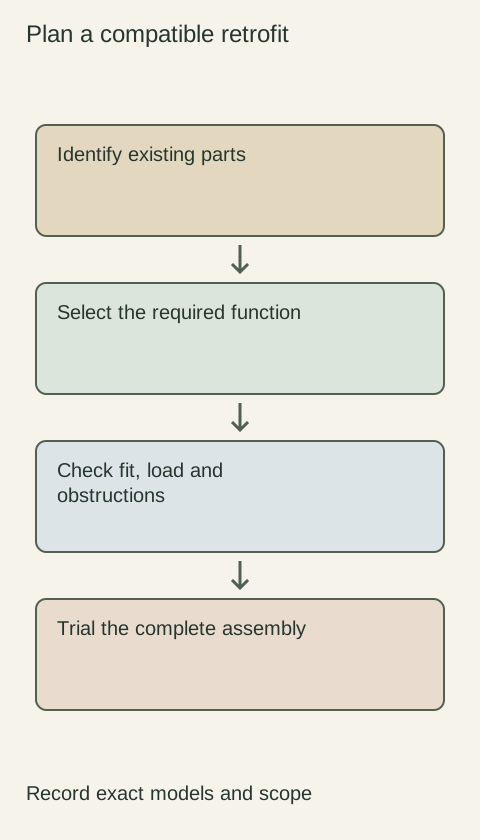
Adding soft close or opening assistance to existing cabinets
A soft-close upgrade starts with identifying the existing hardware. Closing assistance and opening assistance solve different tasks and may require different parts.
Blum distinguishes mechanical soft close, mechanical opening, combined opening with soft close and electrical assistance in its product information. These are separate systems. Soft close does not make a door touch-open, and an added opening device does not automatically create a compatible soft-closing assembly. Product examples explain the categories without confirming that an existing cabinet can accept them.
Write the actual complaint: a door slams, a loaded drawer is hard to start, a lift-up front is difficult to reach, or a handleless drawer does not release reliably. Try the cabinet with its normal contents and note the symptom. Correct a rubbing front or loose attachment before treating every problem as missing damping.
Identify what is already installed
Photograph the whole opening, hinge arm or slide, mounting plate and any readable part marks. Record the door position, material, thickness where required by the selected guide and any interior accessories. A picture of the hinge logo alone may omit the plate that determines compatibility. For drawers, include locking devices and the space behind the drawer.
Find the manufacturer's current planning or service document for that exact system. If the part is unmarked, compare measurements with a supported replacement drawing rather than buying by resemblance. Preserve existing parts until the new arrangement is verified. An unidentified mechanism is a reason to complete identification, not to drill exploratory holes.
Diagram Illustrative diagram; not a product specification.
Choose the least disruptive compatible route
An approved clip-on damper may be possible for a particular hinge family. Other doors may need replacement hinges and plates, while some drawers require different runners or a new drawer box. A generic add-on damper is not proof of appropriate closing behavior. Compare the amount of cabinet alteration, retained adjustment and parts availability for the actual candidate.
For an illustrative retrofit, imagine a door with a compatible manufacturer-listed damper and a neighboring drawer whose old slide has no supported soft-close conversion. The door may permit a small hardware change while the drawer needs a different scope. Quote them separately so a simple door upgrade does not conceal the drawer rebuilding work.
Check space, load and operating behavior
Use the selected product's requirements for door or drawer size, weight, mounting, gaps and required space. Do not transplant a clearance or load value from a different system. Check doors behind internal pull-outs, a drawer near plumbing and any obstruction to the mechanism. Added hardware cannot occupy the same space as existing contents or utilities.
Opening assistance needs a practical user test. Try the intended touch location, ordinary loading and a neighboring front open. Understand the normal reset or re-engagement method from the official guide. Electrical systems also need a documented power and service arrangement appropriate to the selected product; keep electrical work within the responsible installer's scope.
Trial the complete assembly before repeating it
Install a compatible trial only with the owner's authorization and the product instructions. Keep a record of parts and the original condition. Test repeated normal opening and closing with the expected contents, looking for rubbing, incomplete closing and accidental activation. Do not copy arbitrary screw turns or adjustment angles from another hinge.
If the trial fails, stop and identify whether the problem is alignment, compatibility, mounting or the selected function. More damping is not a cure for a door that physically collides. Return to the guide or the manufacturer's technical support with the part identification and a short video of the symptom.
Approve the scope and maintenance record
The final proposal should say which openings receive which components, what carpentry or electrical work is included and which existing parts remain. Keep the exact model instructions with the cabinet record. A successful retrofit means the selected assembly works under its documented conditions; it does not establish a universal conversion kit for every cabinet in the house.
Compare the total retrofit work, not just the kit price
Write down removal, drilling, drawer modification, component supply, adjustment and return visits separately. Include electrical coordination only where the selected arrangement needs it.
Ask whether original hardware can be reinstated if the trial is unsuitable, and identify any irreversible work before it begins. Compare that scope with replacing only the troublesome opening.
A compatible small repair may be enough, while rebuilding every drawer can change the economics. Preserve the trial record so later work repeats the proven assembly rather than a different product with a similar feature name.
Finish references
Pure White
Cream White
Light Warm Gray
Gray
Navy
Black
Oak Tone
Dark Walnut Tone
Design study Design references only. The finish studies do not establish actual material, color matching or availability. Compare the selected physical sample.See all finish options →
Compare the actual countertop products, heat-source routine and fabrication proposal. A fired porcelain slab and resin-bound quartz are different materials, but neither label replaces a complete kitchen specification.
Compare a complete tile-and-grout installation with a specified slab surface. The choice changes the wall’s repeated joints, material transitions, care and finished edges.
Granite is a broad commercial name; quartz surfacing is a manufactured product. Choose with the selected slabs, care requirements and complete fabrication in view.
The sample shows the door frame, a separate center panel, the face frame and the cabinet box. Each component has its own place in this Shaker construction.
Shaker construction: door frame, center panel, face frame and cabinet box. The cutaway helps locate these parts; confirm each material in the specifications for the selected cabinet.
01 / Door frame
The Shaker door has rails and stiles around a separate center panel. The frame and center panel are different components; confirm their materials in the specifications for the selected cabinet.
02 / Face frame
The face frame surrounds the opening at the front of the cabinet box and sits behind the doors. The face frame, door frame and cabinet box are separate parts.
03 / Cabinet box
The sample exposes the cabinet sides, interior surfaces and layered edges. The image does not establish the wood species or material specification of a selected cabinet.