Granite or engineered quartz countertops: compare the actual stone and finished kitchen
Granite is a broad commercial name; quartz surfacing is a manufactured product. Choose with the selected slabs, care requirements and complete fabrication in view.
Choose granite when the particular natural stone, its visible character and its documented care suit the kitchen you want. Choose engineered quartz when the selected manufactured design and its care requirements are the better fit. Neither name identifies a universally cheaper, damage-proof or maintenance-free kitchen. The meaningful comparison is between actual materials that can be fabricated into your approved countertop, including the sink opening, exposed edges and joints.
First identify what the granite label covers
Use Natural Stone, the Natural Stone Institute’s educational site, explains that commercial granite is broader than geological granite and can include other rock types. It also describes variation within a quarry. A trade name therefore does not by itself establish a single geological identity or perfectly uniform slabs.
This matters when the shortlisted stones look very different. A dark, fine-textured slab and a coarse, pale slab need their own identification and suitability discussion. Do not apply a statement about a light specimen to every dark stone sold under the same broad category. Record the supplier’s stone identity and the allocated slabs, then keep that information with the fabricator’s proposal.
Cambria describes its quartz surfacing as quartz crystals combined with binders and pigments. It is a manufactured slab product. A granite-like pattern in this category remains engineered quartz; visible mineral particles or a stone-inspired design do not make it a quarried granite slab.
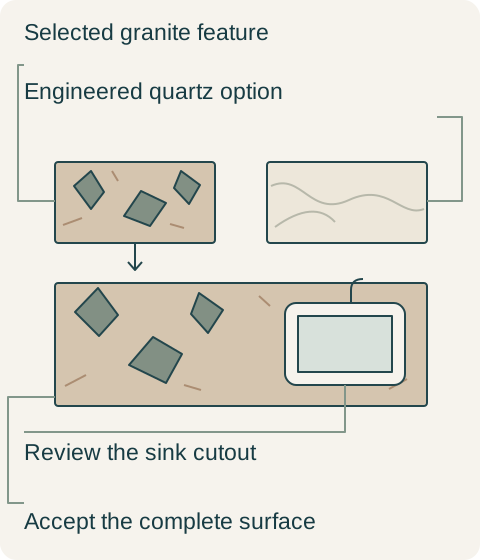
Teaching example Original hypothetical selection diagram. The granite feature is allocated to the broad top rather than left beside the sink opening. Patterns are illustrative, not photographs or named product designs; the diagram is not a cutting or support specification.
A treated granite slab is still a different product
The Natural Stone Institute notes that many granite slabs receive resin treatment to fill small natural features. It also explains that sealing can benefit some granite without being necessary for every granite countertop. Resin treatment of a quarried slab should not be confused with manufacturing an aggregate-and-binder slab.
Keep the purchasing questions separate: what is the stone, what treatment has the offered slab received, and what care is intended after installation? Avoid deciding that treated stone is automatically defective, or that the presence of resin makes both categories identical. If a visible feature concerns you, identify it on the actual slab and have the fabricator evaluate it before approving the cut layout. Appearance acceptance does not replace a suitability assessment.
Compare the pattern where you will see it every day
Take the comparison beyond a polished chip. View the island face from the kitchen entrance, the working surface from standing height and the exposed edge from the dining position. For granite, decide whether a particular mineral cluster or contrasting patch belongs in the finished surface you are buying. For quartz, inspect the chosen design at countertop scale rather than assuming every manufactured surface is visually plain.
Show the sink opening on the selected layout. Removing the center of an attractive feature can leave a different composition around the bowl. A narrow strip beside an opening may also show a detail quite differently from the broad island. Ask to see which part of the offered slab becomes each visible piece. You are approving a resulting kitchen surface, not collecting a photograph of an untouched slab.
Separate sealing from the rest of ownership
Cambria’s care FAQ says its surfaces need no sealing, recommends heat protection, and notes that stone surfaces are not chip-proof. Those instructions describe that manufacturer’s product. They do not establish that all quartz products share every care rule, or that eliminating sealing removes every possible source of damage.
For the selected granite, obtain the stone-specific cleaning and sealing plan, including any conditions created by its finish or treatment. Do not insert an automatic annual sealing charge into the comparison without a basis for that stone. For either proposal, identify how hot cookware will be set down and how the sink edge will be used. A countertop choice should work with the household’s cooking routine, not depend on an unsupported promise that the surface can endure anything.
The granite choice survives a complete review
In a hypothetical renovation, the owners prefer a granite slab whose mixed mineral pattern relates to their restrained cabinet fronts. The quartz alternative also fits the room, but they find its selected pattern less appealing. They initially worry that buying any granite commits them to the same yearly treatment schedule they have heard about elsewhere.
The fabricator supplies a care plan for the chosen stone and confirms its suitability for the agreed kitchen. The owners accept that plan instead of applying a generic schedule. They also review a dark mineral cluster near the planned sink: the proposed cut would leave it as an isolated mark at the rim. An alternative allocation keeps the cluster on the broad island and gives the sink surround the appearance they accept.
They choose the granite package after accepting the revised layout, finished edge, sink detail and complete installed price within their budget. The decision includes the selected slab identities and care plan. They do not expect a future slab bought under the same trade name to reproduce this exact composition. Their reason for choosing granite is the actual finished result, not a claim that natural stone always costs less or never needs attention.
Put both proposals on the same fabrication basis
Compare the same completed scope: material allocation, thickness, edge treatment, cutouts, joints, supporting work, delivery and installation. If a preferred pattern requires a different allocation or additional material, retain that consequence in the quote. An attractive slab price is not the price of a finished kitchen. Likewise, a higher quartz proposal may include work missing from the granite number, or the reverse.
Review the cabinet support and appliance interfaces with the selected fabricator. A stone name, a heavy sample or a hardness claim does not specify unsupported spans or the details around openings. Keep any changes visible when the material changes, especially where the accepted sink or exposed edge is essential to the design.
If the chosen granite later becomes unavailable, compare the replacement slab as a new visual and fabrication proposal. If the quartz design changes, review its actual appearance and product instructions as well. The completed choice belongs to a specific material and kitchen, rather than to a permanent winner in a granite-versus-quartz ranking.
Pure White
Cream White
Light Warm Gray
Gray
Navy
Black
Oak Tone
Dark Walnut Tone
Design study These finish studies are design references, not a list of currently orderable colors. Screens and lighting change the appearance; compare a physical sample before choosing.See all finish options →
A laminate top is a surfaced assembly; quartz is an engineered slab. Judge the finished edge, sink system, care and installed scope before treating a stone-like pattern or a material reputation as the answer.
Compare the actual countertop products, heat-source routine and fabrication proposal. A fired porcelain slab and resin-bound quartz are different materials, but neither label replaces a complete kitchen specification.
The sample shows the door frame, a separate center panel, the face frame and the cabinet box. Each component has its own place in this Shaker construction.
Shaker construction: door frame, center panel, face frame and cabinet box. The cutaway helps locate these parts; confirm each material in the specifications for the selected cabinet.
01 / Door frame
The Shaker door has rails and stiles around a separate center panel. The frame and center panel are different components; confirm their materials in the specifications for the selected cabinet.
02 / Face frame
The face frame surrounds the opening at the front of the cabinet box and sits behind the doors. The face frame, door frame and cabinet box are separate parts.
03 / Cabinet box
The sample exposes the cabinet sides, interior surfaces and layered edges. The image does not establish the wood species or material specification of a selected cabinet.