Gray or dark soapstone? Choose the surface you want to live with
A dark display sample may have been treated with oil or wax. Compare that state with untreated stone before matching cabinets or promising a uniform black countertop.
A gray soapstone sample and a nearly black one may show different treatments rather than different stones. Before choosing a cabinet color to match either, establish what condition you are looking at. The useful question is not simply whether soapstone needs maintenance. It is whether you want to preserve a relatively light look, encourage a darker one, or accept the changing appearance of a working surface.
A dark sample needs a treatment description
Polycor's soapstone guide shows both untreated gray installations and Alberene surfaces darkened with wax. It describes the visual change as a treatment choice, and includes kitchens intentionally left untreated. A dark photographed countertop therefore does not establish the untreated color of the slab offered for your project.
Ask the supplier to identify the actual stone and the treatment on the reference sample. View an untreated comparison from the same selection if possible. A sample from another variety is useful for exploring appearance, but it cannot demonstrate how the reserved slab will look. Record whether the sample is dry and untreated, oiled, waxed or finished by another documented method.
Take the cabinet sample to this comparison. A pale door may feel quite different against soft gray stone and a strongly darkened surface. Look at the backsplash and exposed end as well as the horizontal top: a decision based only on a small flat chip can miss how the dark edge outlines the entire cabinet run. You are choosing a relationship between surfaces, not an isolated black swatch.
Oiling is not the same decision as sealing
M. Teixeira, a soapstone supplier and fabricator, explains that optional mineral oil darkens soapstone and is not a sealer protecting it from absorption. It also notes that customers may leave the stone untreated. This distinction prevents an appearance preference from being sold as a compulsory sealing program.
That does not make every treatment, cleaner or stone interchangeable. Keep the selected supplier's instructions with the actual surface specification. An enhancer or coating offered under a different system should be evaluated on its own terms. Do not apply a generic marble or granite maintenance schedule merely because all the options are called natural stone.
For the buyer, separate routine cleaning from optional work done to produce a desired color. Someone may happily wipe a counter after use but dislike periodically evening out its darkened appearance. Another household may enjoy the changing surface. Both preferences are reasonable; the material decision should acknowledge which experience the owner wants.
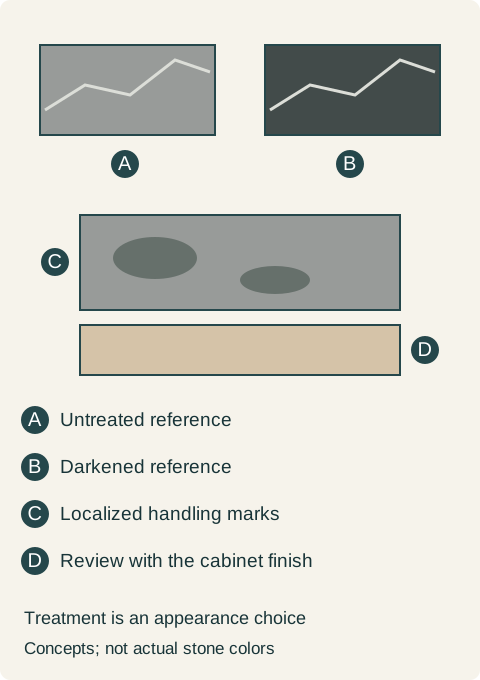
Teaching example Conceptual comparison of untreated, deliberately darkened and unevenly handled surfaces. These swatches explain appearance states; they are not stone samples, exact colors or a prediction of aging.
Untreated does not mean visually frozen
M. Teixeira describes natural darkening and explains that oil can produce charcoal, black or green-toned effects depending on the variety. It also describes treatment fading and renewed application. Those observations are reasons to ask about the particular stone; they do not support a guaranteed final shade or a universal maintenance interval.
Do not approve a light sample on the assumption that ordinary use will leave it unchanged. Ask to see a used reference and discuss what the supplier regards as expected appearance variation. Treat that reference as an example, not a promise that your sink area, island and seldom-used end will age at identical rates.
It helps to distinguish an unwanted mark from an unacceptable ownership experience. The supplier may have a way to address a particular mark, yet the buyer may still dislike having to think about it. A material is not the right choice solely because its appearance can be adjusted. The work and the look between treatments are part of the choice too.
Follow the preference through a real cabinet selection
Consider a hypothetical kitchen with cream perimeter cabinets and a wood island. The owner initially chooses a very dark soapstone sample for a strong outline around the cream doors. At the sample review, the same selection in its untreated condition looks softer, and the owner prefers that relationship with the wood. The supplier explains the expected changes with use. The owner accepts variation and specifies the untreated appearance rather than paying for darkening that contradicts the selected look.
If that owner instead wanted a consistently dark appearance, the decision would be different: review the treated reference and its care commitment before accepting the stone. If neither the untreated changes nor the upkeep of the treated look is acceptable, compare another documented countertop option. Choosing another material is more useful than expecting soapstone to behave like an unchanging manufactured color chip.
Make the handover match the sample decision
The approved record should identify the stone selection, surface finish and treatment state, alongside the cabinet sample used to judge them. State who performs any initial treatment and which care instructions accompany the installation. This avoids a well-intended final oiling changing a lighter appearance the buyer deliberately selected.
Ask for the same clarity on visible edges and any matching backsplash. Do not let one untreated reference govern the top while a separate treated photograph governs the edge color. Keep an accurately labeled sample for comparison, recognizing that it records an approved appearance state rather than a warranty against future natural variation. That is a more useful handover than the vague instruction to keep the stone black.
Pure White
Cream White
Light Warm Gray
Gray
Navy
Black
Oak Tone
Dark Walnut Tone
Design study These finish studies are design references, not a list of currently orderable colors. Screens and lighting change the appearance; compare a physical sample before choosing.See all finish options →
The sample shows the door frame, a separate center panel, the face frame and the cabinet box. Each component has its own place in this Shaker construction.
Shaker construction: door frame, center panel, face frame and cabinet box. The cutaway helps locate these parts; confirm each material in the specifications for the selected cabinet.
01 / Door frame
The Shaker door has rails and stiles around a separate center panel. The frame and center panel are different components; confirm their materials in the specifications for the selected cabinet.
02 / Face frame
The face frame surrounds the opening at the front of the cabinet box and sits behind the doors. The face frame, door frame and cabinet box are separate parts.
03 / Cabinet box
The sample exposes the cabinet sides, interior surfaces and layered edges. The image does not establish the wood species or material specification of a selected cabinet.