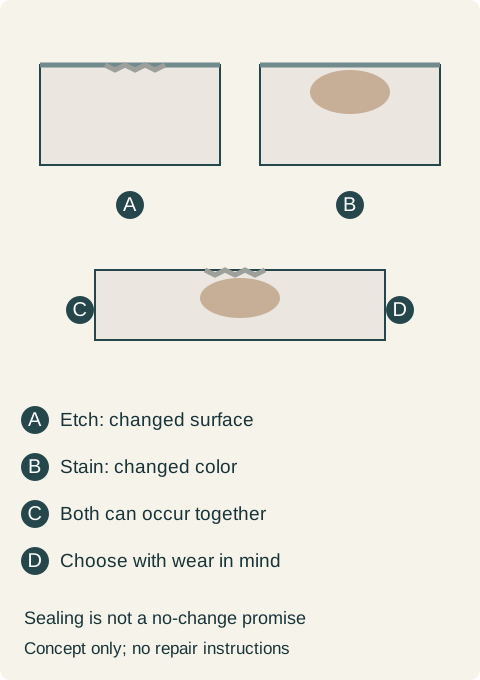
If an unchanging, polished countertop is essential to your kitchen design, settle that expectation before approving marble. A stone can be clean yet have a dull area. Treating every mark as a stain leads to the wrong purchase discussion: stain resistance does not answer every question about how the surface will look after use.
An etch changes the surface, not just its color
The Natural Stone Institute explains that acids can etch calcareous stone and that an exposure may etch, stain, or do both. It also distinguishes impregnating sealers, which improve stain resistance rather than making stone stain-proof. These are separate behaviors, not interchangeable names for dirty stone.
Its marble-care article describes etching as a dull area that may be more noticeable on polished marble than on honed or textured finishes. A less reflective finish can change how visible a mark is; it does not establish immunity to the underlying reaction.
That distinction matters when choosing a sample. A photograph taken straight down may emphasize color and veining while revealing little about reflected light. Look at the proposed finish from the seating side and from the work aisle, including under the lighting planned above the island. Ask the supplier to show representative wear on the same type of finish, not simply another pristine slab.
Do not identify an unknown installed mark solely from its outline. Residue, water deposits, scratches and surface changes can require different responses. For a purchase decision, the useful question is whether the likely appearance and maintenance suit the household. Diagnosing an existing mark belongs with someone who can inspect that stone.
Decide whether changing sheen will bother the household
Imagine a kitchen whose island is intended to look like a continuous reflective sheet beneath pendant lights. The household likes marble's veining, but finds the supplier's worn sample distracting whenever light travels across it. The buyer does not approve the slab on the assumption that sealing will preserve the original shine indefinitely. Instead, the buyer compares other surface options with their own wear limitations.
Another household may prefer a less uniform, lived-in finish. After viewing representative changes, it accepts the marble and keeps the preparation tools and care routine needed for that choice. Acceptance should come from seeing the condition, not from being told after installation that every change is desirable character.
Neither household needs to win an argument about whether marble is good or bad. Their expectations differ. Describe the desired result in observable terms: whether variations in reflected light are acceptable, where the countertop is viewed most often, and how much routine care the users will actually perform.
Teaching example Conceptual distinction: a surface change can alter reflected light, while a stain can change color below the face. Both can occur together. This is not a diagnostic test or a section of a particular stone.
Separate the protection proposal from the stone itself
A quote that says sealed marble should identify the treatment and its stated purpose. If a separate topical coating is offered, evaluate it as an additional surface system with its own appearance, instructions and renewal requirements. Do not silently substitute that promise for the behavior of untreated stone or an ordinary impregnator.
Avoid choosing by an unsupported maintenance calendar. Ask for the instructions applicable to the stone, finish and treatment being supplied. A routine borrowed from a different kitchen can conceal differences in use and product. Also ask how a future localized repair would be assessed alongside the surrounding finish; do not assume a small repaired patch will always disappear.
Coordinate the choice with the cabinet design
Keep the approved countertop finish beside the cabinet sample and view the pair in the intended lighting. A quiet honed surface and a highly reflective surface can make the same cabinet color read differently. The cabinet decision should follow the finish you intend to live with, not a polished sample that will later be replaced by a different treatment.
Retain the selected slab identity, finish, treatment scope and representative appearance discussion with the order. If the household still expects the surface never to change, the selection remains unresolved. Making that choice before templating is far more useful than a reassurance that does not describe what the buyer will see.
Pure White
Cream White
Light Warm Gray
Gray
Navy
Black
Oak Tone
Dark Walnut Tone
Design study These finish studies are design references, not a list of currently orderable colors. Screens and lighting change the appearance; compare a physical sample before choosing.See all finish options →
A patterned surface and a patterned slab body are different features. Compare an actual cut edge and sink opening before choosing the fabrication detail.
The sample shows the door frame, a separate center panel, the face frame and the cabinet box. Each component has its own place in this Shaker construction.
Shaker construction: door frame, center panel, face frame and cabinet box. The cutaway helps locate these parts; confirm each material in the specifications for the selected cabinet.
01 / Door frame
The Shaker door has rails and stiles around a separate center panel. The frame and center panel are different components; confirm their materials in the specifications for the selected cabinet.
02 / Face frame
The face frame surrounds the opening at the front of the cabinet box and sits behind the doors. The face frame, door frame and cabinet box are separate parts.
03 / Cabinet box
The sample exposes the cabinet sides, interior surfaces and layered edges. The image does not establish the wood species or material specification of a selected cabinet.