Sliding mirror cabinet: can you use the reflection and shelves together?
Sliding doors remove a forward swing, but the reflecting surface moves with them. Choose the cabinet by its open and closed task sequence, not only by whether it clears the faucet.
A sliding mirror cabinet is worth considering when a hinged mirror would interfere with the basin area or nearby fixtures. Its advantage is a different opening motion, not uninterrupted access to every shelf and every part of the mirror. Check where the reflection remains when the needed compartment is open, then decide whether closing the door between retrieval and grooming suits the routine.
Moving the mirror changes the working view
Jensen's manufacturer-hosted catalogue identifies the Ensign cabinet with sliding mirror doors. That provides a real example of this structure, distinct from a hinged front or a mirror that rises vertically. Confirm the current selected model and its complete installation information rather than ordering from an old catalogue image alone.
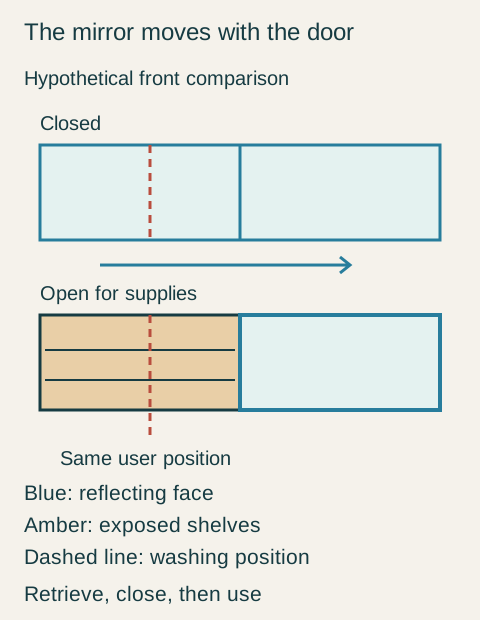
For an overlapping sliding-door arrangement, moving a panel exposes storage while covering another part of the opening. The reflecting surface moves with the panel. A mirror that serves the basin beautifully when closed may no longer be in front of the user's face when that side is open.
Trace the actual track arrangement instead of assuming all sliders behave alike. Some designs keep moving panels within the cabinet outline; others need space beside the box. Also separate the door movement from the fixed cabinet projection. Eliminating a forward swing does not make a surface-mounted cabinet flush with the wall.
Decide whether retrieval and grooming must happen together
Try the task from the intended washing position. Open the compartment that contains the daily supplies and look at the remaining reflection without deliberately leaning sideways. If the useful mirror has moved away, test the natural next step: retrieve the items, close the panel, then use the basin and mirror.
Teaching example Hypothetical front view of overlapping sliding mirrors: closed above, left storage area exposed below. Blue is the reflecting face; amber is the shelf opening. The dashed line marks the same washing position in both states. Opening that side removes its reflection until the panels move back. This is not a Jensen dimension or track drawing.
That sequence can work very well for someone who takes out a small current group at the start. It is less convenient for someone who wants the cabinet to stay open while comparing products or changing tools repeatedly in front of the mirror. A separate fixed mirror with side storage may preserve that simultaneous use, if the wall and approach can accommodate it.
The open shelf area also needs to release the objects normally stored there. A wide tray can sit on a shelf yet be difficult to remove through the part exposed by the sliding doors. Do not assume that removing a mirror panel is an acceptable daily retrieval method. Compare the actual opening and manufacturer's intended operation with the selected inventory.
A compact bathroom accepts an extra closing step
Consider a hypothetical bathroom with a basin near a side return. The reviewed hinged-cabinet option opens into the space occupied by a tall faucet and the user's approach. Raising that cabinet enough to avoid the conflict would no longer provide the preferred reflection for the actual user. The proposed sliding model avoids that forward door movement and has a suitable fixed projection at the basin.
During the trial, sliding open the supply compartment shifts the useful mirror away from the washing position. The owner first considers this a failure. But her usual routine is to remove a small toiletries group, use it, then return it. The items have a clear landing place on the adjacent dry part of the vanity, and she does not need to keep the cabinet open while grooming.
She tests retrieval, closes the mirror, completes the routine and returns the group through the same opening. This works without changing her standing position or relocating the faucet. She selects the sliding cabinet, accepting the deliberate closing step. A fixed mirror plus side cupboard is rejected here because the adjacent wall area is already occupied by a window and its trim.
Keep the selected cabinet's limits visible
That result does not establish that sliding doors suit every tight bathroom. Check the actual track travel, exposed opening, fixed body depth and useful reflection as one proposal. If electrical features are included, their location and installation belong to the selected product's professional coordination; the opening type does not settle that work.
The final choice should describe what happens with the doors open, not merely that the closed mirror fits. A sliding cabinet earns its place when avoiding the swing solves a real conflict and the retrieve-close-use sequence remains comfortable.
Pure White
Cream White
Light Warm Gray
Gray
Navy
Black
Oak Tone
Dark Walnut Tone
Design study These finish studies are design references, not a list of currently orderable colors. Screens and lighting change the appearance; compare a physical sample before choosing.See all finish options →
Add the dimensions that contribute to the finished assembly, including lights and required end pieces. The sum of the mirror-cabinet widths alone can understate what must fit above the vanity.
The sample shows the door frame, a separate center panel, the face frame and the cabinet box. Each component has its own place in this Shaker construction.
Shaker construction: door frame, center panel, face frame and cabinet box. The cutaway helps locate these parts; confirm each material in the specifications for the selected cabinet.
01 / Door frame
The Shaker door has rails and stiles around a separate center panel. The frame and center panel are different components; confirm their materials in the specifications for the selected cabinet.
02 / Face frame
The face frame surrounds the opening at the front of the cabinet box and sits behind the doors. The face frame, door frame and cabinet box are separate parts.
03 / Cabinet box
The sample exposes the cabinet sides, interior surfaces and layered edges. The image does not establish the wood species or material specification of a selected cabinet.