Sink food-waste disposer or strainer collection: choose the cleanup routine first
A disposer changes how suitable food scraps leave the sink; a strainer retains them for removal. Compare the actual cleanup sequence, controls and complete sink cabinet before buying the motor.
Choose strainer collection when retaining scraps and moving them to the appropriate receptacle is an acceptable household routine, or when an approved disposer installation is not available. Consider a disposer when the household wants suitable food scraps processed at the sink and accepts the equipment, operating requirements and maintenance access that come with it. The decision concerns the whole sink arrangement. A powerful-looking motor alone does not show whether cleanup will become easier.
Start with the material that actually arrives at the sink after ordinary meals. Distinguish suitable food scraps from packaging, utensils and anything excluded by the selected manufacturer's instructions. A disposer is not a replacement for the kitchen's trash and sorting arrangements. Equally, a strainer is not a complete solution unless the household has somewhere practical to empty what it collects.
Understand the work the machine performs
InSinkErator explains that rotating impellers move material against a stationary grind ring rather than using blender-style blades. Water carries the resulting particles through the outlet. This describes the mechanism, not permission to process every kitchen discard.
That mechanism changes the route of suitable scraps: they leave through the drainage arrangement rather than being carried out in the strainer. It does not make every object arriving at the sink appropriate for that route. Read the selected unit's operating and material restrictions before choosing it, and keep the other receptacles available for the streams that remain. There is no universal list in this guide that overrides a model's instructions.
In a strainer-based arrangement, food stays at the sink until someone lifts out the collection and transfers it. That can suit a household that already separates preparation waste beside the board and brings relatively little to the sink. Another household may dislike repeatedly moving the wet collected material. Describe that actual inconvenience instead of assuming everyone benefits equally from the same machine.
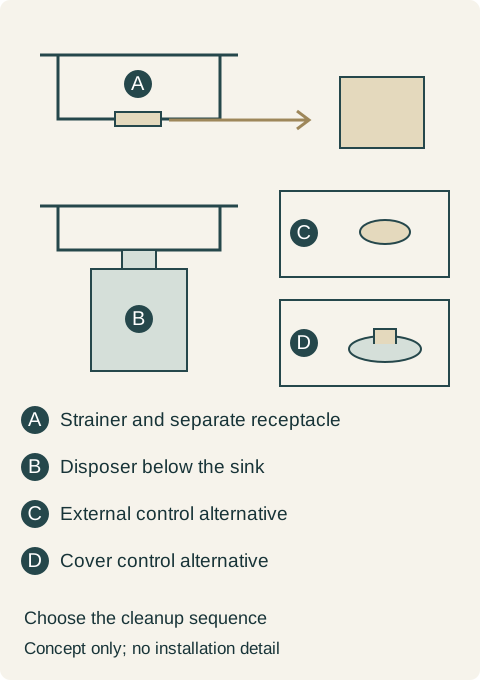
Teaching example Functional comparison only. A retains scraps at the strainer for transfer to a separate receptacle. B represents a disposer beneath the sink. C is an external control for a compatible continuous-feed system; D is the activating cover of a batch-feed system. C and D are alternatives, not instructions to combine controls. Lines indicate the task relationship, not plumbing or wiring.
Compare when loading and operation happen
InSinkErator distinguishes continuous-feed models controlled by a wall or air switch from batch-feed models activated with their cover in place. These are different operating sequences, not interchangeable names for the same control.
With the continuous-feed proposal, examine where the specified control is reached while someone works at the sink. Include any deck-mounted accessory in the sink and faucet layout. A separately quoted air switch does not automatically belong to every unit, and a convenient-looking button is not proof that the complete arrangement is compatible. Have the selected control and appliance identified as a supported combination.
With the batch-feed proposal, the activating cover becomes part of the repeated routine. Loading and covered operation occur in successive stages. Keep a place for the cover while the sink is being used in another way, and try the required handling on the actual product or a suitable demonstration. Do not assume that every ordinary drain stopper will activate it, or that the cover can be omitted when it is inconvenient.
The feed choice should follow how the household clears dishes. Someone who collects the suitable scraps and then operates the machine may be comfortable with the covered sequence. Someone who expects ongoing loading during operation may prefer the appropriate continuous-feed arrangement. The appliance manual determines operation in either case. These preferences do not establish that one category is universally safer, faster or quieter.
Buy the sink cabinet as a complete arrangement
Have the proposed sink, drain connection, disposer body and any other retained equipment reviewed together. A model that fits below the bowl may still displace a planned bin or obstruct the way another component is serviced. Do not compare a bare sink cabinet in one proposal with a fully equipped cabinet in the other. Draw the contents that the household actually intends to keep.
Access also belongs in the purchase. The installation needs to support the manufacturer's specified service tasks without treating stored bottles or a fixed organizer as permanent obstructions. This does not mean leaving the entire cabinet empty. It means placing retained storage where it can coexist with the particular equipment and the access it needs.
The site's drainage, power and other applicable requirements must be reviewed by the responsible professionals before committing to the appliance. A manufacturer's description of how grinding works does not establish approval for a particular building or wastewater arrangement. If the proposed installation is unsupported, the useful alternative is a finished strainer-and-receptacle layout rather than an appliance waiting in a box.
A household chooses the covered sequence
Consider a hypothetical renovation where the family currently empties a sink strainer after clearing plates. They already separate packaging and other unsuitable items. Their objection is the repeated transfer of the collected suitable food scraps, not the existence of every trash container in the kitchen. Their proposed installation has been reviewed for the actual sink and site.
They compare retaining the strainer, a compatible continuous-feed package and a batch-feed package. During a product demonstration, they try the controls and cover with representative dry handling tasks rather than improvising a running test. Their cleanup naturally gathers the appropriate scraps before operation. They are comfortable placing and removing the required cover, and the sink-side arrangement provides a place for it when removed.
They choose the batch-feed package because its covered sequence fits that existing routine and avoids adding the external-control arrangement in the alternative quote. They accept the cover handling rather than pretending it is an inconvenience that will disappear. The actual selected unit and sink configuration, including their compatibility, determine the order; this is not a promise that any batch-feed model fits the same opening and cabinet.
A previously proposed slide-out organizer conflicts with the actual equipment and is removed from the order. The cleaners have a confirmed place in the retained adjacent utility storage. The separate receptacle remains for the materials that do not go through the disposer. The completed choice therefore includes both the chosen appliance and a usable home for the displaced storage.
Compare ownership without inventing a payback
The appliance quote should include the approved unit, controls, installation scope and the cabinet changes required by that proposal. The strainer option should include the collection and receptacle arrangement that will actually be used. Comparing the disposer alone with an unfinished empty sink cabinet hides the costs and compromises of both choices.
Check the selected unit's cleaning, service and replacement information when comparing ownership. No category name guarantees that a future unit will have the same body or connections. Likewise, do not justify the purchase with an assumed reduction in garbage service, a universal environmental advantage or an invented maintenance interval. Those claims require evidence beyond the mechanism described here.
The final decision should be easy to describe in a normal meal: where unsuitable material goes, how suitable scraps are handled, how the chosen control is used according to its instructions, and where the remaining cabinet contents live. If the machine removes a repeated difficulty and the complete installation works, it has a clear purpose. If strainer collection already suits the household, retaining it leaves a fully functional option rather than an incomplete upgrade.
Pure White
Cream White
Light Warm Gray
Gray
Navy
Black
Oak Tone
Dark Walnut Tone
Design study These finish studies are design references, not a list of currently orderable colors. Screens and lighting change the appearance; compare a physical sample before choosing.See all finish options →
The basin, disposal, filter and their access requirements share the same cabinet. Resolve that complete arrangement first, then assign storage to the remaining usable regions.
An inset waste bin can accept scraps from the worktop without opening a cabinet front. Decide whether its fixed position and bucket below are worth giving up that part of the prep surface and storage.
The sample shows the door frame, a separate center panel, the face frame and the cabinet box. Each component has its own place in this Shaker construction.
Shaker construction: door frame, center panel, face frame and cabinet box. The cutaway helps locate these parts; confirm each material in the specifications for the selected cabinet.
01 / Door frame
The Shaker door has rails and stiles around a separate center panel. The frame and center panel are different components; confirm their materials in the specifications for the selected cabinet.
02 / Face frame
The face frame surrounds the opening at the front of the cabinet box and sits behind the doors. The face frame, door frame and cabinet box are separate parts.
03 / Cabinet box
The sample exposes the cabinet sides, interior surfaces and layered edges. The image does not establish the wood species or material specification of a selected cabinet.