Can a multifunction oven replace the microwave and the main oven?
Count independently usable cooking cavities before counting modes. A single cavity can simplify the cabinet layout, but it cannot accept an unrelated microwave task while occupied by a baking task that must continue.
A multifunction oven can replace separate appliances when its permitted cooking methods, usable interior and shared-cavity schedule match the household. It is a poor substitute when an ordinary meal repeatedly needs the main oven and microwave independently at the same time. Decide that before removing an appliance opening from the cabinet plan. A longer function list does not create another place to put a dish.
Count cavities before comparing features
GE describes Advantium configurations with microwave, convection and other cooking modes. That is a description of cooking versatility; it should not be read as a count of independently occupied cooking spaces.
A single-cavity appliance can use different methods, and a supported combination program may employ different forms of heating together. That still acts within the selected program and shared space. It does not turn an ongoing baking task into an independent microwave task for another person. Read both the supported modes and the physical arrangement before comparing proposals.
GE's catalogued combination double wall oven distinguishes an upper Speedcook oven and a lower convection oven. It illustrates another meaning of combination: separate cavities within an appliance assembly, rather than several modes in a shared cavity.
That product example is not a current stock recommendation. It helps separate the choices: a multifunction cavity alone, separate microwave and main oven appliances, or an expressly supported assembly containing separate cavities. Do not use the word combination as the entire appliance description on a cabinet quote.
Test the overlap that actually happens at dinner
Consider a household that often bakes a tray of vegetables while another person wants to microwave a bowl of rice. The vegetable dish needs to remain in its baking cycle; the rice is assigned a separate microwave task under its applicable instructions. Simply putting both dishes into the same cavity does not give each its own unrelated mode or controls. Nor does a spare rack solve that scheduling conflict.
The question is whether the household is content to do those jobs in sequence. If the answer is yes, a shared cavity may be useful. If someone regularly interrupts the main cooking task to gain microwave access, the apparent appliance reduction has transferred a recurring inconvenience into the room. Do not base the decision only on a holiday meal that rarely happens, or ignore an overlap that happens on normal evenings.
Write the tasks in the order the people want to do them. Mark which ones can move earlier or later and which ones the household wants available independently. This is a planning sequence, not a cooking timetable: use the appliance and food instructions for actual operation. No invented duration or temperature is needed to identify that two requested tasks overlap.
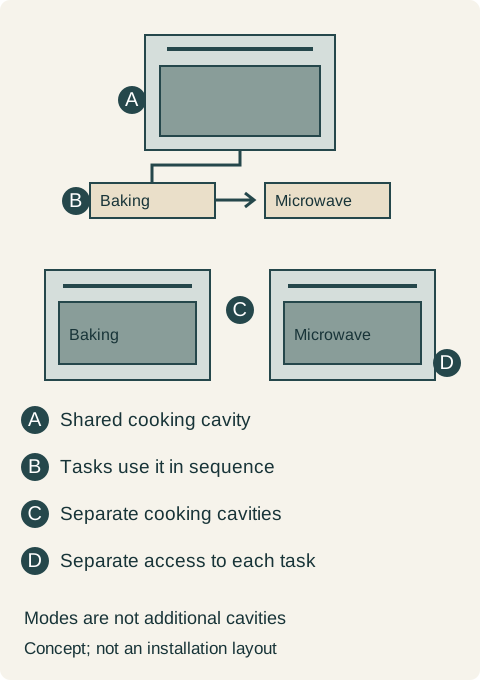
Teaching example Conceptual task allocation: the upper arrangement directs different tasks into a shared cavity in sequence; the lower arrangement assigns them to separate cavities. The lower fronts are separated for clarity, not an approved installation layout. No cooking time, temperature or appliance dimensions are shown.
Keep the useful interior separate from the cabinet opening
The smaller front of a proposed appliance is not proof that its interior will accept the cookware currently assigned to the main oven. Check the household's actual baking sheet, covered casserole and handled dish against the chosen cavity, its permitted tray or rack arrangement and the complete insertion path. Include handles and lids where they belong to the intended use.
A cold, empty cookware comparison can reveal a poor match without operating an oven. A vessel that passes the door but conflicts with the selected support arrangement is not a successful fit. Conversely, a household that normally cooks small portions may gain little from preserving an oversized cavity purely because it has always been in the kitchen.
Keep physical fit and cooking suitability distinct. A metal pan fitting inside a cavity does not approve it for microwave operation. The cabinet designer should preserve room for the chosen equipment and accessories; the manufacturer's operating instructions determine what can be used in each mode.
Accessories need a home after reducing the appliance count
GE's Advantium tray guidance assigns different trays and racks to different modes. The named appliance family demonstrates why a multifunction purchase can bring interchangeable parts that require storage, even when it removes an appliance front.
Compare the accessories supplied with the exact selection. Give clean, cool trays and racks an accessible place where their shapes are protected and the user can distinguish them. A narrow leftover gap is not automatically useful tray storage, and an appliance cavity should not be assumed to be a permanent cupboard for unused accessories.
Follow the operating instructions for changing parts and handling anything that has been heated. For cabinet planning, keep the ordinary landing available and provide a separate storage position for parts when ready to put away. Do not make a hot component's temporary position depend on emptying a drawer full of utensils.
A household chooses independent use over the extra cupboard
In a hypothetical remodel, the initial proposal replaces the microwave and main wall oven with a single multifunction cavity. The elevation gains space for a closed storage compartment. The family likes that cleaner arrangement, and its usual dishes fit the candidate interior.
The weekday review changes the decision. A baking task regularly continues while another family member reheats a bowl by microwave. The household does not want that person to wait for the baking cycle, and it does not want to reorganize dinner around a mode change. The existing separate arrangement already serves both tasks without that queue.
The family therefore retains a main oven and an independently usable microwave. It accepts less closed storage in the appliance zone, assigns the planned serving dishes to an existing adjacent cabinet after checking their fit, and chooses the microwave location through a separate reach and landing review. The main reason for the extra appliance space is independent access during an ordinary meal, not a belief that more appliances always mean a better kitchen.
This choice does not authorize an arbitrary stack. Separate appliances require a supported installation arrangement, while a combined appliance assembly has its own opening and support requirements. The selected configuration, not this conceptual comparison, determines the cabinet construction.
When the single-cavity option is the better allocation
A household whose baking and reheating rarely overlap may reasonably choose the multifunction cavity. It should have verified the recurring cookware, accepted the mode changes and allocated the accessories before treating the released cabinet space as a benefit. Describe what will actually occupy that space, including shelves and access, instead of recording only an empty rectangle on the elevation.
Compare complete costs for the viable arrangements: appliances, required trim, cabinet work, professional installation and any electrical work identified for the exact equipment. A reduced appliance count does not establish the cheaper installed package. Equally, paying for a separate cavity that the household cannot reach comfortably or does not use independently may bring little value.
The final cabinet decision should name the physical configuration and the tasks it preserves. Keep the microwave independent when that access solves a repeated conflict; consolidate when the shared schedule works and the recovered storage has a real use. Both outcomes are more useful than choosing by the number of functions printed on the front.
Pure White
Cream White
Light Warm Gray
Gray
Navy
Black
Oak Tone
Dark Walnut Tone
Design study These finish studies are design references, not a list of currently orderable colors. Screens and lighting change the appearance; compare a physical sample before choosing.See all finish options →
An outer front can cover a gap without confirming the required opening, support or attachment. Match the exact appliance and accessory configuration to the cabinet detail behind it.
A vertically arranged oven pair needs a task assignment and user trial for both cavities. Lowering the assembly changes both positions; seeing the upper controls does not prove upper-rack access.
The drawer must open, but the person must also see, load and lift the vessel from above. Check the countertop projection, controls and transfer to a real landing together.
The sample shows the door frame, a separate center panel, the face frame and the cabinet box. Each component has its own place in this Shaker construction.
Shaker construction: door frame, center panel, face frame and cabinet box. The cutaway helps locate these parts; confirm each material in the specifications for the selected cabinet.
01 / Door frame
The Shaker door has rails and stiles around a separate center panel. The frame and center panel are different components; confirm their materials in the specifications for the selected cabinet.
02 / Face frame
The face frame surrounds the opening at the front of the cabinet box and sits behind the doors. The face frame, door frame and cabinet box are separate parts.
03 / Cabinet box
The sample exposes the cabinet sides, interior surfaces and layered edges. The image does not establish the wood species or material specification of a selected cabinet.