Test a microwave drawer below the counter with the actual bowl and user
The drawer must open, but the person must also see, load and lift the vessel from above. Check the countertop projection, controls and transfer to a real landing together.
Choose a below-counter microwave drawer by testing access from above with the intended user and cookware. Clearing the opposite cabinet only proves that the drawer can travel. The person still needs to see the food, lower the vessel into the cavity, operate the controls and lift the vessel out without an awkward change of grip. Keep those tasks in the same location trial.
Establish the actual appliance and counter relationship
Use a model designed as a microwave drawer and its applicable installation information. Confirm the supported opening, support, securing arrangement and front position with the responsible installer before deciding the finished cabinet detail. A microwave drawer is an appliance assembly; an ordinary cabinet drawer containing a countertop microwave does not establish the same permitted installation.
The cited Sharp installation guide explicitly discusses control visibility and access with extended countertops. That is a useful model-specific example of why the countertop projection belongs in the check. Use the selected appliance’s instructions rather than transferring that guide’s dimensions or an assumed mounting adjustment to a different model.
Check the vessel from above, including its handles
Choose the bowl, covered dish or handled container the household expects to use. Verify that the vessel and its intended use are suitable under the appliance instructions. Then check its complete outline, including lid and handles, against the actual cavity and the opening available when the drawer is extended. Outside appliance width does not answer that question.
In a permitted demonstration or stable mockup, begin with the cold, empty vessel. Have the user look into it and lower it into the intended position, keeping the counter and drawer front in the test. Include the hand positions and appropriate mitts used for removal. A bowl that physically fits can still leave an inconvenient grip if its handles sit close to the cavity edge.
ABCD
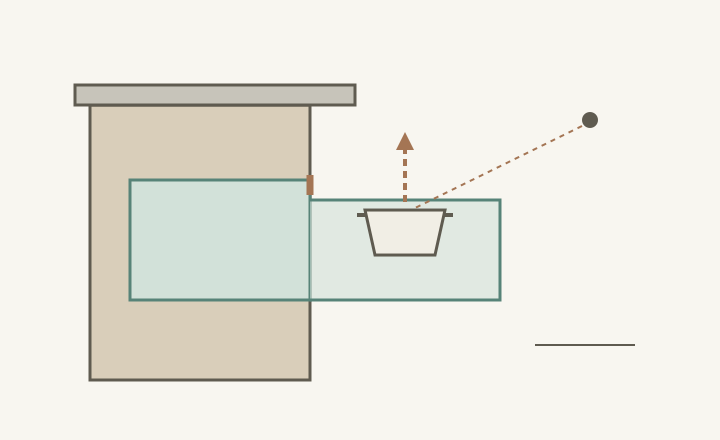
Diagram The sketch separates the counter, extended drawer, vessel and view from above. It is not a real model, acceptable installation height, body-clearance standard or load recommendation. The actual appliance and user determine the task.
A
Include the actual countertop projection.
B
The complete vessel and grip must clear the opening.
C
The extended drawer occupies space while the user lifts.
D
Seeing into the vessel is a separate check from opening the drawer.
Do not trade hidden controls for a better front line
Try reading and operating the controls from the intended standing or seated position, as applicable to the actual user. Include any opening movement of the control panel that belongs to the model. A deeper counter edge or a visually recessed appliance front can change the view and reach even when the cabinet opening is unchanged.
In a hypothetical island arrangement, the drawer opens completely into the aisle and a shallow plate is easy to remove. The household’s covered casserole is taller and has side handles; lifting it requires a different grip and a more upright rise before turning toward the counter. The plate demonstration did not establish that this recurring dish works equally well.
Follow removal to an available landing
Identify the surface where the container will actually go. With the drawer still open, rehearse lifting clear and moving to that landing. If the destination is the countertop above the appliance, include its height and projection rather than assuming that “directly above” means an easy transfer. Keep other counter items and the person’s approach in the scene.
An empty vessel tests shape and movement, not control of a loaded dish. Consider the expected load separately, using only cold, stable loads comfortably within the user’s ability for any rehearsal, with suitable assistance. Do not use hot contents or challenge lifting limits to validate the layout. Follow the appliance’s operating instructions for actual heating and handling.
Evaluate the location with the rest of the kitchen operating
Keep nearby cabinet fronts, stools and ordinary through traffic in the plan. Decide whether a person may need to wait while the microwave drawer is open; a clear mechanical path does not establish simultaneous passage. Repeat loading as well as unloading, and check other regular users independently instead of treating one successful demonstration as universal access.
Record the exact appliance, installed front and counter profile, representative vessels, controls, landing and tested sequence. If the location does not support the intended tasks, compare another supported position or appliance arrangement before fixing the cabinetry. Recheck after changing the counter overhang or cookware assignment: those changes can affect use without changing the nominal cabinet width.
Pure White
Cream White
Light Warm Gray
Gray
Navy
Black
Oak Tone
Dark Walnut Tone
Design study These finish studies are design references, not a list of currently orderable colors. Screens and lighting change the appearance; compare a physical sample before choosing.See all finish options →
A vertically arranged oven pair needs a task assignment and user trial for both cavities. Lowering the assembly changes both positions; seeing the upper controls does not prove upper-rack access.
A cabinet opening that accepts the microwave body is not proof of an approved enclosure. Verify the model, any required matched kit and the complete airflow and opening details first.
The sample shows the door frame, a separate center panel, the face frame and the cabinet box. Each component has its own place in this Shaker construction.
Shaker construction: door frame, center panel, face frame and cabinet box. The cutaway helps locate these parts; confirm each material in the specifications for the selected cabinet.
01 / Door frame
The Shaker door has rails and stiles around a separate center panel. The frame and center panel are different components; confirm their materials in the specifications for the selected cabinet.
02 / Face frame
The face frame surrounds the opening at the front of the cabinet box and sits behind the doors. The face frame, door frame and cabinet box are separate parts.
03 / Cabinet box
The sample exposes the cabinet sides, interior surfaces and layered edges. The image does not establish the wood species or material specification of a selected cabinet.