Semi-Custom vs. Custom Kitchen Cabinets: What Changes?
Buy the changes your kitchen needs, rather than a label. Separate catalog modifications from project-specific fabrication, then compare complete finished packages.
Start with the exception that would justify custom work
Choose a semi-custom package when its offered cabinets and confirmed modifications achieve the kitchen you want. Choose a fully custom proposal when a worthwhile requirement remains outside that package and the proposed fabrication actually resolves it. The useful starting point is an exception on your drawing: a shape, interior arrangement, profile or finish relationship that the offered system cannot provide. The word custom alone does not tell you whether there is such an exception.
A kitchen designed individually for your room is not necessarily built from individually invented cabinets. A designer can make a highly personal layout from catalog units, and a cabinetmaker can build an ordinary rectangular arrangement to project-specific dimensions. Both can be appropriate. Ask what changes in the delivered furniture, not merely whether someone used design software to draw your kitchen.
Size choice and fabrication freedom are different
KraftMaid identifies its offering as semi-custom and describes a special-order program for modifying cabinet width, depth and height. That is a useful counterexample to the assumption that semi-custom always means unchanged standard boxes. Eligibility still belongs to the selected cabinet and current program.
An offered size modification may retain the original door family, hardware system and construction. It does not automatically permit a different curved front, custom internal partition or unusual exposed end. Conversely, a fully custom maker may use established construction methods and specialist-supplied fronts. Custom should mean that the agreed project requirements are being made, not that every hinge and component is invented for the order.
Barker describes custom-size cabinets that ship ready to assemble. Customization and delivery format therefore need separate questions: a custom cabinet need not arrive assembled. This example does not establish the capabilities, construction or delivery format of another supplier.
Separate these choices in the proposal. Record the approved dimensions and configuration, the materials and hardware, the finish, and the condition at delivery. A change in any of them can affect the comparison even when both headings say custom kitchen.
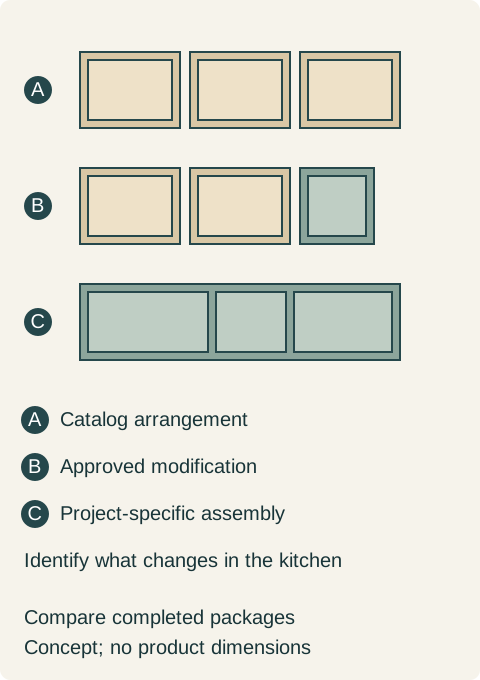
Teaching example Conceptual decision: A is a catalog cabinet arrangement; B changes a permitted cabinet dimension while retaining that system; C uses a project-specific assembly. The drawing shows purchasing scope, not available sizes, construction strength or a production drawing.
Mark each requested departure from the offered system
Ask the designer to show the ordinary catalog arrangement first, then identify the changes needed for the accepted plan. One cabinet might need reduced depth to preserve a passage. A display section might need a different interior finish. A visible end might need a shaped treatment that the selected line does not supply. These are different requests and should receive separate answers.
For each departure, distinguish an offered factory modification, a deliberately designed site operation and separate fabrication. Do not leave an unsupported change under a note saying adjust as needed. If an installer would have to rebuild a drawer box or alter a finished front, have that work accepted and priced before treating the catalog cabinet as the solution.
Also identify requirements that are preferences rather than constraints. Equal-looking doors, an uninterrupted grain pattern and a particular molding profile can matter greatly, but they should be named. The homeowner can then decide whether the extra scope earns its cost. Calling every preference essential prevents a useful comparison; dismissing all appearance requirements as decoration is equally unhelpful.
Custom dimensions do not remove installation allowances
A cabinet made to an exact nominal width still needs a buildable relationship to the room. Wall irregularity, scribing, front movement, appliance requirements and the installation sequence remain. Do not ask a fabricator to occupy the entire measured gap merely to eliminate the word filler from the quote. A deliberately allowed edge strip may be part of a well-designed custom installation.
Use the completed assembly to check usable storage. An outside width does not prove an interior opening, and a revised depth may affect the chosen drawer system or organizer. Get the proposed result shown with the actual components. The benefit of a modified or custom box exists only if the stored items and moving parts still work together.
Compare complete packages after the exceptions are resolved
Consider a hypothetical US-dollar comparison. A semi-custom cabinet package starts at $18,000. Confirmed modifications add $1,200, and the required finished panels add $800, producing a $20,000 package at the agreed delivery stage. A fully custom proposal at $21,800 already includes those same exposed surfaces and accepted dimensions. Identical installation and all other project costs are outside both figures. These are teaching amounts, not market prices or usaKT quotes.
In this hypothetical kitchen, the critical exception is a shallow return beside the dining route. The semi-custom supplier confirms the necessary depth modification and shows a compatible interior. Its accepted door and finish options also satisfy the owner. The custom proposal offers an additional shaped end, but that detail is not part of the owner's required design. The owner chooses the $20,000 completed package and keeps the $1,800 difference, rather than comparing the unfinished $18,000 scope with the complete custom proposal.
That result does not establish that semi-custom is always cheaper. If the required end shape or internal configuration were unavailable in the offered system, the proposals would no longer provide the same result. Obtain a price for the actual alternative instead of adding a vague allowance and assuming the missing fabrication can be supplied later.
A mixed package needs a reason and a resolved junction
A separately fabricated island can accompany catalog perimeter cabinets when its shape or use warrants it. Treat that as a coordinated design, not an automatic saving. Examine the junctions that viewers actually compare: top levels, door proportions, exposed ends and finish transitions. An intentionally different island finish may be easier to judge than an unsupported promise to match unrelated coatings exactly.
Define who owns the interface with the countertop, appliances and surrounding cabinets. A specialist may correctly build the custom portion while the combined plan remains unresolved. Keep the complete elevation and material samples with both orders so a change to one package does not silently invalidate the other.
Buy a defined result, with records for the next change
Before approving the order, obtain the selected configuration, accepted modifications, material and finish information, included operations and delivery condition in writing. Ask how a later replacement would be identified. A catalog code alone may miss a modified depth; a custom description without a retained drawing may miss the original configuration.
Choose the package that meets the real brief with responsibilities you understand. If custom fabrication solves a meaningful limitation, show that improvement on the plan and price it. If the confirmed semi-custom options already solve the room, there is no need to purchase a broader label in order to get a kitchen designed for you.
Pure White
Cream White
Light Warm Gray
Gray
Navy
Black
Oak Tone
Dark Walnut Tone
Design study These finish studies are design references, not a list of currently orderable colors. Screens and lighting change the appearance; compare a physical sample before choosing.See all finish options →
A cabinetmaker can build the boxes and buy custom doors from a specialist. Follow the dimensions, profiles and finish across that manufacturing split before choosing the package.
The sample shows the door frame, a separate center panel, the face frame and the cabinet box. Each component has its own place in this Shaker construction.
Shaker construction: door frame, center panel, face frame and cabinet box. The cutaway helps locate these parts; confirm each material in the specifications for the selected cabinet.
01 / Door frame
The Shaker door has rails and stiles around a separate center panel. The frame and center panel are different components; confirm their materials in the specifications for the selected cabinet.
02 / Face frame
The face frame surrounds the opening at the front of the cabinet box and sits behind the doors. The face frame, door frame and cabinet box are separate parts.
03 / Cabinet box
The sample exposes the cabinet sides, interior surfaces and layered edges. The image does not establish the wood species or material specification of a selected cabinet.