Portable vs. built-in dishwashers: cabinet layout choices
A rolling dishwasher can retain existing cabinets, but it brings washing into the sink area during use. Compare that daily arrangement with the storage and installation work a built-in machine replaces.
Choose a rolling dishwasher when preserving the existing cabinet run matters and the kitchen can support the machine's connected working state. Choose a built-in dishwasher when a permanent washing position is worth the cabinet space and installation work it requires. Portability does not eliminate the appliance's footprint; it changes where that footprint sits during the day. The right purchase depends on what happens around the sink while dishes are being washed, as well as where the machine waits afterward.
This comparison concerns a floor-standing machine that rolls to a faucet connection. A countertop dishwasher occupies preparation space differently, and a machine designed for permanent installation has a different installation brief. Do not use the word compact to merge those choices. Start with the appliance type, then compare the actual racks, installation requirements and room arrangement of suitable models.
Whirlpool distinguishes a built-in dishwasher connected to the home's plumbing beneath the counter from a rolling portable machine connected to the kitchen faucet. The important difference here is the location and connection arrangement, not a universal capacity or performance ranking.
Walk through the current sink-side cabinet contents before deciding to remove a base. A cabinet holding everyday pots may be more valuable than a compartment full of items that could move elsewhere. The built-in proposal needs an exact replacement home for that collection. It also needs a properly coordinated appliance opening and countertop support; deleting a box from a drawing is not a completed installation design.
Retaining the run with a rolling appliance can avoid that particular storage loss. It still introduces an object into the room. A vacant corner can be a useful home only if the loaded machine can be handled as intended and the corner is genuinely available. A dining chair that must disappear whenever dishes are washed is part of the purchase consequence, not empty floor space.
Keep the reason for preservation explicit. The household may value usable older cabinetry, want a limited alteration or expect to leave the property. These are different priorities. Avoid assigning a universal savings claim: the selected appliance, any approved faucet changes, suitable utilities and actual cabinet work determine the comparison. A lower appliance price cannot compensate for an operating arrangement the household will not use.
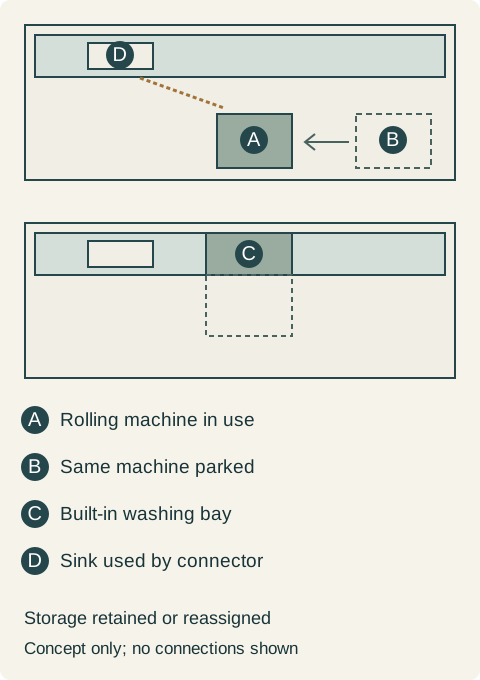
Teaching example The upper concept keeps the cabinet run and shows a rolling dishwasher beside the sink, with a separate dashed parking outline for the same machine. The lower option replaces a cabinet bay with a built-in dishwasher. The gold connection line is a functional relationship, not a hose route or plumbing instruction.
The kitchen faucet joins the washing system
GE's Unicouple guidance describes an adapter for compatible threaded faucet spouts and a connector that supplies the dishwasher while returning wastewater into the sink. Compatibility and the receiving sink are therefore part of this arrangement, not merely the machine's parked dimensions.
Before choosing a rolling model, establish whether its approved connection works with the faucet that will remain. An attractive pull-out head or an available nearby sink is not proof. If changing the faucet is necessary, include the complete replacement and its ordinary washing use in the proposal. Do not invent a chain of adapters to make an otherwise unsuitable product appear compatible.
Then consider what the household does at the sink during that period. Preparing another meal, filling a large vessel and washing an item by hand may overlap the dishwasher's use. Follow the selected model's instructions for what remains available while connected; do not promise normal unrestricted faucet use or assume the receiving basin is simply spare preparation space. This is a use-planning question, not a connection tutorial.
Loading and unloading should not borrow another task's place
Place the used plates and bowls where they normally arrive after a meal. Show where the door opens, where the person stands and where the next dirty item waits. For a rolling machine, the best position for reaching the faucet may not be the best position for opening the door. A workable hose connection alone does not establish a workable dish-loading station.
Do the return to clean storage too. A built-in machine can have a stable relationship to the dish cabinet, but its open door still needs to coexist with the user and adjacent fronts. A portable arrangement may work well when clean dishes are put away from its connected position before it returns home. Decide the routine rather than assuming that wheeling a full appliance around will always improve access.
Compare the actual dishes in each candidate's permitted rack arrangement. A product category or exterior width does not decide whether the large bowl fits with the dinner plates. Keep hand-washed items in the sink-side plan as well. Otherwise, the proposed cleanup arrangement can look complete only because the awkward pieces have been omitted.
The household that gives up a cabinet
In a hypothetical kitchen, the existing sink-side base contains frequently used pots. A rolling dishwasher initially seems attractive because it keeps that storage intact. Its parked location is available, and the proposed faucet connection is verified for the candidate. During the family's ordinary evening, however, another person continues preparing food at the same sink while the first meal's dishes are being cleared. The owners do not want that work organized around a connected appliance beside the sink.
They compare a permanent bay with a real new home for the pots. A neighboring storage arrangement can receive the retained collection without sacrificing the preparation counter, and a trial confirms that loading and unloading at the proposed bay work with the dish cabinet. The project team includes the required appliance opening, top support, connections and finished adjacent surfaces in the installation scope.
The household selects the built-in machine and accepts the loss of the original pot cabinet. The decision buys a permanent dishwashing position and avoids the repeated faucet-connection arrangement. It does not claim that the built-in category washes better. If the pots had no practical new home, or the building work were outside the project's scope, the portable option would deserve another look rather than a forced cabinet sacrifice.
Keep future conversion separate from today's purchase
A rolling appliance should not be bought on an unsupported promise that it can later be built into the same gap. Any conversion needs explicit support for the exact model and its required components. Likewise, a built-in unit should not be treated as finished freestanding furniture just because it can be drawn beside a cabinet. Price the arrangement that will actually be installed and used now.
The final comparison should include the retained or displaced cabinet contents, the occupied sink area, the complete wash-and-unload routine and the work each option requires. That turns portability from a vague convenience into a clear choice about how the kitchen operates.
Pure White
Cream White
Light Warm Gray
Gray
Navy
Black
Oak Tone
Dark Walnut Tone
Design study These finish studies are design references, not a list of currently orderable colors. Screens and lighting change the appearance; compare a physical sample before choosing.See all finish options →
Compare the cabinet arrangement and the daily dish load together. A narrower appliance can leave an unusable strip, while the countertop above an undercounter machine may remain exactly the same.
The closest cabinet is useful only if it can be reached and opened while unloading. Map the actual clean-dish destinations with the appliance door and racks in use.
The sample shows the door frame, a separate center panel, the face frame and the cabinet box. Each component has its own place in this Shaker construction.
Shaker construction: door frame, center panel, face frame and cabinet box. The cutaway helps locate these parts; confirm each material in the specifications for the selected cabinet.
01 / Door frame
The Shaker door has rails and stiles around a separate center panel. The frame and center panel are different components; confirm their materials in the specifications for the selected cabinet.
02 / Face frame
The face frame surrounds the opening at the front of the cabinet box and sits behind the doors. The face frame, door frame and cabinet box are separate parts.
03 / Cabinet box
The sample exposes the cabinet sides, interior surfaces and layered edges. The image does not establish the wood species or material specification of a selected cabinet.