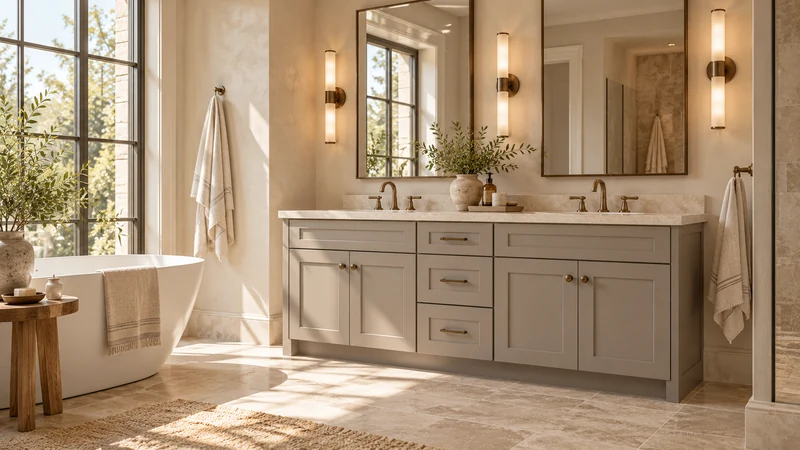
Keeping a familiar vanity top can preserve a look the household likes and avoid changing fixtures unnecessarily. But a top that works on the current cabinet is not automatically transferable to another one. Its existing cutouts and basin positions are fixed, its support may depend on the old furniture, and removal can reveal conditions that were hidden. Evaluate reuse before making the new cabinet depend on an unverified retained piece.
Identify what you are actually retaining
Record the top's overall outline, front and side projections, basin positions, faucet holes and backsplash arrangement. Note seams, joints and any attached side pieces. Separate the top itself from the basin, faucet, drain and splash components; retaining one does not establish that every adjoining part can remain. If product identification or old drawings exist, keep them with the current photographs.
Photograph visible chips, cracks, stains or previous repairs without deciding from the photograph alone whether they affect reuse. Look below where accessible to understand the existing support and connections. Mark concealed areas as unknown. The purpose is to give the appropriate installer or fabricator a useful record, not to certify a retained top from its good appearance above the cabinet.
Design study This design study shows the top perimeter, basin positions and cabinet below as a combined arrangement. It is not evidence that a real existing top can be removed or reused.
Discuss removal before promising reuse
Ask the responsible trades to review how the top and its attached components would be separated from the old cabinet and surrounding finishes. Distinguish a preliminary opinion from a guarantee of intact removal. Existing attachment, hidden damage and access can affect what happens once work begins. Agree on the handling and temporary storage plan appropriate to the actual piece.
Keep a fallback decision in the project scope if the top cannot be retained in usable condition. That does not require buying a replacement in advance, but the household should know whether cabinet selection would need to change and which decisions would reopen. A reuse plan is more practical when the consequence of losing the old top is understood before the room is dismantled.
Match fixed geometry to the new interior
Place the retained top's actual basin and hole positions over the candidate cabinet drawing. Check the bowl underside, drain, faucet connections, rails, partitions and drawers together. A different cabinet with similar outside dimensions may place structure directly below the old basin. Reusing the top means accepting its geometry unless an appropriate professional confirms a specific alteration is feasible.
Review the supporting relationship separately from the perimeter fit. The new cabinet must support the retained assembly as required for that piece, not simply hide underneath its outer edge. Ask the responsible professionals to confirm the arrangement. Do not assume old support points can disappear because the top looks stiff, or that a new rail can be removed because it conflicts with the basin.
Follow a replacement decision through
Imagine a hypothetical top that remains attractive and appears to cover a proposed cabinet. Its existing basin sits over a door bay in the old vanity, but the replacement puts a drawer partition in that same location. The reuse choice now constrains cabinet selection. A compatible interior may preserve the top, while keeping the favored drawer arrangement may require reconsidering the top-and-basin selection.
Compare those outcomes by the household's priorities. If the existing top is the feature worth preserving, choose furniture that genuinely works with it. If the purpose of the renovation is a particular storage improvement, retaining the top at the cost of that function may defeat the project. Do not count reuse as a success merely because the pieces can be made to occupy the same area.
Close the remaining uncertainties before ordering
Check the retained perimeter against the planned cabinet position and the surrounding room. A different depth, side placement or wall finish can change the visible overhang and backsplash relationship. Confirm which fixtures can be reused and what connection work remains, even if their holes stay in place. A fixed hole pattern is useful information, not confirmation of fixture condition or compatibility.
Keep the condition review, removal assumptions, support plan and candidate cabinet together in the decision record. Identify which findings can be confirmed before dismantling and which require inspection afterward. Make the final cabinet commitment with those dependencies understood. Reuse is a sound selection when the retained assembly is suitable and the new interior serves the intended routine, with a realistic plan for the uncertainties.
Pure White
Cream White
Light Warm Gray
Gray
Navy
Black
Oak Tone
Dark Walnut Tone
Design study These finish studies are design references, not a list of currently orderable colors. Screens and lighting change the appearance; compare a physical sample before choosing.See all finish options →
Match the fixed bowl position, underside shape and required support to the actual cabinet, rather than treating similar overall widths as compatibility.
The sample shows the door frame, a separate center panel, the face frame and the cabinet box. Each component has its own place in this Shaker construction.
Shaker construction: door frame, center panel, face frame and cabinet box. The cutaway helps locate these parts; confirm each material in the specifications for the selected cabinet.
01 / Door frame
The Shaker door has rails and stiles around a separate center panel. The frame and center panel are different components; confirm their materials in the specifications for the selected cabinet.
02 / Face frame
The face frame surrounds the opening at the front of the cabinet box and sits behind the doors. The face frame, door frame and cabinet box are separate parts.
03 / Cabinet box
The sample exposes the cabinet sides, interior surfaces and layered edges. The image does not establish the wood species or material specification of a selected cabinet.