How do you match an integrated basin top with a vanity cabinet?
Match the fixed bowl position, underside shape and required support to the actual cabinet, rather than treating similar overall widths as compatibility.
An integrated basin top combines the washing bowl and surrounding top in a predetermined arrangement. That can simplify selection when the complete combination is supported, but it also fixes relationships that might otherwise be chosen separately. The cabinet must accommodate the underside, support the top as specified and leave room for connections and drawers. A matching width label answers only a small part of that review.
Identify exactly what is being paired
Obtain the integrated top's model identification, dimensional drawing and installation information, along with the cabinet's precise size and interior configuration. Check whether the manufacturer names a compatible cabinet or collection. If there is a documented pairing, confirm that it covers the selected variant rather than assuming every cabinet in the family shares the same interior or support arrangement.
If the parts come from different suppliers, make the combination explicit in the inquiry. One supplier confirming its own nominal width does not establish that both pieces work together. Ask for review of the actual assembly, including who will confirm the support relationship and underside clearance. Keep the top procurement separate from the cabinet scope unless the actual proposal includes both.
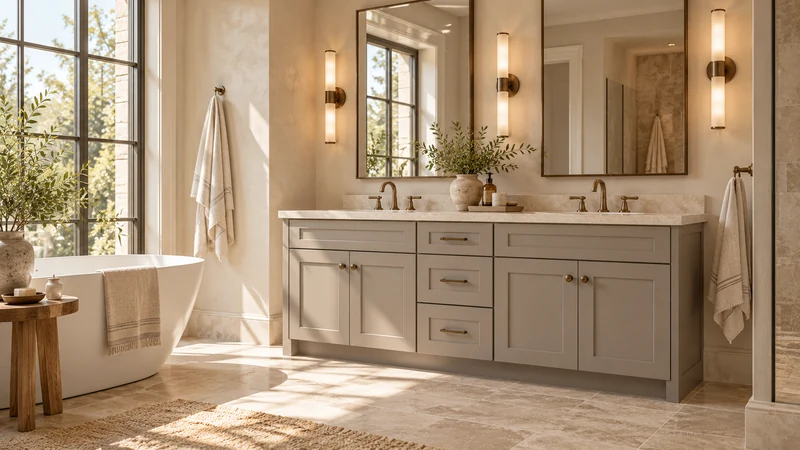
Design study The top perimeter and cabinet fronts can be compared visually, but the underside remains hidden. This design study cannot identify an integrated-top product or establish support compatibility.
Read the underside and the support together
Compare the top's outer perimeter with the cabinet's top edges, rails and other specified supporting areas. Then place the molded or formed bowl underside over the interior. A shape that fits inside the overall cabinet outline can still meet a rail or partition. Do not remove that structure from the comparison merely because it is not visible after installation.
The top may also have an underside edge, return or other feature that affects how it sits. Use the selected product information to identify it rather than assuming the entire underside is a flat slab. Ask the responsible supplier or installer to confirm the contact and support arrangement. A good-looking overhang does not demonstrate that the load is supported in the intended places.
Accept the bowl position as a product constraint
With an integrated top, the bowl's relationship to the perimeter is part of the selected piece. Check that fixed location against the cabinet's door bay, drawer bank and retained plumbing. Do not assume the installer can move the bowl slightly while preserving the same top. If a different position is needed, that may require a different product or a revised cabinet arrangement.
Check the selected faucet-hole arrangement and drain compatibility as part of the same review. These features can constrain the fixture choices even when the overall top fits the furniture. Identify the actual holes and connection details from the product documentation. Do not turn a top selection into an unplanned assumption that existing faucet and drain components will automatically transfer.
Work through a misleading width match
Imagine a hypothetical cabinet and integrated top whose advertised widths appear to belong together. The perimeter looks reasonable in plan, but the fixed bowl underside intersects the cabinet's upper rail. Moving the top sideways would spoil the end relationship and would not create the support arrangement the product needs. Matching labels have therefore not produced a compatible pair.
Compare a documented cabinet match, another integrated top whose underside suits the cabinet, or a separately coordinated basin-and-top approach. Those alternatives have different selection work and may change the layout. Do not accept cutting the rail, shifting the top or adding improvised support as the default solution. The conflict should be resolved in the product pairing before the cabinet is ordered.
Check the room after the pairing works
Once the components are compatible, review their combined outside dimensions against the walls, door trim and adjacent fixtures. The top perimeter may project beyond the cabinet, while a rear or side detail may affect how it meets the room. Confirm those conditions without assuming that the cabinet's nominal footprint describes the whole assembly.
Keep the final cabinet designation, integrated-top designation, support review, fixture choices and room fit in the same selection record. Recheck after a substitution, even when the replacement carries the same width description. A dependable match is a specific combination with its fixed relationships resolved; it is not a general promise that any top and cabinet with similar labels can be joined.
Pure White
Cream White
Light Warm Gray
Gray
Navy
Black
Oak Tone
Dark Walnut Tone
Design study These finish studies are design references, not a list of currently orderable colors. Screens and lighting change the appearance; compare a physical sample before choosing.See all finish options →
Compare the basin's exterior underside, mounting arrangement and drain with the full drawer envelope before treating the visible bowl size as a fit check.
The sample shows the door frame, a separate center panel, the face frame and the cabinet box. Each component has its own place in this Shaker construction.
Shaker construction: door frame, center panel, face frame and cabinet box. The cutaway helps locate these parts; confirm each material in the specifications for the selected cabinet.
01 / Door frame
The Shaker door has rails and stiles around a separate center panel. The frame and center panel are different components; confirm their materials in the specifications for the selected cabinet.
02 / Face frame
The face frame surrounds the opening at the front of the cabinet box and sits behind the doors. The face frame, door frame and cabinet box are separate parts.
03 / Cabinet box
The sample exposes the cabinet sides, interior surfaces and layered edges. The image does not establish the wood species or material specification of a selected cabinet.