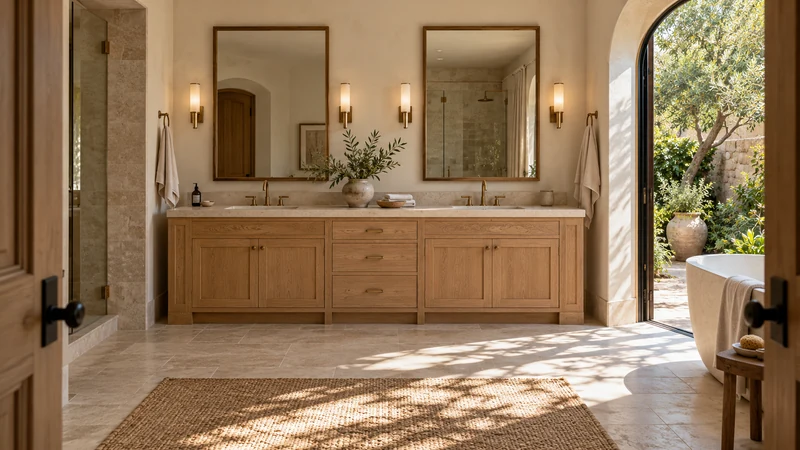
Keeping an existing basin while changing the surrounding vanity is a different decision from keeping the entire old top. A separately retained basin needs a compatible new opening, support and connection arrangement. Its visible size alone does not supply those details. Start by establishing what the basin is and how it was intended to be mounted, then decide whether the available evidence is sufficient to design the new assembly around it.
Identify the basin before describing the opening
Look for a manufacturer name, model mark, label or retained purchase record. Photograph any identification that can be reached safely, along with the visible rim and underside. Record the current installation type and distinguish it from the type the new project proposes. Do not assume a basin designed for one mounting arrangement can be reused in another merely because the shape looks suitable.
If the model is uncertain, label it unidentified rather than choosing the closest catalog picture. Visually similar basins can differ in their outer rim, drain location or mounting details. Give the existing item a clear project identifier so photographs, measurements and later removal records refer to the same physical piece. That prevents a similar replacement from accidentally becoming the basis of the new drawing.
Design study A basin is part of a larger top-and-cabinet arrangement. This design study illustrates that relationship but cannot identify or assess a homeowner’s retained basin.
Obtain the right information for the new top
Seek the manufacturer's applicable installation information and cutout template for the identified model. Distinguish the exterior basin outline from the opening the top requires. Neither a measurement across the visible bowl nor a tracing of the old top opening automatically establishes the correct new cutout. The cited Kohler guide requests the basin model when ordering the associated top.
If documentation is unavailable, ask the responsible fabricator whether the actual basin can be evaluated and used to establish an acceptable plan. That is a professional review of the physical item, not an invitation to invent a template from a photograph. Clarify whether the basin must be available before the top is finalized and how that requirement affects the renovation sequence.
Inspect what removal may change
Have the appropriate trades assess the basin's condition and how it would be separated from the old assembly. A rim hidden below the top may not be fully inspectable beforehand. Keep that uncertainty explicit until the piece can be examined. Do not promise reuse solely because the visible washing surface is undamaged, and do not assume intact removal has been guaranteed by a preliminary discussion.
Agree on identification, handling and storage after removal. Keep applicable hardware and product records associated with the basin while the professionals determine what can be reused or must be replaced. A loose basin without its identity and review notes can be difficult to incorporate accurately into a new top order, even if the piece itself remains in good condition.
Make a decision when the identity is missing
Imagine a hypothetical basin that the owner likes, but whose model cannot be established. A visually similar online template appears plausible, yet its mounting details are unconfirmed. The practical choices are to arrange a physical review before finalizing the new top or to select a documented replacement basin. Using the approximate template would turn an unresolved identity problem into a fabrication commitment.
Compare the value of keeping the existing item with the time and coordination that verification requires. If the basin is a defining feature, that work may be worthwhile. If it is ordinary and the new layout benefits from another shape, a documented replacement may simplify the project. Neither choice should rest on the unsupported assumption that similar-looking bowls are interchangeable.
Check the new cabinet around the retained basin
Once the basin and mounting plan are understood, place its underside, drain and required support into the selected cabinet drawing. Confirm the relationship with rails, partitions, drawers and service access. Review the chosen faucet and drain with the responsible suppliers; retaining the bowl does not establish that every old connection component remains appropriate for the new arrangement.
Finish with the basin identifier, verified documentation or physical-review result, condition findings and coordinated cabinet-and-top selection. State which matters still depend on removal. Commit to the new assembly only with those dependencies understood. A retained basin can be a useful part of the renovation when its identity and fit are established, rather than assumed from its familiar appearance.
Pure White
Cream White
Light Warm Gray
Gray
Navy
Black
Oak Tone
Dark Walnut Tone
Design study These finish studies are design references, not a list of currently orderable colors. Screens and lighting change the appearance; compare a physical sample before choosing.See all finish options →
Match the fixed bowl position, underside shape and required support to the actual cabinet, rather than treating similar overall widths as compatibility.
The sample shows the door frame, a separate center panel, the face frame and the cabinet box. Each component has its own place in this Shaker construction.
Shaker construction: door frame, center panel, face frame and cabinet box. The cutaway helps locate these parts; confirm each material in the specifications for the selected cabinet.
01 / Door frame
The Shaker door has rails and stiles around a separate center panel. The frame and center panel are different components; confirm their materials in the specifications for the selected cabinet.
02 / Face frame
The face frame surrounds the opening at the front of the cabinet box and sits behind the doors. The face frame, door frame and cabinet box are separate parts.
03 / Cabinet box
The sample exposes the cabinet sides, interior surfaces and layered edges. The image does not establish the wood species or material specification of a selected cabinet.