Will a replacement recessed mirror cabinet fit the old opening?
Compare the required wall opening, the outer face that hides old marks, and the available recess depth separately. A wide remodeling flange can conceal an edge without making an unsuitable opening usable.
Choose a replacement recessed mirror cabinet only after the required opening and the visible coverage both work. A larger mirror face may hide the old paint line while its cabinet body still needs a larger hole. The reverse can happen too: a body fits the recess, but the new face exposes damaged tile around it. Treat these as separate acceptance checks above the selected vanity.
Use the dimension that names the wall opening
Robern's R³ specification separates the required roughing-in opening from the product's outside dimensions and shows a remodeling flange intended to hide gaps or paint lines. That distinction is useful beyond this particular model. The width shown in a shopping title is not automatically the width to compare with an existing wall recess.
Obtain the selected model's required opening, body projection and installed face size. A rough-opening requirement can already include the manufacturer's installation allowance; do not replace it with a subtraction based on the outer mirror. Also distinguish a visible tile opening from the usable framed opening behind it. A tile edge does not establish support or hidden depth.
Reject a face that hides an incompatible box
In a hypothetical survey, the usable existing opening is 18 inches wide, 30 inches high and 4 inches deep. Candidate A has a 20-by-32-inch face, but its instructions call for a 19-by-31-by-4-inch opening. Although its face would cover the old hole, the opening is 1 inch too small in width and height for that specification. These are illustrative cabinet dimensions, not those of the cited Robern model.
The owner wants to retain the surrounding tile and has excluded enlargement work. Candidate A is therefore removed from the shortlist. Calling its flange a remodeling feature does not overcome the dimension conflict. Nor should an installer be expected to trim the cabinet to make the purchase fit.
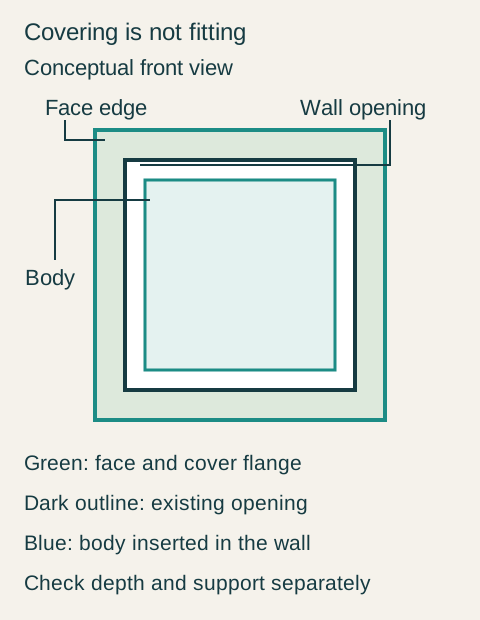
Teaching example Conceptual front view showing three distinct boundaries: green is the replacement face/flange, the dark rectangle is the wall opening, and the inner blue area represents the cabinet body. A face can cover the opening without proving that the cabinet fits into it. The drawing is not to scale and does not establish a mounting detail.
A second candidate solves a different part of the problem
For this hypothetical comparison, Candidate B also has a 20-by-32-inch face, but its documented opening requirement is 18 by 30 by 4 inches. The existing recess matches those stated requirements. The old finish marks occupy a centered 19-by-31-inch rectangle, so the face extends 0.5 inch beyond those marks on every side. That is a coverage calculation, not a recommended overlap or mounting allowance.
A centered overlay matters. The same overall size can leave a mark exposed if the recess and old face were offset. Place the surveyed edge and the proposed face in the same elevation, using the basin and a fixed wall reference. Check corners and any irregular scar individually instead of assuming a rectangular paint outline describes every damaged area.
Keep the fit result separate from mounting and daily use
In the hypothetical selection, the wall review confirms the required usable depth and a suitable support arrangement for Candidate B. Its actual door movement clears the chosen faucet, and the users can see themselves from the washing position. The shelves also accept their daily kit without relying on space behind the hinge. These checks preserve the purpose of the mirror cabinet rather than letting a convenient wall fit determine everything.
The owner chooses Candidate B and retains the tile because the required opening, face coverage and working position all agree. Candidate A offered a similar visible size but required excluded wall work. The supplier receives the exact selected model and the surveyed opening, while the wall and mounting findings remain part of the installation scope.
Before ordering, compare the current drawing revision with the selected variant. Surface-mounted alternatives can require different side pieces and project farther over the basin; they should be assessed as another assembly. A flange is useful when its coverage solves the actual finish problem and the cabinet behind it already meets the wall requirements.
Pure White
Cream White
Light Warm Gray
Gray
Navy
Black
Oak Tone
Dark Walnut Tone
Design study These finish studies are design references, not a list of currently orderable colors. Screens and lighting change the appearance; compare a physical sample before choosing.See all finish options →
Review the old mirror's wall footprint, mounting or recess, storage and lighting relationships before selecting the new mirror with the vanity. The visible glass is only part of the existing arrangement, and removing it can create work that cabinet measurements alone do not reveal.
Map the tile boundaries, openings and attachment conditions, then compare the complete replacement assembly in that same wall position. Keeping the tile is a project constraint that needs coordinated review, not a result guaranteed by matching the old cabinet's width.
The sample shows the door frame, a separate center panel, the face frame and the cabinet box. Each component has its own place in this Shaker construction.
Shaker construction: door frame, center panel, face frame and cabinet box. The cutaway helps locate these parts; confirm each material in the specifications for the selected cabinet.
01 / Door frame
The Shaker door has rails and stiles around a separate center panel. The frame and center panel are different components; confirm their materials in the specifications for the selected cabinet.
02 / Face frame
The face frame surrounds the opening at the front of the cabinet box and sits behind the doors. The face frame, door frame and cabinet box are separate parts.
03 / Cabinet box
The sample exposes the cabinet sides, interior surfaces and layered edges. The image does not establish the wood species or material specification of a selected cabinet.