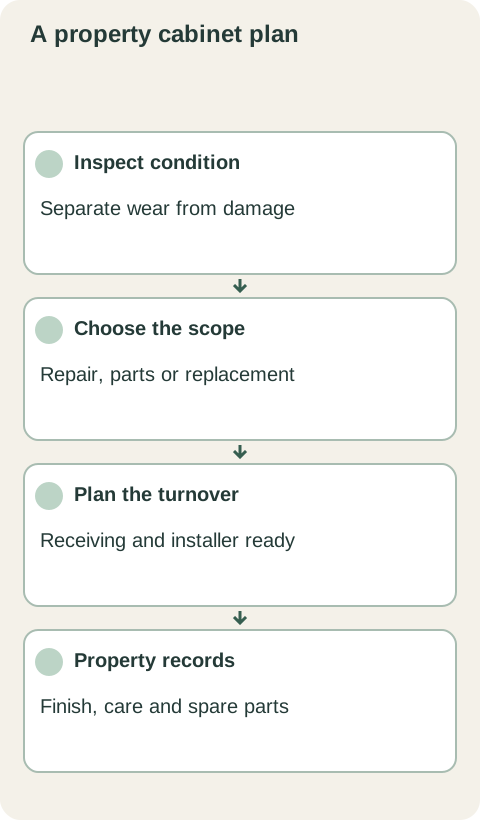
A rental turnover or a home prepared for resale needs a cabinet decision that fits the condition of the room. Start with an inspection rather than a color trend. The useful question is what work will leave the kitchen usable, coherent and maintainable within the project’s actual budget. New cabinets cannot by themselves establish a resale gain or a faster rental.
Sort cosmetic wear from a failing cabinet
Empty the cabinets and inspect boxes, backs, bottoms and attachment points. Record water damage, loose joints, swollen surfaces and doors that rub. A misaligned door does not automatically mean the box needs replacing; a fresh finish does not repair a damaged structure. Have uncertain damage evaluated by the appropriate installer or repair professional. KraftMaid’s project-scope guide distinguishes replacement work from a wider renovation. Use that boundary to avoid starting a cosmetic refresh that quietly becomes a different project.
A small project may involve adjustment, approved touch-up or replacement of an identified part. Before retaining a box, determine whether the required part is available and compatible. For full replacement, inspect the incoming order before making the installation depend on it; KraftMaid’s delivery guide supports that sequence. Keep the existing kitchen operational where the project permits while unresolved items are checked. Do not promise a turnover deadline based on an unconfirmed delivery estimate or assume new fronts will fit old hinge locations.
Diagram Choose the intervention after checking condition, then preserve the product identity.
Choose repeatable specifications for maintenance
For a property you will manage, record product line, door style, finish, hardware and spare parts. KraftMaid’s FAQ illustrates how original order information helps identify its own replacement items; another supplier needs its own identification process. Prefer a clear maintenance file over a vague claim that a neutral color will always be available. Compare cleaning instructions, replaceable components and accessible adjustment points. A currently available finish may later change, so keep a labeled sample and request compatibility information for future reorders.
Write the actual use problems: drawers that cannot hold needed utensils, missing storage near the sink or a door blocking an appliance. Then price alternatives that address those problems. A large layout change may require work beyond cabinets; separate that scope before choosing. For resale, make condition and product descriptions accurate and retain documentation of the work. Avoid assigning a universal return on investment or promising that a particular finish will raise the sale price.
Plan access, receiving and downtime
Coordinate who may enter the property, where the cabinets can be protected and when installation can begin. For an occupied home, discuss a workable temporary routine with the project team. A rental turnover needs the same clear receiving responsibilities as any other job. Do not let an empty unit become a wet or unsecured storage area. Link cabinet arrival, inspection and installer readiness in the plan, with unresolved dates marked as estimates until confirmed.
Leave a practical property handoff
At completion, walk through door and drawer operation with the installer and record unresolved defects separately from maintenance instructions. Keep the cabinet schedule, finish identification, care instructions, spare hardware and original purchase record. If a property manager takes over, identify the route for requesting parts and where the labeled sample is stored. For resale, leave a concise description of what was replaced and what remained. This helps the next person maintain the room without guessing from the listing photographs.
Write the maintenance outcome into the scope
Tell the installer which cabinets will remain and which parts will be changed, and mark those boundaries on the drawing. At handoff, make sure the owner knows how to clean the selected surfaces and identify any retained hardware. If a finish has been touched up, record the product used and the location rather than describing the whole kitchen as newly replaced. Keep before-and-after condition photos for the property record. They help the next manager distinguish an old condition from a new issue without inventing a promised service life or financial return.
Before you release the order
Inspect structure and moisture damage before choosing cosmetic work.
Compare repair, selective replacement and a full cabinet order.
Keep timing dependent on confirmed supply and site readiness.
Leave product and maintenance records with the property.
Finish references
Pure White
Cream White
Light Warm Gray
Gray
Navy
Black
Oak Tone
Dark Walnut Tone
Design study These finish studies are design references, not a list of currently orderable colors. Screens and lighting change the appearance; compare a physical sample before choosing.See all finish options →
Choose the service that covers the decisions your remodel actually needs. Compare product choices, room coordination, drawings and compensation before paying for overlapping work.
A microwave on a table is not a complete meal arrangement. Decide what you will prepare, where the supplies will live and how cleanup works before the old kitchen is removed.
A smaller first order is useful only if it leaves a finished, usable kitchen and does not force expensive work to be repeated. Separate genuinely independent additions from connected cabinet and countertop work.
The sample shows the door frame, a separate center panel, the face frame and the cabinet box. Each component has its own place in this Shaker construction.
Shaker construction: door frame, center panel, face frame and cabinet box. The cutaway helps locate these parts; confirm each material in the specifications for the selected cabinet.
01 / Door frame
The Shaker door has rails and stiles around a separate center panel. The frame and center panel are different components; confirm their materials in the specifications for the selected cabinet.
02 / Face frame
The face frame surrounds the opening at the front of the cabinet box and sits behind the doors. The face frame, door frame and cabinet box are separate parts.
03 / Cabinet box
The sample exposes the cabinet sides, interior surfaces and layered edges. The image does not establish the wood species or material specification of a selected cabinet.