Independent kitchen designer or cabinet dealer design service: which should you hire?
Choose the service that covers the decisions your remodel actually needs. Compare product choices, room coordination, drawings and compensation before paying for overlapping work.
Use a cabinet dealer's design service when the proposed service, product range and coordination cover your project well. Hire an independent kitchen designer when you need a separate design engagement, a broader selection process or room decisions that the particular dealer proposal does not include. Neither business model proves design quality. The useful comparison is between identified people, written scopes and the kitchen you are trying to complete.
Start with what is unresolved. A cabinet replacement in an accepted layout may need skilled storage planning and product selection. A larger remodel may still need a decision about the room arrangement, lighting, appliance placement and how finishes relate to adjoining rooms. Those projects do not need identical services. Buying a more elaborate engagement than the project needs can waste money; buying only a cabinet drawing when the room still needs design can leave expensive decisions without an owner.
A room designer and a cabinet specialist can overlap
NKBA's definition of the kitchen and bath design specialty includes planning and selections, documentation and coordination with allied professionals. That is a description of the profession, not a promise that every consultation includes every activity. Read the actual proposal to learn which parts a particular designer will provide.
A dealer-based designer may have deep knowledge of the cabinet line, its options and its ordering process. An independent designer may coordinate a wider room scope or work with a supplier selected later. Those are possible strengths, not automatic dividing lines. Some dealers offer extensive room design; some independent engagements are limited to a layout consultation. Ask about the specific service instead of classifying it by the sign outside the office.
Also separate design from the work of other project professionals. If the remodel includes changes outside the designer's agreed scope, identify who handles them. A persuasive rendering does not appoint a contractor, establish structural feasibility or confirm installation. The purpose of selecting the designer is to organize the design work, not to pretend that one title covers every task in the renovation.
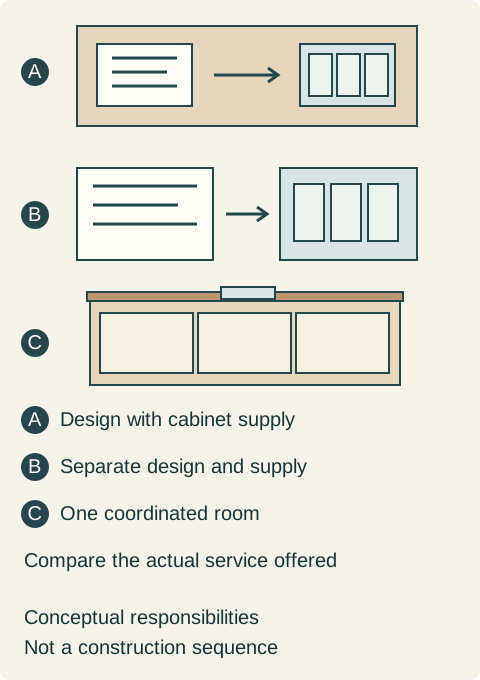
Teaching example Conceptual service comparison. A connects design and cabinet supply within one selected service. B separates room design from the eventual cabinet supplier. C represents the same finished kitchen both arrangements must deliver. The boxes indicate responsibilities, not company rankings or a required construction sequence.
Decide how open the product choice needs to remain
If you already prefer a cabinet line that meets the project, a designer who works closely with that line may be the efficient choice. Ask to see how the proposal handles storage, finished ends and the details you care about. A known product range is not a disadvantage when it contains a good solution and its limits are understood.
If you are still comparing substantially different cabinet systems or coordinating several rooms, ask whether the designer can evaluate those alternatives within the engagement. Do not assume independent means access to every brand or absence of product sales. Find out which suppliers the designer works with, how substitutions are evaluated and who will prepare the final order from the accepted design.
Keep the comparison practical. A broader catalog is valuable only when it changes a decision that matters. If all suitable candidates produce an acceptable kitchen, endless additional product searches can delay the choice without improving it. Conversely, a design should not hide a significant functional compromise just because the first supplier cannot provide the preferred arrangement.
Compare compensation and useful deliverables together
Request the design charge, purchasing arrangement and included revisions in writing. Ask whether a charge is separate, credited against an order or part of a larger proposal, and what conditions apply. A free introductory conversation is not necessarily a complete design service. This guide does not assume a standard fee or that either arrangement is always less expensive.
Find out what drawings you receive, at what stage, and whether the agreed terms let you use them with another supplier. Clarify that before paying for design on the assumption that the files can be shopped freely. Ownership and permitted use should come from the actual agreement; a consumer should not have to discover the restriction after choosing a different cabinet source.
Compare total project coverage rather than only the visible design fee. If a lower-fee proposal omits the lighting and finish coordination you need, identify how that work will be supplied. If a second designer duplicates work already included in the cabinet package, narrow the roles or choose one lead. Paying twice for overlapping drawings does not create twice the coordination.
Ask candidates to explain a relevant completed project
Look for an explanation of a kitchen with constraints like yours, not only an attractive portfolio photograph. Ask what changed from the first idea, which compromise was accepted and how the cabinets, appliances and room finishes were coordinated. A designer who can explain the reasoning gives you more useful evidence than a collection of finishes unrelated to your project.
KraftMaid's preparation guidance asks homeowners to bring ideas, describe how they use the kitchen, consider what is changing, provide photographs and rough measurements, and discuss budget and timing. Those inputs can make your interviews comparable. Give candidates the same starting information rather than rewarding whichever person happened to receive the clearest brief.
Use a small, concrete question from your project to understand the proposed working relationship. For example, ask how a retained refrigerator would affect the design and who checks the final installation information. You are learning how decisions get resolved, not requesting an unpaid complete design from every candidate. Discuss response process, review meetings and who becomes the contact when the preferred person is unavailable.
The cabinet proposal is suitable; the unresolved room needs a separate lead
Imagine a household replacing kitchen cabinets while rethinking the connection to its dining area. The dealer's proposal includes cabinet layout, selections and ordering. The owners like the line and want to keep it. However, lighting locations, the dining-side finish arrangement and the relationship between the kitchen and existing furniture are outside that particular proposal.
The owners compare extending the dealer's scope with a separate room-design engagement. In this hypothetical case the dealer does not offer the additional work, so they hire an independent designer for those room decisions. They do not commission a second unrelated cabinet order. The designer and dealer agree on a shared room layout, then the dealer develops the selected cabinet line within it.
The accepted arrangement names who issues the room design, who translates it into cabinet details, who verifies field conditions and who approves changes. The owner receives one coordinated current proposal rather than two competing plans. The extra engagement is purchased because it closes specific missing work, not because the owners assume independent designers are inherently better.
For a household retaining an accepted room arrangement, the same dealer service might be enough. That buyer could spend the additional design budget elsewhere without accepting a lesser kitchen. The decision changes with the work still needed, not with a universal preference for one business model.
Finish with a clear lead and a usable order
Before engaging the service, agree on the scope, product-selection limits, compensation, deliverables and responsibility for coordinating the other contributors. Name the person who resolves a conflict between a room drawing and a cabinet detail. A collection of qualified people still needs a clear way to reach one accepted design.
Then carry that agreement through purchasing. The cabinet schedule should follow the accepted design, and changes should return to the responsible person before ordering. Manufacturer examples in this guide do not establish services or brand relationships offered by USA KITCHENS & TOPS. Choose the actual arrangement that gets your room designed and your cabinet purchase resolved without leaving gaps or buying duplicate work.
Pure White
Cream White
Light Warm Gray
Gray
Navy
Black
Oak Tone
Dark Walnut Tone
Design study These finish studies are design references, not a list of currently orderable colors. Screens and lighting change the appearance; compare a physical sample before choosing.See all finish options →
Translate the design into identifiable products, details and responsibilities. A useful handoff lets another professional price and build the intended arrangement without reconstructing private conversations.
The sample shows the door frame, a separate center panel, the face frame and the cabinet box. Each component has its own place in this Shaker construction.
Shaker construction: door frame, center panel, face frame and cabinet box. The cutaway helps locate these parts; confirm each material in the specifications for the selected cabinet.
01 / Door frame
The Shaker door has rails and stiles around a separate center panel. The frame and center panel are different components; confirm their materials in the specifications for the selected cabinet.
02 / Face frame
The face frame surrounds the opening at the front of the cabinet box and sits behind the doors. The face frame, door frame and cabinet box are separate parts.
03 / Cabinet box
The sample exposes the cabinet sides, interior surfaces and layered edges. The image does not establish the wood species or material specification of a selected cabinet.