A removable-divider range or fixed double ovens: which flexibility will you use?
Samsung Flex Duo illustrates a cavity that can change between full and divided use. Compare that with fixed upper and lower ovens by the cookware, door access and changeover routine you actually need.
Choose a removable-divider range when changing between divided cooking and a full cavity solves a recurring need, and you accept the actual door behavior and changeover work. Choose fixed double ovens when their separate interiors already fit the important dishes and you value a configuration that stays ready without moving a divider. Both can provide separate cooking spaces, but they do not offer the same physical flexibility.
Start with a distinction that a total-capacity figure cannot express. Divided cooking gives each intended group its own permitted space and settings. Full-cavity use makes a different interior available after the supported changeover. Those are alternative states of the convertible appliance. It does not simultaneously provide a full-height cavity and retain the separate compartment occupying part of that same space.
What the removable divider changes
Samsung's cited Flex Duo product example describes using the full oven or dividing it into smaller compartments for different temperatures. This illustrates a changeable cavity arrangement; it does not promise that every vessel or pair of settings is supported.
Check the intended cookware in both states. A shallow baking tray may fit the upper compartment, while a tall covered vessel may require the full interior. Include handles, lid and the actual permitted rack position. Do not compare an empty advertised volume with a dish whose usable shape has never been tested.
For divided use, identify the modes and settings that the exact model permits together. Different temperatures is not an invitation to choose any combination by guesswork. The manufacturer's instructions must support the actual pair of tasks. If they do not, the attractive divided picture is not the arrangement the household needs.
For full-cavity use, check what changes besides removing the divider: the supported rack arrangement, available modes and the parts that must be put away. Follow the product's changeover instructions between uses. The purchase should not rely on rearranging hot components midway through a meal or treating a configuration change as instantaneous.
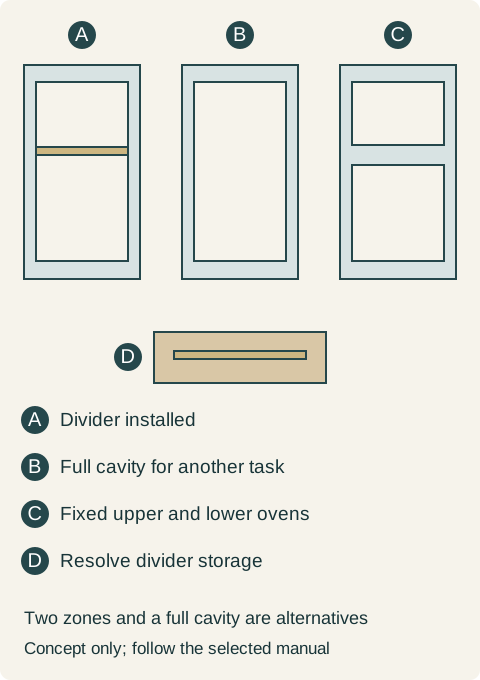
Teaching example Conceptual cavity comparison. A shows a removable divider installed; B shows a full cavity after the permitted changeover. C shows fixed upper and lower ovens as a different arrangement; D is a separate storage position to be resolved for a removed divider. These are alternative states and purchases, not ovens operating together. No door mechanism, removal procedure, heating elements, dimensions or approved cookware clearances are specified.
Divided space and independently opening doors are different features
Samsung distinguishes Flex Duo from its model-dependent hinged Dual Door: equipped models permit upper-only or whole-door access. Confirm the actual door configuration rather than inferring it from divided cooking.
Rehearse the ordinary access sequence on the intended model. If the lower dish needs attention while something remains above, observe which door movement is required and where the user stands. Assess physical access with cool, empty cookware; that trial does not measure heat loss or guarantee a cooking result. A buyer can accept the full-door action, but it should be a conscious part of the choice.
Also compare the grip and controls during that trial. State which dish you want to reach and let the intended user carry out the appropriate motion. A photograph with everything already open can leave out the operating sequence the owner needs to understand.
Fixed double ovens have their own limits and advantages
The cited GE double-oven manual identifies upper and lower oven controls and documents separate upper and lower doors. It represents a fixed double-oven arrangement, rather than a full cavity created by removing a cooking divider.
Compare each interior separately. Adding their capacities does not show whether the household's tall covered pot fits either one. If a vessel is unsuitable for both, it cannot be assigned to their combined volume on a kitchen plan. A different vessel may be acceptable, but replacing it or changing the batch belongs in the purchase decision.
Fixed separation can be useful when the same division of tasks repeats often. There is no routine conversion to perform simply to restore that arrangement. However, it remains necessary to check which modes each oven supports; identical-looking handles do not establish identical capabilities. Nor does the presence of a second oven guarantee that its working position is comfortable for the intended user.
Test reaching into each cavity and transferring the relevant dish to the actual landing surface. In a range, the oven locations belong to the appliance; they cannot be independently raised within the cabinets like freely placed boxes. If the lower working position is unsuitable, more nominal capacity does not fix it. Compare another complete appliance arrangement rather than inventing an installation height.
Give the removed component a real home
A convertible appliance needs somewhere for the divider when it is not in use. First establish whether the selected model provides an intended storage location and what that location can accept. Do not assume an appliance drawer is available for pans if its assigned job is already to hold a required component.
If the kitchen supplies the storage, test the clean, cool divider's actual shape and handling. It should be retrievable for the next changeover without emptying unrelated cookware onto the counter. Keep its storage separate from the temporary landing used for hot ovenware. A spare drawing rectangle is not a resolved home unless the component fits and can be taken out.
Review any other racks or accessories moved between configurations at the same time. The benefit of changing the cavity should survive the ordinary work of storing and retrieving its parts. Someone who rarely changes modes may find this easy; someone who wants to switch arrangements repeatedly within a busy cooking session may prefer a fixed configuration.
A tall covered pot changes this household's choice
Imagine owners replacing a range while keeping the general cabinet arrangement. Their weekday oven work uses shallow dishes that suit the supported divided configuration. They also regularly use a tall covered pot that they want to keep. It fits the tested full-cavity candidate in its permitted arrangement but not either interior of the fixed double-oven candidate they are comparing.
They first consider replacing the pot or dividing its task into different vessels. They prefer to keep the existing vessel and method. Its use occurs on a separate cooking occasion, so restoring the full cavity does not compete with a simultaneous divided-oven task. This timing matters: the purchase would not solve a meal requiring both arrangements at once.
The owners choose the removable-divider range after checking the model's permitted weekday settings and door motions. They accept opening the whole door for lower-compartment access on the selected Dual Door version. They also assign the clean, cool divider to a tested nearby cabinet position, moving the occasional serving trays previously there to an existing suitable shelf.
The completed order retains the adjacent working counter and includes the selected range's installation requirements. The household accepts the between-use changeover and the storage tradeoff in return for preserving both its regular shallow-dish arrangement and its tall-pot occasion. It does not buy a promise of faster cooking, lower energy use or identical results between the configurations.
Keep the comparison about complete appliances
The oven arrangement is important, but the cooking surface, controls, care and installation still belong to the purchase. Do not accept an unsuitable surface layout simply because the oven converts. Compare the equipment needed for both proposals, including any cookware replacement and storage alterations that make each viable.
Product examples explain the construction choices; they do not establish local inventory or a USA KITCHENS & TOPS sales offering. The exact version matters, especially when a family name includes different door designs. Verify the offered model before approving its cabinet relationship.
A fixed double oven can be the more useful purchase when both interiors fit and the household wants their separate access every day. A removable divider earns its place when the full-cavity state is genuinely needed and the changeover works. The decision turns on usable configurations, not the number of ovens a feature label appears to promise.
Pure White
Cream White
Light Warm Gray
Gray
Navy
Black
Oak Tone
Dark Walnut Tone
Design study These finish studies are design references, not a list of currently orderable colors. Screens and lighting change the appearance; compare a physical sample before choosing.See all finish options →
Count independently usable cooking cavities before counting modes. A single cavity can simplify the cabinet layout, but it cannot accept an unrelated microwave task while occupied by a baking task that must continue.
A vertically arranged oven pair needs a task assignment and user trial for both cavities. Lowering the assembly changes both positions; seeing the upper controls does not prove upper-rack access.
A range combines surface cooking and baking in one appliance. Separates let you choose those components and their supported positions independently, but the cabinet and installation package must earn that flexibility.
The sample shows the door frame, a separate center panel, the face frame and the cabinet box. Each component has its own place in this Shaker construction.
Shaker construction: door frame, center panel, face frame and cabinet box. The cutaway helps locate these parts; confirm each material in the specifications for the selected cabinet.
01 / Door frame
The Shaker door has rails and stiles around a separate center panel. The frame and center panel are different components; confirm their materials in the specifications for the selected cabinet.
02 / Face frame
The face frame surrounds the opening at the front of the cabinet box and sits behind the doors. The face frame, door frame and cabinet box are separate parts.
03 / Cabinet box
The sample exposes the cabinet sides, interior surfaces and layered edges. The image does not establish the wood species or material specification of a selected cabinet.