Range or separate cooktop and oven: compare the complete cooking package
A range combines surface cooking and baking in one appliance. Separates let you choose those components and their supported positions independently, but the cabinet and installation package must earn that flexibility.
Choose the equipment package before choosing its cabinet openings
Buy a range when the combined cooking surface and oven suit the household and keeping them together is useful. Buy a separate cooktop and oven when independently choosing the components or their locations solves a real cooking problem. Separates are not automatically an upgrade. Their value has to survive the extra appliance interfaces, cabinetry and installation scope that come with the chosen arrangement.
The comparison needs the same cooking brief on both sides. Include the pans used at the surface, the baking dishes used inside the oven, the people who cook and the tasks that overlap. A favorite cooktop compared only with the price of a complete range is an unfinished comparison. Add the oven that completes the separate proposal before deciding what the kitchen gains.
Whirlpool defines a range as an appliance combining an oven and cooking surface, while a cooktop is a dedicated surface without an integrated oven. That distinction does not determine the fuel, features or installation compatibility of particular models.
Separate components do not always mean separate positions
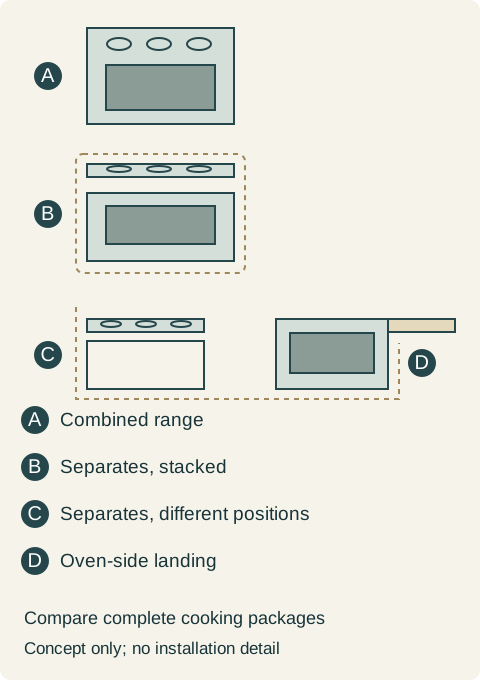
There are several sensible arrangements to compare. A range keeps its surface and oven in the same appliance. An approved cooktop-and-oven pair can occupy a similar part of the run while remaining separate products. Or a cooktop can stay in the working counter while the oven occupies another supported location. Those last arrangements have different reasons for being chosen.
Stacking separate products does not, by itself, give the oven a higher working position or create an independent approach for another cook. It can still be useful if the actual component choices are better suited to the household. But compatibility needs to be established for that exact combination, including the cabinet construction between and around them. A cooktop above an oven is not merely two rectangles that happen to fit.
Placing the oven elsewhere can separate the baking approach from the pans on the cooking surface. It can also add a trip between them and claim storage at the new location. Trace the actual meal rather than assuming that separation is always more convenient. An oven across a frequently occupied route may exchange one conflict for another.
Teaching example Three equipment concepts: A is a combined range; B stacks separately selected components in an approved arrangement; C separates the cooking surface and oven positions, with D indicating the oven-side landing. The linked outline identifies the paired components, not a shared utility connection. No product compatibility or dimension is specified.
Choose both working surfaces with the same care
For the cooking surface, place representations of the pans that are regularly used together. Include handles and the selected controls. A larger nominal appliance is not proof of a better pan arrangement, and more cooking positions are not useful if the household never uses them. The important preference may be the control location or the room between the actual pots rather than the overall count.
For the oven, test the intended vessels, rack arrangement, visibility and door movement on the actual candidates. The advertised cavity volume does not describe whether a particular tray enters comfortably or whether the user likes operating the controls. Keep these observations separate from assumptions about how well a category cooks. A range can have an excellent oven for the household; a separate oven can be a poor match despite its own impressive feature list.
Fuel preference also belongs to the actual package. Choosing a particular cooking surface does not establish the oven's requirements, and buying a range does not necessarily mean its surface and oven use the same energy source. Compare documented candidates and the site's supported supply arrangements. This guide provides no connection sizes or electrical or gas installation procedure.
Make the cabinet consequences visible
A range opening takes the place of the cabinetry occupied by that appliance. A cooktop has its own top opening and installation requirements below; any proposed drawer space beneath it remains conditional on the specific construction. An oven cabinet supplies a different opening and support. Distinguish those assemblies in the quote instead of applying the same generic base cabinet to every version.
If the oven moves into a tall run, account for the pantry contents or continuous counter displaced there. If it stays below the cooktop, do not claim that the cabinet has gained full-depth drawers at the same location. The best-looking front elevation can quietly count both an oven and useful storage in the same volume. An honest comparison keeps the retained contents present in every proposal.
Ventilation remains part of the selected surface-cooking arrangement whichever package is chosen. Moving the oven does not resolve the cooktop's exhaust or other installation requirements. Have the complete proposed equipment, support and connections coordinated before releasing the cabinet openings. The choice is between complete working kitchens, not between appliance silhouettes.
A household pays for independent working positions
Consider a hypothetical household that often has one person baking while another prepares a meal at the cooking surface. In its preferred range position, opening the oven brings the baker into the same working place used for managing pans. The kitchen can accommodate the separate oven beside an existing clear counter, and the household has a confirmed alternative home for the supplies currently stored there.
The owners compare a suitable range, an approved stacked pair and components in separate positions. The stacked pair offers independent product selection but does not change the shared approach. In the separated version, the oven user can remove and set down a representative cool tray at the nearby counter without crossing the pan user's position. The selected cooktop's controls and pan arrangement also work for the surface cook. The test includes the drawers and household passage, not only the closed appliances.
They select the separate locations and buy the complete cabinet and installation package. They accept relocating the former storage and the added work at the oven bay because it changes a repeated meal routine. The nearby counter is kept available for oven transfers during those meals. Their reason is the working relationship of the selected components, not a belief that separate appliances are inherently more professional.
Think about later changes without promising an easy replacement
With separate products, a future proposal can address a cooktop or oven individually, but the retained opening, connections and adjacent equipment still need checking. This can limit the replacement choices, particularly for stacked combinations. Separately purchased does not mean universally interchangeable, and no design can promise that a future model will fit today's opening.
A range brings the functions together in a single purchased assembly. That does not imply every fault requires replacing the whole appliance; repair scope depends on the actual issue and service options. Avoid using an imagined repair bill to justify one category. Compare current equipment, cabinetry, installation and the household benefit that is known now.
The finished purchase should name the full range or both separate models, their approved locations, the storage that remains and the work each person can complete. If independent placement or selection adds little to those tasks, the combined appliance remains a strong option. If separation resolves an important repeated conflict, its additional scope has a clear purpose.
Pure White
Cream White
Light Warm Gray
Gray
Navy
Black
Oak Tone
Dark Walnut Tone
Design study These finish studies are design references, not a list of currently orderable colors. Screens and lighting change the appearance; compare a physical sample before choosing.See all finish options →
A rangetop is not simply a cooktop with different knobs. Its front opening and supporting cabinet can differ, while some cooktops also place controls through the cabinet face.
A tower can change appliance access while removing a prep surface and dividing what remains. Test the same cooking task and retained contents in both complete layouts.
Control-panel height is only part of the decision. Test the rack used, open door, person’s stance, grip and available landing together before fixing the oven cabinet.
The sample shows the door frame, a separate center panel, the face frame and the cabinet box. Each component has its own place in this Shaker construction.
Shaker construction: door frame, center panel, face frame and cabinet box. The cutaway helps locate these parts; confirm each material in the specifications for the selected cabinet.
01 / Door frame
The Shaker door has rails and stiles around a separate center panel. The frame and center panel are different components; confirm their materials in the specifications for the selected cabinet.
02 / Face frame
The face frame surrounds the opening at the front of the cabinet box and sits behind the doors. The face frame, door frame and cabinet box are separate parts.
03 / Cabinet box
The sample exposes the cabinet sides, interior surfaces and layered edges. The image does not establish the wood species or material specification of a selected cabinet.