Ice and water in the refrigerator door, or an internal dispenser?
Choose the dispenser package with your everyday glasses, bottles and ice routine. A plain refrigerator front can still conceal a water outlet, while a door dispenser changes access without creating a separate drinks station.
Choose an external ice-and-water dispenser when obtaining those items without opening the main refrigerator door is useful in the household's regular routine, and the actual dispensing recess accepts the containers that matter. Choose an internal-water arrangement when the uninterrupted front is worth opening the refrigerator for water and using the selected model's separate ice-access method. Compare complete refrigerators, including their storage, rather than buying a front appearance in isolation.
Neither choice automatically provides a separate drinks station. Someone standing at the refrigerator still occupies its approach, and anyone wanting food may need the same area. The benefit of avoiding a door opening can be real without claiming that the kitchen has gained an independent workspace. That distinction matters when the refrigerator faces a busy island or passage.
Water location and ice location are separate decisions
GE's cited family manual shows an external water-and-ice dispenser and, on applicable models, an internal water outlet on the compartment's left wall. It does not make every refrigerator with an internal water outlet an ice dispenser at that same position.
Ask the seller to demonstrate the complete offered package. Where does water emerge? How does the user obtain ice? Is the relevant ice-making equipment included, optional or absent on that exact version? A photograph of a plain door does not answer those questions. Keep the actual features with the model identity so a substitution does not silently change the routine.
An internal-water candidate may require a separate visit to its ice bin. Assess the location actually offered, rather than assuming all such products put ice in the same drawer. Conversely, a door dispenser does not tell you whether another ice-making unit is present elsewhere. Choose the necessary equipment deliberately; an unused extra feature should not determine the refrigerator purchase.
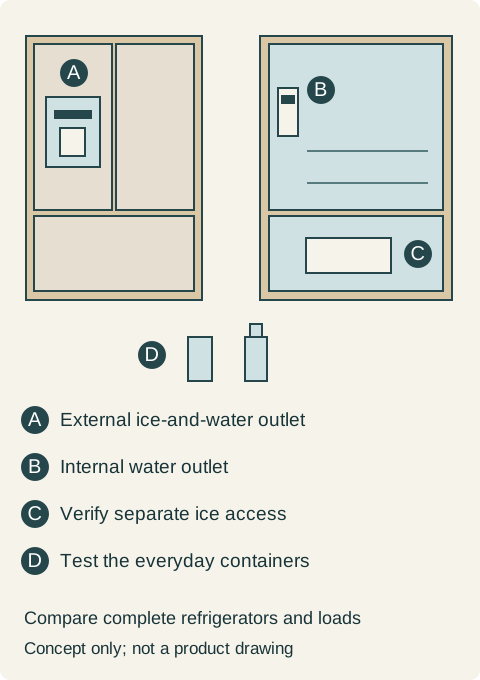
Teaching example Conceptual alternative dispenser arrangements. A shows an external ice-and-water recess on a closed refrigerator front. B is an internal water outlet in an exposed compartment; its door is omitted so the outlet can be seen. C marks the separate ice-storage assignment to verify for that internal-water proposal, not a universal ice-maker location. D is the retained glass and bottle group used to test both proposals. No dispensing height, door swing, plumbing route, capacity or product dimensions are specified.
Bring the container that will be filled most often
Try the daily bottle, ordinary glass and any regularly filled pitcher with the candidate's supported dispensing arrangement. Include the container's opening, handle and the way the user holds it. The recess that looks generous around a small showroom tumbler may not suit a tall bottle or broad pitcher. Do not assume that a removable lid or tilted position is acceptable unless the real task still works as intended.
For an external dispenser, assess access to the water and ice controls with the container present. A successful water trial does not prove the same container is suitable for dispensing ice. Use a manufacturer's permitted demonstration with an appropriate container; do not improvise a funnel or reach into a chute to make a poor match appear workable. If the normal bottle needs another filling method, decide whether that limitation defeats the reason for buying the dispenser.
For an internal outlet, test the actual button or lever, the container position and the necessary door opening. The absence of a door-front recess does not guarantee unrestricted pitcher space. Shelves, bins and the outlet's location remain part of the physical task. Let the person who normally fills the bottle carry out the trial instead of accepting a demonstration with a different glass.
Account for opening the refrigerator and obtaining ice
Walk through a complete drink. Retrieve the glass, get any required ice, add water and leave. Include where the glass can wait when another action needs a free hand. An internal-water arrangement can be entirely satisfactory for a household that fills a bottle before leaving; it may feel different to people making repeated iced drinks while someone else gathers ingredients.
For a door dispenser, show the user's standing position while the refrigerator remains shut. Then show the food-retrieval task beside it. The door may still need to open through the dispenser user's position. Do not describe the tasks as simultaneous merely because one uses an exterior control and the other uses the interior.
For the internal proposal, repeat the task with the water-access door and any separate ice compartment in their useful positions. The sequence may require closing one before approaching the other. That is not automatically a reason to reject it, but it is work the household should accept knowingly. Compare the whole action rather than counting only the number of handles touched.
Compare the refrigerator behind the feature
Inspect the actual shelves, door bins, ice equipment and freezer organization in both candidates. Identify where the ordinary milk container, condiments, covered dishes and frozen packages will go. Do not declare that every internal dispenser saves food space or every external dispenser removes the same amount. Product layouts differ; the household needs the arrangement it is being offered.
Use the same regular collection in both comparisons. A feature can be convenient while its associated refrigerator fails the storage task. If a door bin no longer accepts a familiar container, decide where that container moves and whether the new position displaces something equally necessary. Avoid assigning the same interior space to the ice equipment and overflow food on a planning sketch.
The cabinet surround should follow the selected complete appliance. A similar advertised width is not proof that the alternative fits the same opening, ventilation provision or door movement. Determine the real installation arrangement with the responsible installer before the cabinetry is released. Do not keep an unsuitable model merely because its dispenser has already been drawn into the elevation.
An uninterrupted front wins only after the task works
In a hypothetical kitchen renovation, the household wants a plain refrigerator front but also uses refrigerator water every day. Its usual routine is filling a retained bottle before leaving home. Ice is used occasionally, and the owners are comfortable obtaining it separately. They compare an external ice-and-water candidate with an internal-water candidate that includes an accessible freezer ice bin.
The external candidate works with an ordinary glass, but its checked dispensing position does not accommodate the retained bottle in the intended filling posture. The owners could replace the bottle or fill another container first. They decline those extra changes because the bottle is the item the routine is meant to serve, not an occasional exception.
The internal candidate accepts the bottle with its actual controls and permitted door opening. The door does not block the agreed morning approach in the proposed room. The separate ice-bin task also works, and the family's regular frozen packages fit the remaining freezer organization. The owners are not choosing a clear front while ignoring where the ice equipment and food go.
They buy the internal-water package and accept opening the refrigerator for the daily fill and obtaining ice separately when wanted. The kitchen retains its planned glass-storage cabinet rather than adding another drink appliance. The accepted price includes the selected refrigerator and confirmed installation scope; no savings are inferred from hiding the outlet.
Include ownership work and the option to omit the dispenser
Compare the prescribed care for the actual outlets, trays, ice components and filters. An invisible outlet is still a component that needs its specified upkeep. An exterior tray should not be mistaken for a sink, and a filter label does not establish that a particular water-treatment need has been met. This buying comparison supplies no filtration claims or universal replacement interval.
A household already satisfied with another drinking-water source may not need refrigerator dispensing at all. If that option is considered, identify the remaining ice supply and the selected refrigerator's actual connection requirements. Omitting a visible water outlet does not prove that a refrigerator equipped with an ice maker needs no water connection.
Compare complete prices without inventing a category-wide reliability, energy or maintenance-cost advantage. Keep the household's accepted container, ice-access sequence and full storage arrangement attached to the model selection. External dispensing is useful when the ordinary task benefits from it; internal dispensing is useful when the accepted door-opening routine preserves the front the household wants. Both decisions depend on the real appliance behind that front.
Pure White
Cream White
Light Warm Gray
Gray
Navy
Black
Oak Tone
Dark Walnut Tone
Design study These finish studies are design references, not a list of currently orderable colors. Screens and lighting change the appearance; compare a physical sample before choosing.See all finish options →
A concealed connection needs an access plan that works with the appliance, cabinet fronts and normal contents in place. Seeing a point on an empty-room drawing is only the beginning.
Separate daily production from ice ready to scoop. A dedicated machine can serve frequent demand near the drinks area, but its bin is not automatically a freezer and its advertised output does not describe a party’s starting supply.
The sample shows the door frame, a separate center panel, the face frame and the cabinet box. Each component has its own place in this Shaker construction.
Shaker construction: door frame, center panel, face frame and cabinet box. The cutaway helps locate these parts; confirm each material in the specifications for the selected cabinet.
01 / Door frame
The Shaker door has rails and stiles around a separate center panel. The frame and center panel are different components; confirm their materials in the specifications for the selected cabinet.
02 / Face frame
The face frame surrounds the opening at the front of the cabinet box and sits behind the doors. The face frame, door frame and cabinet box are separate parts.
03 / Cabinet box
The sample exposes the cabinet sides, interior surfaces and layered edges. The image does not establish the wood species or material specification of a selected cabinet.