Do you need a dedicated ice maker, or should that cabinet stay storage?
Separate daily production from ice ready to scoop. A dedicated machine can serve frequent demand near the drinks area, but its bin is not automatically a freezer and its advertised output does not describe a party’s starting supply.
Choose a dedicated ice maker when the household needs a separate, regularly used ice supply and the complete drinks station works better with that appliance than with the cabinet it replaces. Retain the cabinet when existing freezer ice and a practical plan for occasional extra demand meet the need. The key comparison is not which machine has the largest daily-production number. It is how much usable ice is available when wanted, how it is replenished, and what the kitchen gives up to provide it.
Production, storage and starting supply answer different questions
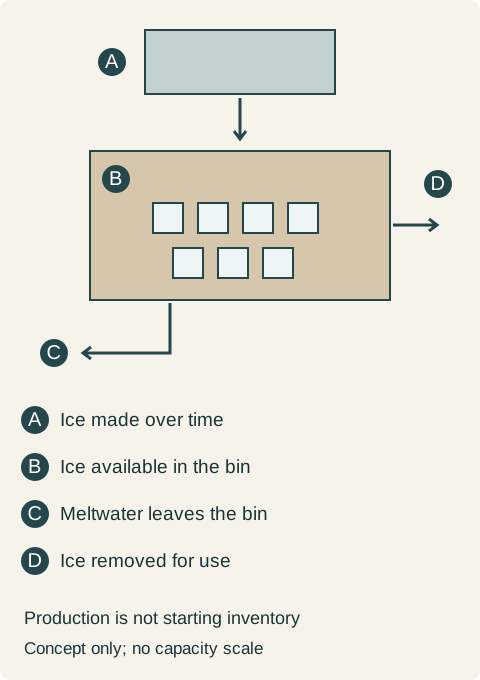
Production describes ice made over a stated period and under stated conditions. Storage capacity describes how much a particular bin can hold. Starting supply is the ice actually present when a gathering or routine begins. A high production figure does not mean that quantity can be removed from the bin at once.
An empty bin also does not fill instantly because the machine is switched on. Read the selected model's startup and production information. Do not convert a daily maximum into an hourly average and treat the result as guaranteed replenishment during every part of an event. Ice arrives through the machine's actual cycles, and the quoted conditions still matter.
Separate ordinary use from the busiest occasion. A household may need little ice during a normal week and a concentrated supply for occasional guests. Another may use it steadily throughout each day. The same daily total can conceal very different demands on the available bin and on the person fetching more ice.
A dedicated bin may not hold ice like a freezer
GE explains that the bin in its described Monogram standalone square-cube ice makers is not a freezer: ice melts and is replenished. Production stops when the bin is full and restarts as needed.
That operating arrangement changes the buying expectation. It is not simply a freezer drawer that happens to make ice. Confirm the selected product's own storage and operating behavior before promising to fill it well ahead and leave that exact supply unchanged. Do not transfer the described Monogram arrangement to every appliance with an ice-maker label.
Nor should the cabinet plan count the ice bin as overflow space for bottles or food. A dedicated ice compartment has its own permitted use. Keep beverage storage, glassware and ice supply as separate functions unless the particular product explicitly provides a suitable compartment for each. A drawing of drinks standing beside an appliance does not put those drinks inside it.
Teaching example Conceptual stock and flow: A adds newly made ice to B, the ice currently available. C shows meltwater leaving the illustrated nonfreezer bin; D is ice taken for use. This is not a plumbing diagram, cycle forecast or claim that every ice maker uses this arrangement.
Check the demand that must be ready together
Begin with the household's own observations of previous use, including ice put into drinks and any separately planned serving use. Keep the chosen ice form in the comparison. A person wanting a particular cube or nugget format may value it independently of quantity, but should try the offered result rather than inferring it from a clear product photograph.
For a hypothetical gathering, the owner plans a concentrated draw of 14 pounds and expects only 10 pounds to be available at its start. Before allowing for additional production or melting, the starting shortfall is 14 − 10 = 4 pounds. These are invented planning inputs, not a machine rating or a recommendation for any number of guests.
The subtraction identifies a missing starting supply; it does not size the final appliance or backup. Later production might help some later demand, while melting and earlier withdrawals might reduce what remains. Resolve those events in their actual order instead of treating the daily production label as ice already in hand.
If the response is to arrange a separate reserve, identify its suitable storage and retrieval before accepting it as a solution. Ice that cannot be accommodated in the household's actual freezer arrangement is not a completed backup plan. Follow the relevant equipment and storage instructions; this purchase comparison does not prescribe handling or storage periods.
Compare a complete drinks station with a complete storage cabinet
A dedicated unit can put ice beside glassware and drinks, reducing repeated trips to the main refrigerator. That is useful when those trips are a real recurring inconvenience. Show where the user stands and where a glass or serving container waits while ice is obtained. The benefit disappears if the appliance door or another person's work blocks that position.
Then name what the appliance removes. If the proposed bay currently holds serving dishes, those dishes need a workable home; an attractive drink station should not create a daily search for the dinner plates. Keeping a dry cabinet may be more valuable than making occasional ice access closer. Conversely, frequently moving through the cooking area for ice may justify sacrificing less-used local storage.
Water, drainage, power and service arrangements still require the exact installation plan. They are reasons to price a complete proposal, not the whole case for buying the appliance. Confirm the useful task first, then have the responsible installer establish whether that proposal can be built without taking space already assigned to adjacent storage.
An occasional host keeps the dry cabinet
In the hypothetical household, the existing freezer supply serves ordinary days. The larger gathering exposes the starting-supply gap described above, but it happens infrequently. The owner compares a dedicated machine with an arrangement that retains the freezer ice source and sets aside suitable freezer space for the separately planned additional supply.
The freezer allocation is actually available after reorganizing the existing contents; it is not an empty rectangle drawn over occupied shelves. A rehearsal also leaves a usable route to the drinks area. The owner chooses that arrangement and keeps the proposed appliance bay as a dry cabinet for serving dishes and glasses, accepting the occasional extra preparation and transfer.
This choice would be weaker for a household with frequent demand, no workable reserve space or repeated ice trips through active cooking. Such a household may prefer a dedicated unit after confirming starting supply, replenishment and the remaining storage. The difference is the household's use, not whether a built-in front makes the kitchen look more complete.
Include care and the whole installed cost
KitchenAid's ice-maker guidance identifies recurring cleaning of the ice-making system and air-cooled condenser. That is an ownership task to review for the selected model, not a universal cleaning interval or procedure.
Compare the appliance, the required installation, any supplied-versus-extra components, and the furniture changes. Include the actual care and filter requirements where applicable. Do not assume that a machine with automatic ice production also cleans itself without the user's prescribed work, or invent operating-cost savings from its size.
The purchase earns its cabinet position when it supplies the intended ice use, leaves a workable kitchen and has an accepted ownership routine. A decision to retain ordinary storage can be equally complete when its real ice source and occasional reserve are both accounted for. Neither conclusion follows from the largest number on a product card.
Pure White
Cream White
Light Warm Gray
Gray
Navy
Black
Oak Tone
Dark Walnut Tone
Design study These finish studies are design references, not a list of currently orderable colors. Screens and lighting change the appearance; compare a physical sample before choosing.See all finish options →
The machine’s cavity is only part of the plan. Confirm the selected water, drain and power arrangement, then reserve connections, access and any required removal route before promising adjacent storage.
A flush front does not establish a working installation. Confirm enclosure permission, keep the required ventilation opening effective and test the door with the actual bottles and neighboring fronts.
The sample shows the door frame, a separate center panel, the face frame and the cabinet box. Each component has its own place in this Shaker construction.
Shaker construction: door frame, center panel, face frame and cabinet box. The cutaway helps locate these parts; confirm each material in the specifications for the selected cabinet.
01 / Door frame
The Shaker door has rails and stiles around a separate center panel. The frame and center panel are different components; confirm their materials in the specifications for the selected cabinet.
02 / Face frame
The face frame surrounds the opening at the front of the cabinet box and sits behind the doors. The face frame, door frame and cabinet box are separate parts.
03 / Cabinet box
The sample exposes the cabinet sides, interior surfaces and layered edges. The image does not establish the wood species or material specification of a selected cabinet.