Recycled-glass countertops: choose the binder as well as the glass
Similar glass chips can sit in different materials. Compare a cement-bound and a resin-bound surface by their documented care, finished appearance and complete cabinet layout.
Recycled-glass countertops are not a single maintenance category. The visible glass can be set in different surrounding materials, and that material matters when choosing the surface for a kitchen or vanity. A sample with attractive blue or white fragments answers a color question. It does not tell you whether the finished product needs sealing or which cleaner belongs beside the sink.
Identify the material between the glass pieces
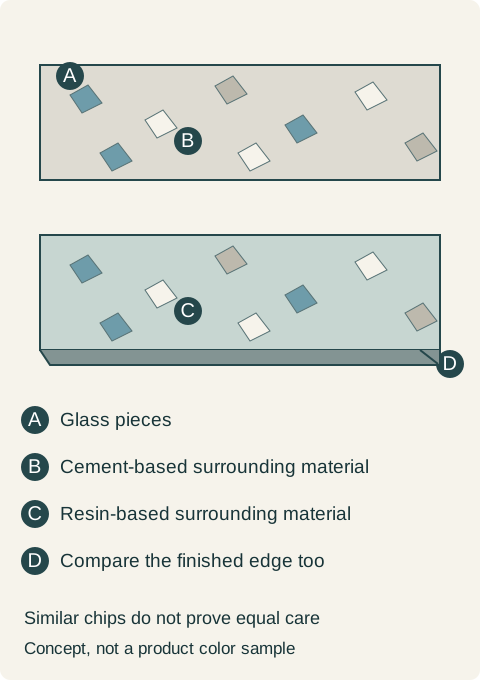
IceStone describes its surface as recycled glass combined with portland cement. The glass is an ingredient within a manufactured surface, rather than a continuous sheet of glass. Identify the complete product before transferring expectations from a glass tabletop to a countertop sample.
The same company's SpectrumStone page describes a different combination that includes glass, quartz and resin binder, and states that sealing is not required for that product. Similar-looking fragments therefore do not establish the same construction or care requirements across the two lines.
Read the product designation on the sample and quote, not simply recycled glass. If the supplier offers an alternative with a similar color, ask for its own composition and care instructions. A visually close substitution can change a decision the buyer made about maintenance, even when both materials belong under the same broad showroom heading.
Compare the care you will actually undertake
IceStone's current care page calls for prompt spill cleanup, protection from hot cookware and cutting, and attention to the sealer, with resealing potentially needed according to use. These are product-specific directions. They do not establish a fixed resealing interval for every cement-bound surface.
For the resin-bound candidate, obtain the selected product's full care information rather than turning no sealing required into no maintenance. Cleaning, heat protection and damage assessment remain separate questions. A statement about one task does not answer all of them, and a label on a sample does not replace the instructions delivered with the installed surface.
Place those requirements beside the household's ordinary routine. Someone may be willing to monitor and maintain a sealer because a particular surface is the preferred design. Another buyer may want to avoid that additional task. Neither needs a claim that the other material is universally worse; the useful comparison identifies what will happen in this kitchen after installation.
Teaching example Conceptual comparison: glass pieces sit within a continuous surrounding material. The drawings use similar chips to isolate the binder distinction; they are not product samples, mixture ratios or a prediction of color.
Review the whole slab with the cabinet finishes
Look at the fragments and the surrounding color separately. In one sample the chips may dominate; in another the field between them supplies most of the visible color. Place the cabinet door beside a larger surface sample and view both from standing distance. A small piece inspected close up can make a scattered accent appear more dominant than it does across an entire counter.
Use the intended lighting, especially where glass fragments catch highlights. Review the countertop horizontally and the cabinet door vertically. Rotating both samples into the same plane for a photograph can obscure how they will be seen in the room. The cabinet's sheen and grain also affect whether the combination feels calm or busy.
If the plan carries the surface up the wall, evaluate that larger area before ordering. A lively countertop may be exactly what the kitchen needs while the same fragments across a full-height backsplash compete with framed doors and open shelves. The alternative is not necessarily another countertop: keeping a quieter wall finish can preserve the selected surface without multiplying its visual activity.
Include the edge and basin opening
Ask to see the proposed finished edge, including the way the glass and surrounding material appear in section. Do not approve a thick-looking built-up edge using only a face sample. The exposed edge and any joins in that construction become part of the finished appearance.
Do the same at a sink or vanity opening. Confirm the selected basin, opening and support requirements with the fabricator and cabinet supplier. A decision about the binder does not approve a particular cutout or permit a cabinet rail to be removed. Those relationships still need the product's current fabrication guidance.
Discuss who would assess an edge chip or another future defect and what an acceptable repair might look like. Do not assume a local repair will be invisible merely because the surface already contains varied fragments. Keep the actual product and color identified for future advice rather than saving only the description recycled glass.
A choice that changes the maintenance task, not the whole kitchen
Consider a household choosing a speckled surface beside oak-toned cabinet fronts. Its first preference is a cement-bound sample whose pale field and glass colors work well with the wood. During the comparison, the owners decide they do not want to take on the selected product's sealer monitoring and possible resealing. The concern is that specific task, not an unsupported judgment about durability.
They compare a documented resin-bound alternative and accept that its field color and fragment distribution are different. The revised sample works with the cabinet door under the room lighting, and its instructions fit the care routine they are prepared to follow. They choose it for the countertop, retain a quieter backsplash and have the selected sink opening and edge included in the fabrication proposal. The purchase is a complete revised surface scheme, not a promise that every recycled-glass slab looks and behaves alike.
Another household might retain the original sample and accept its maintenance requirements. In either case, the final quote should identify the actual surface, finish, edge, cutouts, installation scope and care documents. Keep any recycled-content claims tied to their specific product and evidence; the material category alone cannot establish an environmental ranking or the best choice for every room.
Pure White
Cream White
Light Warm Gray
Gray
Navy
Black
Oak Tone
Dark Walnut Tone
Design study These finish studies are design references, not a list of currently orderable colors. Screens and lighting change the appearance; compare a physical sample before choosing.See all finish options →
A patterned surface and a patterned slab body are different features. Compare an actual cut edge and sink opening before choosing the fabrication detail.
A board, its wood portion and a finished cabinet have different totals. Check what a recycled-content percentage actually counts before comparing products.
A full-height backsplash is more than extra countertop square footage. Decide its boundaries, visible edges, interruptions and slab layout with the cabinet elevation.
The sample shows the door frame, a separate center panel, the face frame and the cabinet box. Each component has its own place in this Shaker construction.
Shaker construction: door frame, center panel, face frame and cabinet box. The cutaway helps locate these parts; confirm each material in the specifications for the selected cabinet.
01 / Door frame
The Shaker door has rails and stiles around a separate center panel. The frame and center panel are different components; confirm their materials in the specifications for the selected cabinet.
02 / Face frame
The face frame surrounds the opening at the front of the cabinet box and sits behind the doors. The face frame, door frame and cabinet box are separate parts.
03 / Cabinet box
The sample exposes the cabinet sides, interior surfaces and layered edges. The image does not establish the wood species or material specification of a selected cabinet.