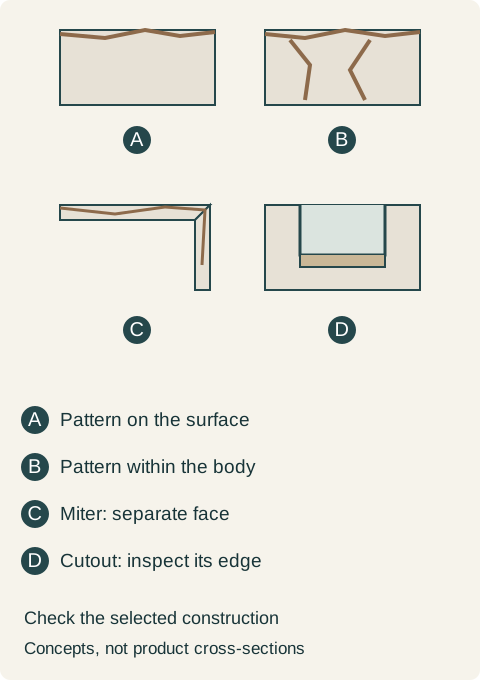
Will the countertop pattern continue through the edge?
A patterned surface and a patterned slab body are different features. Compare an actual cut edge and sink opening before choosing the fabrication detail.
The top of a countertop sample can look richly veined while its cut edge looks almost plain. That is not enough information to call the material defective. The decorative surface and the body beneath it can be constructed differently. For a kitchen with an exposed front edge and an undermount sink, both appearances belong in the selection.
The material family does not answer the question
MSI distinguishes Color Body from Full Body within its Q+ engineered surfaces. Color Body keeps decorative veins on the face; Full Body carries complementary pattern below it. Those are distinctions within a named range, not a rule for all quartz products.
Caesarstone describes In-Sync technology in its porcelain collection as coordinating body, surface and edge. This is another reason not to assume that every porcelain product has the same edge appearance.
Ask which construction applies to the actual color and version being quoted. A brochure describing a technology does not establish that every design from the brand uses it. A similar-looking color from another collection may have a different body. The approved order needs the product identity that produced the sample you accepted.
The practical comparison is between finished edge samples, not slogans such as full body or natural-looking. A complementary internal pattern may relate to the face without duplicating every visible vein. Look at the transition itself, including the place where a bold line reaches the front.
A miter changes what you see at the front
A built-down miter can place another decorated face along the front of the countertop. The visible face is a separate piece arranged to meet the top; it is not proof that the pattern extends through the entire slab. The selected material and fabrication method still determine the actual joint and edge.
This can be a useful appearance choice when the exposed slab body is plainer than the household wants. It also changes the edge assembly, so the fabricator must coordinate the finished drop with cabinet doors and drawers. Do not select the visual depth without showing where the cabinet fronts open beneath it.
The same treatment should not be assumed at every opening. An undermount sink leaves an internal cut edge visible, and the front miter sample does not show that condition. Ask for an example of the proposed sink opening in the selected material. Review its corners and face-to-edge transition as well as the long, straight front.
Teaching example Appearance concepts: a surface pattern can end above a plain body, while another construction carries a pattern below the face. The miter sketch adds a separate patterned face; it does not change the slab body. Not product sections or fabrication instructions.
Decide whether the plain cut edge bothers you
In a hypothetical kitchen, the household likes a strongly veined face and approves a mitered front. A sink-opening sample then shows a much quieter body around the bowl. If that contrast is unwelcome, the household can compare a different product construction or reconsider the sink detail with the fabricator. Simply requesting the same miter everywhere is not an adequate specification.
Suppose the household instead accepts the quiet sink edge because it frames the bowl without another strong pattern. It retains the original surface, mitered front and approved cutout appearance. Seeing the difference before fabrication avoids an unwelcome surprise at installation.
A product that carries more pattern through its body does not automatically resolve every fabrication issue. Its proposed edge shape, joints and sink arrangement still require approval. Appearance through the thickness is one selection criterion, not a substitute for the rest of the design.
Keep the edge decision attached to the cabinet order
Retain the face sample, the finished edge example and the sink-detail approval together. Identify which edges remain visible after adjacent cabinets, walls and appliances are in place. Money spent on an elaborate edge that is permanently concealed does not improve what the household sees.
If a substitution changes the product body or the fabrication detail, reopen the affected approvals before cutting. Avoid describing all quartz as continuously veined or all porcelain as surface-only. The reliable answer is the selected product, viewed at the exposed edges it will actually have in this kitchen.
Pure White
Cream White
Light Warm Gray
Gray
Navy
Black
Oak Tone
Dark Walnut Tone
Design study These finish studies are design references, not a list of currently orderable colors. Screens and lighting change the appearance; compare a physical sample before choosing.See all finish options →
The exposed rim changes cleaning access, the visible opening and sometimes the operation of workstation accessories. Choose the edge relationship with the actual sink.
The sample shows the door frame, a separate center panel, the face frame and the cabinet box. Each component has its own place in this Shaker construction.
Shaker construction: door frame, center panel, face frame and cabinet box. The cutaway helps locate these parts; confirm each material in the specifications for the selected cabinet.
01 / Door frame
The Shaker door has rails and stiles around a separate center panel. The frame and center panel are different components; confirm their materials in the specifications for the selected cabinet.
02 / Face frame
The face frame surrounds the opening at the front of the cabinet box and sits behind the doors. The face frame, door frame and cabinet box are separate parts.
03 / Cabinet box
The sample exposes the cabinet sides, interior surfaces and layered edges. The image does not establish the wood species or material specification of a selected cabinet.