Reclaimed cabinet wood: preserve the old face or buy remilled stock?
Reclaimed origin and an original aged surface are different purchase requirements. Choose the finished door construction that preserves the features you value instead of expecting every old board to become any new profile.
Choose remilled reclaimed lumber when the project needs prepared stock for a new cabinet component and does not depend on retaining the board’s old outer face. Choose an original-surface proposal when that actual aged face is the reason for buying, and accept a door design that accommodates it. Both can use reclaimed wood. The difference is what survives the conversion into the new component. A purchase based only on a photograph of an old beam leaves that important decision unresolved.
Prepared cabinet stock is a different deliverable
Elmwood distinguishes kiln-dried, graded, planed and ripped cabinet lumber from original dimensional stock that retains its earlier board characteristics. Those descriptions buy different starting conditions, even when the wood has the same reclaimed origin. For a homeowner commissioning cabinet doors, the practical issue is what the cabinetmaker receives and what the finished sample represents. A price for unprocessed-looking boards and a price for a finished door cannot be compared simply by the amount of wood visible in a photograph.
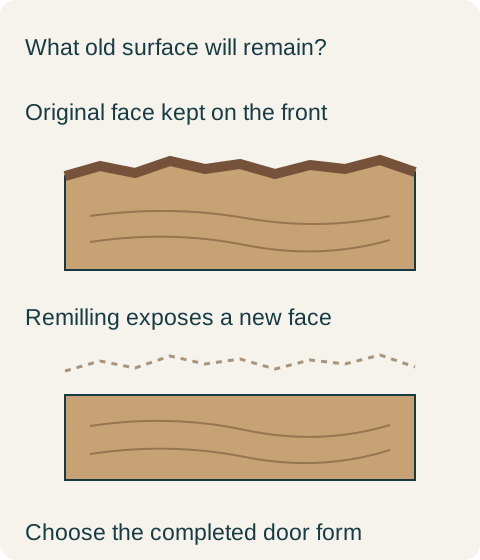
An old face is a physical surface, not a color distributed through every future cut. If a new profile cuts below it, that part of the original face is removed. If the shop planes the face flat, the accepted appearance must be the resulting face rather than the surface shown before machining. A stain may create a chosen color, but it does not put the removed historical surface back. This distinction helps resolve an otherwise contradictory request: keep every old surface detail while making the front look exactly like a freshly machined catalog profile.
Original does not necessarily mean rough
Elmwood’s glossary includes originally smooth-surfaced antique stock with patina but without saw marks. Roughness alone therefore is not a useful test of origin. Decide which feature matters: the material’s previous use, a particular old face, a tactile texture, or the finished color. Those preferences can lead to different selections. A smooth remilled front can meet a requirement for reused wood while missing a requirement for visible historic tool marks; a rough-looking new surface can satisfy the texture preference without establishing reclaimed provenance.
Diagram Conceptual sections: an irregular old outer face is retained above; machining exposes a new face below. Reclaimed origin can remain in both, but original surface features do not remain where removed. Not a machining-depth specification.
Preserving the old face changes this door selection
In a hypothetical kitchen, the owners want the old saw-marked face shown in a reclaimed-board sample. Their first choice of deeply profiled door would machine away parts of that face. After reviewing finished mockups, they select the offered flatter door construction that retains the desired visible face and accept its prepared edges and back. They decline the profiled version rather than asking a color treatment to recreate the removed surface. The chosen package keeps the material history visible where the owners actually value it.
The decision also sets limits on the sample. A loose board demonstrates a face, but a finished door demonstrates how that face meets edges, joints and hardware preparation. Review those transitions together. A newly cut edge may be intentionally visible or receive an accepted treatment; neither should arrive as a surprise. In the hypothetical kitchen, the owners prefer the retained face even with the agreed edge treatment. A buyer who instead wants a uniformly machined profile could select prepared reclaimed stock and accept a different final appearance without abandoning the reuse objective.
Old stock still goes through a manufacturing process
Elmwood’s process separately identifies denailing, rough milling, kiln drying, planing and ripping. Age alone is not a delivery specification. The cabinet proposal should identify the material preparation actually included, rather than treating years in an old building as proof that the lumber is ready for a new door. That is particularly relevant when the owner supplies boards to a cabinetmaker: the material purchase and the finished-component work must meet at an agreed starting condition.
Character features also need a place in the component. A hole that the owners like near the center of a decorative face does not automatically belong beside an attachment or across a joint. Keep aesthetic acceptance separate from the maker’s assessment of the actual piece and construction. The point is not to remove every mark; it is to choose usable components in which the retained features support the intended appearance. A general instruction to keep all character does not settle every local placement decision.
Compare finished doors, not a promise of uniform history
Look at a representative group of completed pieces when the kitchen will contain a repeated run of fronts. Decide whether the mix of retained marks and newly worked areas forms an acceptable composition. The hypothetical owners accept variation in the visible old faces, but they do not ask for a particular hole or saw mark to recur on every door. If a tightly repeated pattern is essential, that preference may point toward another offered product. The selection should acknowledge what is actually being made from the available material.
Keep the agreed provenance description, prepared-stock scope and finished sample together. The quotation should include the machining, construction and finish required to turn that stock into the accepted front, including companion trim and visible ends where relevant. Do not assign a universal premium or saving to reclaimed wood: the delivered work can differ substantially between a retained-face component and one made from remilled stock. In this kitchen, retaining the selected old faces is worth choosing the compatible door form; that is the reason to preserve the scope if a substitute is proposed.
Pure White
Cream White
Light Warm Gray
Gray
Navy
Black
Oak Tone
Dark Walnut Tone
Design study These finish studies are design references, not a list of currently orderable colors. Screens and lighting change the appearance; compare a physical sample before choosing.See all finish options →
Compare the actual countertop products, heat-source routine and fabrication proposal. A fired porcelain slab and resin-bound quartz are different materials, but neither label replaces a complete kitchen specification.
The sample shows the door frame, a separate center panel, the face frame and the cabinet box. Each component has its own place in this Shaker construction.
Shaker construction: door frame, center panel, face frame and cabinet box. The cutaway helps locate these parts; confirm each material in the specifications for the selected cabinet.
01 / Door frame
The Shaker door has rails and stiles around a separate center panel. The frame and center panel are different components; confirm their materials in the specifications for the selected cabinet.
02 / Face frame
The face frame surrounds the opening at the front of the cabinet box and sits behind the doors. The face frame, door frame and cabinet box are separate parts.
03 / Cabinet box
The sample exposes the cabinet sides, interior surfaces and layered edges. The image does not establish the wood species or material specification of a selected cabinet.