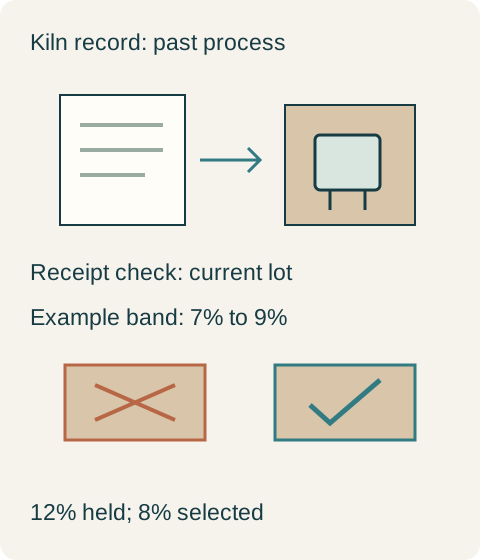
Kiln-dried lumber is not automatically ready to machine into cabinet doors when it reaches a shop. The description records a drying process; moisture can change afterward. A buyer purchasing dimension stock or custom door production should tie acceptance to the received material and the intended manufacturing conditions, rather than treating the kiln label as a permanent property.
A drying target is not a delivery reading
The USDA Wood Handbook describes lumber for furniture, cabinetry and millwork as usually dried to a final moisture content of 6% to 8%. It also explains that a use-specific moisture specification may be needed. That typical drying range is not a universal acceptance rule for every finished cabinet or climate.
The handbook separately says moisture can change during fabrication, transit and storage, and calls for determining moisture content when stock is received. It recommends controlled-humidity storage for cabinet work and furniture lumber. A sound roof protects against rain, but it does not by itself establish the required moisture condition.
The manufacturing concern is not limited to a whole board becoming wider. USDA explains that uncontrolled storage can leave ends wetter than the rest of machined stock. After jointing and edge gluing, subsequent shrinkage can produce splitting or open joints at panel ends. The receipt check therefore protects a later manufacturing step, not merely a tidy warehouse record.
Teaching example Hypothetical purchasing example. The acceptance band belongs to this example, not every climate or cabinet. A drying record and a current receipt measurement answer different questions.
Use the qualified lot for the scheduled doors
Suppose a hypothetical door order specifies a receiving band of 7% to 9% for its agreed production and service conditions. A lot carrying an older kiln-drying record reads 12% under the shop’s verified inspection procedure; another qualified lot reads 8%. The shop allocates the latter to the scheduled doors and separates the wetter lot for conditioning or supplier disposition. The purchase decision is complete: the first lot is not released into this order merely because its paperwork says kiln dried. These values illustrate an agreed project requirement, not a regional standard.
A material change should not quietly change the species, grade or cutting yield that was quoted. The alternate lot in this example is qualified for those requirements as well. If only wetter stock is available, the schedule and conditioning scope must be renegotiated; immediate machining is not made equivalent by a lower lumber price.
Keep the readings attached to the lot
Agree on the inspection method and sampling before delivery, including the instrument instructions and how disputed readings will be checked. A handheld reading is evidence with measurement conditions, not a certificate for every part hidden inside a stack. Preserve the lot identity so later rechecks describe the same material rather than a convenient replacement board.
This specification belongs in the lumber or manufacturing order, with responsibility for unsuitable incoming stock and any conditioning work clearly assigned. After material is accepted, appropriate storage still matters. The useful purchasing distinction is a lot fit for the planned work at the time of use, supported by handling and inspection, rather than an unsupported promise that kiln drying prevents future movement.
Pure White
Cream White
Light Warm Gray
Gray
Navy
Black
Oak Tone
Dark Walnut Tone
Design study These finish studies are design references, not a list of currently orderable colors. Screens and lighting change the appearance; compare a physical sample before choosing.See all finish options →
Locate and document a painted joint line, distinguish an appearance change from looseness or damage, and request an assessment before filling or repainting.
Lumber grades help describe recoverable clear cuttings. Match those cuttings to the actual parts, then evaluate the finished cabinet on its own construction and finish.
Compare the actual countertop products, heat-source routine and fabrication proposal. A fired porcelain slab and resin-bound quartz are different materials, but neither label replaces a complete kitchen specification.
The sample shows the door frame, a separate center panel, the face frame and the cabinet box. Each component has its own place in this Shaker construction.
Shaker construction: door frame, center panel, face frame and cabinet box. The cutaway helps locate these parts; confirm each material in the specifications for the selected cabinet.
01 / Door frame
The Shaker door has rails and stiles around a separate center panel. The frame and center panel are different components; confirm their materials in the specifications for the selected cabinet.
02 / Face frame
The face frame surrounds the opening at the front of the cabinet box and sits behind the doors. The face frame, door frame and cabinet box are separate parts.
03 / Cabinet box
The sample exposes the cabinet sides, interior surfaces and layered edges. The image does not establish the wood species or material specification of a selected cabinet.