

Buying cabinets
Radiant electric or induction: which cooktop should your kitchen buy?
Choose between two electric cooking systems by testing the meals, cookware and controls, then compare the counter and cabinet work each accepted model actually needs.
Start with two complete electric alternatives
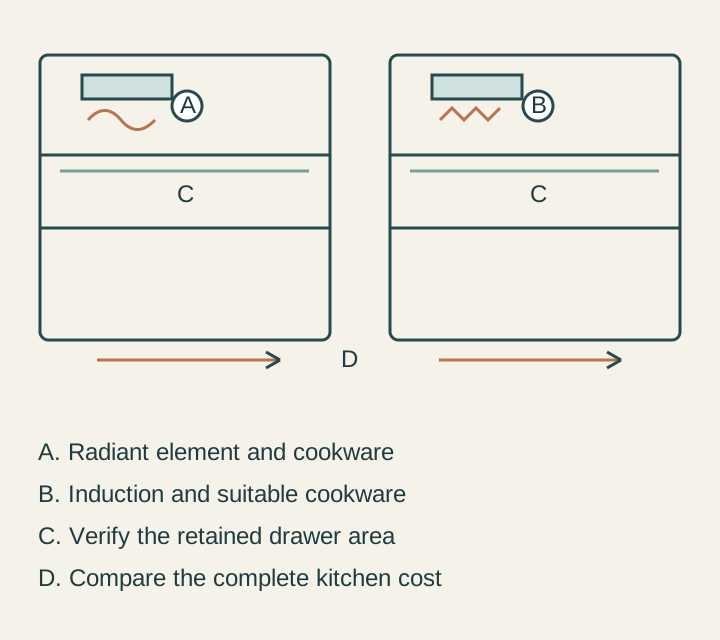
Choose induction when the actual cooktop and suitable cookware make the household’s recurring meals easier, and its complete installed cost is acceptable. Choose a radiant electric cooktop when the accepted model serves those meals and preserving the preferred cookware or simplifying the particular replacement matters more. Both proposals need their own counter opening, cabinet section and electrical review. An electric cooktop already in the kitchen does not make either new model an automatic fit.
This is a useful comparison when the owner wants electric cooking and is buying cabinets, replacing a worn cooktop, or deciding how much of an existing run to keep. The meaningful result is a working cooking bay with the storage still needed beneath it. A smooth black rectangle in a rendering cannot settle that purchase.
Understand the difference without buying a slogan
The Department of Energy explains that induction uses an electromagnetic field to transfer energy into suitable magnetic cookware. Conventional radiant cooking heats through an element. That distinction makes the retained cookware part of the purchase decision.
Reading note: U.S. Department of Energy — Making the Switch to Induction Stoves or Cooktops, How it Works.
Make a short list of the vessels whose loss would actually change your cooking. Include the small pot used daily, the wide skillet, the pan used for a long simmer and any specialty vessel you are determined to retain. Check their suitability against the selected cooktop and cookware instructions. A magnet test can help start the review; the exact appliance’s accepted base sizes and the condition of the pan still need checking.
For the radiant alternative, do not turn compatibility with one familiar pan into approval of the entire collection. Read its cookware guidance too. Flatness, actual base size and the proposed cooking task should be considered on both sides. If you need a replacement vessel, identify one you would willingly use rather than placing an unspecified cookware allowance beside an otherwise complete quote.
Test the meal, then test the controls
Arrange the cold, empty vessels for an ordinary demanding meal on each proposed layout. Consider what cooks at the same time and what is merely waiting. Include lids, projecting handles and the place a spoon rests. A surface with more marked positions may still provide less convenient space for your particular group.
Then follow the control sequence: select a zone, change its setting, identify which zone is active and stop it. Ask other regular cooks to do the same. An owner who dislikes the candidate’s interface should compare another model before rejecting an entire technology. Knobs, individual sliders and shared touch controls create different working sequences that do not follow automatically from the heating method.
A cold layout test tells you whether objects and hands fit. It does not measure simmering, responsiveness or cooking noise. Where a supervised demonstration is available, bring a defined task and ask what equipment is being demonstrated. Otherwise mark that behavior as untested and decide whether the uncertainty is acceptable. Do not replace missing observation with a promise about every induction or radiant appliance.
Find out what the cabinet can actually keep
Draw each accepted cooktop in section above the proposed drawer stack. Reserve its body, connections and the installation spaces its instructions require before assigning utensils to the remaining drawer. Ask the cabinet supplier to identify the usable interior after all fixed parts are included. A shallower-looking face does not establish a deeper drawer.
For retained cabinets, compare the actual drawer box and movement with that section. If an option requires losing the upper drawer, show what takes its contents and include the replacement storage in the design. For new cabinets, avoid buying an expensive internal organizer before the cooktop model and usable compartment have been resolved.
Counter retention is a separate question. Have the responsible fabricator compare the existing opening, support and edge arrangement with each candidate. Matching shopping widths do not prove matching cutouts. A new cooktop that covers the old hole from above may still have an unsuitable support or underside arrangement. Resolve the counter proposal before labeling one option a simple appliance swap.
Compare the cost of an accepted result
Bring both alternatives to the same completion point. Include the cooktop, accepted cookware changes, connection work, counter alterations, drawer changes and the repair of surrounding finishes where needed. Obtain the electrical assessment for the named equipment. The fact that both use electricity does not establish that they require identical supplies or can share every existing provision.
Keep ventilation and a separate preparation surface in the room plan. Neither candidate should be credited with turning its recently used cooking surface into permanent food-preparation space. If a wider model takes an adjoining cabinet, compare the resulting lost storage and reduced landing area against the demonstrated cooking benefit.
For a hypothetical remodel, imagine that the owners’ favored radiant candidate works with their retained pans and drawer arrangement. The induction candidate works well with an accepted replacement for one daily pot, but its proposed installation also changes the top drawer. The owners prefer induction’s demonstrated cooking behavior. They move those utensils to an existing adjacent drawer, confirm that the counter can be retained and compare the complete additional cost before ordering. Their preference has a defined price and storage consequence.
If that utensil move would displace another essential group, the answer could change. The owners might choose another induction model, accept a revised cabinet stack or retain radiant cooking. None of those outcomes means the first demonstration was worthless; it exposed the actual tradeoff while the order could still change.
Approve the cooking bay together
Finish with the exact cooktop, the retained and replacement cookware, the accepted counter scope and the drawer section on one coordinated record. If the appliance changes before ordering, return to those decisions instead of assuming an equal advertised width preserves them.
When both complete options work, it is reasonable to choose the one whose controls and recurring cooking tasks you prefer. When one option needs unacceptable cabinet changes, that is a valid reason to choose the other. Buy the electric cooking arrangement that the household can use as a finished kitchen, with the useful storage and project cost already understood.
Sources & further reading
- U.S. Department of Energy — Making the Switch to Induction Stoves or Cooktops, How it Works