Keep the gas cooktop or change to induction? Compare the complete kitchen purchase
The appliance price is only part of a gas-to-induction change. Include compatible cookware, the cooking layout, electrical work, the retained countertop and the storage left below before deciding.
Choose induction when its actual cooking arrangement, cookware and complete installation make sense for the kitchen you intend to keep. Do not treat a gas-to-induction change as merely exchanging appliances of the same advertised width. A gas replacement and an induction conversion may require different countertop work, connection work and cookware purchases. Compare those finished alternatives before committing to the new cooking base or promising to retain every drawer.
Start with the pans that define your meals
The question is not whether the kitchen owns any pan suitable for induction. It is whether the pans used together for an ordinary meal are suitable and fit the candidate's cooking layout. Identify the large skillet, saucepan, covered pot and other vessels that matter to the household. Include their actual bases, handles and lids rather than substituting a uniform showroom set.
GE explains that induction heats cookware through a magnetic field and requires a suitable magnetic base. Its guidance also calls for flat bases and appropriate pan-to-element sizing. A material name alone does not complete the cookware selection.
Classify each important vessel as retained, replaced or still unresolved according to the appliance and cookware information. Do not assume every stainless-steel pan is compatible. Nor should an incompatible favorite be dismissed as an insignificant accessory if replacing it changes how the owner likes to cook. Include the acceptable replacement in the price and in the storage plan.
After compatibility, place the intended cold, empty pans on the proposed surface. Look at handles and access to the controls with the group present. A pan individually suitable for a cooking zone does not prove that the entire group works conveniently at once. For cooking behavior, use a properly supervised demonstration of the actual system under its instructions; an unpowered layout trial answers geometry, not cooking performance.
Separate preference from a feature label
A smooth surface may appeal because the owner dislikes removing and cleaning the existing gas grates. Judge the proposed surface and its care requirements directly. Glass is not permission to drag cookware, use any cleaner or ignore the manufacturer's cleaning sequence. Equally, keeping gas need not mean keeping the exact grate and control arrangement the household currently dislikes; compare the actual replacement candidate.
Try the controls with the intended pan layout and ordinary viewing position. Knobs and touch controls are product choices rather than a complete definition of the heating technology. A familiar-looking control is not automatically comfortable, and a sleek panel is not automatically difficult. The household should understand how it will select and change the intended cooking zones before the appliance is ordered.
GE's induction-surface guidance notes that heat can pass from the pan back into the glass and that the hot-surface indicator remains on while the glass is hot. Induction does not turn a recently used cooking area into an immediately available preparation counter.
Keep the separate landing and preparation space that the meal needs. The attractive appearance of an empty glass surface should not lead the cabinet plan to remove the place where ingredients and serving dishes actually wait.
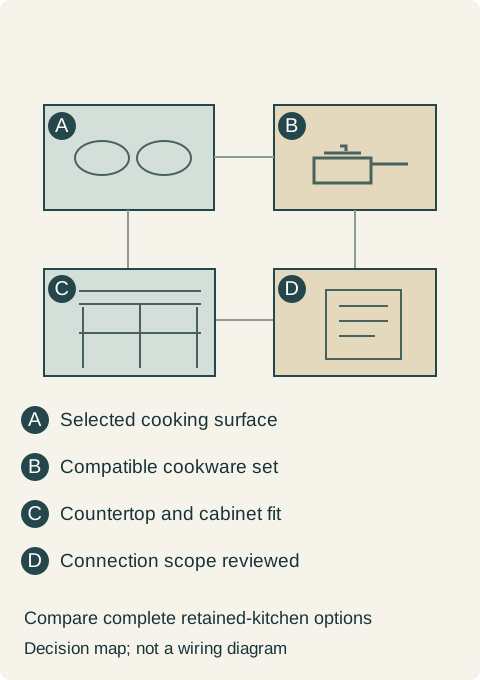
Teaching example The conversion has several connected decisions: A is the selected cooking surface, B the actual cookware set, C the cabinet and countertop arrangement, and D the professionally assessed connection scope. Lines show coordination, not wiring. No connection, cutout or cabinet-clearance dimensions are provided.
Price the connection change before calling the project simple
The installation instructions currently linked from GE's cited induction-cooktop owner page require direct wiring for the covered products and specify the electrical supply. That named requirement is a reason to assess the selected appliance, not a universal connection rule for every induction product.
Have the electrician assess the actual proposed appliance and the existing installation. The result should state the necessary work and what access it needs. A power outlet already serving a gas appliance does not by itself demonstrate that the induction candidate can use it. Do not buy an adapter or treat a different plug shape as the complete conversion plan.
Include professional handling of the existing gas connection and any work needed to leave the retained kitchen complete. The buyer needs a defined scope and price, not instructions for disconnecting a fuel line. Where work passes through a cabinet, coordinate the resulting access and occupied space with the cabinet design before calling the drawers unchanged.
Do not assume every conversion requires the same house-wide upgrade, either. The assessment may find a suitable existing provision or may identify additional work. Those are project results, not conclusions that follow from the word induction. Keep unresolved installation work out of an apparently final appliance-only comparison.
Retaining the counter is another decision
Compare the existing opening, material and support with the selected replacement's documented requirements. The same shopping width does not establish identical cutouts or cover an old opening. Have the responsible fabricator determine whether the counter can remain, needs an acceptable alteration or must be replaced as part of that option.
Below the surface, reserve the appliance, connections and required clear areas, then inspect the actual storage that remains. A thinner-looking glass face does not promise a deeper utensil drawer. The retained gas alternative also needs its own verified installation; it does not receive automatic approval because the kitchen already contains a gas cooktop.
Keep ventilation in the complete review. Changing the heat source does not itself decide which hood, route or cabinet enclosure the selected cooking arrangement needs. Treat any resulting change as part of the proposed kitchen rather than discovering it after the cooking appliance has arrived.
What an accepted conversion includes
A hypothetical household wants a smooth cooking surface while retaining its cabinet run. Its normal meal uses a large skillet and several smaller vessels. Review of the intended induction combination identifies a familiar saucepan that must be replaced. The owners accept a suitable replacement, then verify the whole pan layout and controls rather than assuming that replacing this one item finishes the comparison.
The electrical assessment identifies a defined connection scope that can be included in the planned renovation. The fabricator confirms an acceptable retained-counter solution, and the completed cabinet section preserves the owners' essential cookware drawer. The owner compares that complete package, including professional gas-connection work and the replacement pan, with a verified gas-cooktop replacement.
The household selects induction because it prefers the demonstrated cooking arrangement and accepts the full conversion cost. The order includes the agreed pan replacement and connection work; it does not list only a new cooktop while leaving the rest as an allowance to solve later. A separate preparation surface remains in the layout.
If the cookware change, required cabinet alteration or connection scope had been unacceptable, retaining a suitable gas cooktop would have been a coherent result. Neither choice is settled by a technology slogan. Buy the arrangement the household can use, install and afford as a completed kitchen, and reopen the affected decisions if the model or retained cabinetry changes.
Pure White
Cream White
Light Warm Gray
Gray
Navy
Black
Oak Tone
Dark Walnut Tone
Design study These finish studies are design references, not a list of currently orderable colors. Screens and lighting change the appearance; compare a physical sample before choosing.See all finish options →
A drawer front fitting under the counter does not establish usable storage. Verify the supported installation, reserve the required underside space and check the highest stored item through the drawer’s movement.
A rangetop is not simply a cooktop with different knobs. Its front opening and supporting cabinet can differ, while some cooktops also place controls through the cabinet face.
An under-countertop cooking system can preserve an uninterrupted surface, but it must be selected with the actual slab, finish, controls and cabinet space. A familiar induction label does not make any existing top compatible.
The sample shows the door frame, a separate center panel, the face frame and the cabinet box. Each component has its own place in this Shaker construction.
Shaker construction: door frame, center panel, face frame and cabinet box. The cutaway helps locate these parts; confirm each material in the specifications for the selected cabinet.
01 / Door frame
The Shaker door has rails and stiles around a separate center panel. The frame and center panel are different components; confirm their materials in the specifications for the selected cabinet.
02 / Face frame
The face frame surrounds the opening at the front of the cabinet box and sits behind the doors. The face frame, door frame and cabinet box are separate parts.
03 / Cabinet box
The sample exposes the cabinet sides, interior surfaces and layered edges. The image does not establish the wood species or material specification of a selected cabinet.