A pullout work shelf needs a lock-open function, not merely soft-close runners
Soft closing and holding an extended shelf are different jobs. Specify the lock, release access and correct cabinet application when the shelf will remain out during a task.
If a pullout shelf will remain extended while you arrange ingredients or handle an appliance, specify how it stays open. Soft-close describes controlled closing; it does not establish a positive hold in the working position. Full extension describes travel, and a load rating describes a separate support condition. None of those labels alone supplies a lock-open function.
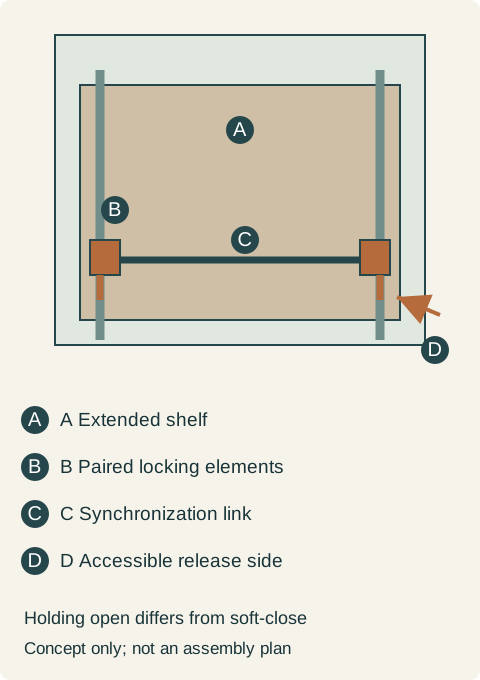
Blum's Pull-Out Shelf Lock is a dedicated full-extension stop with paired locking elements and a synchronized release accessible from either side. It illustrates an explicit holding function rather than a presumed property of a runner.
A working shelf must reach the position where the selected lock is intended to engage. An outer cabinet door, projecting handle or stored object can stop travel before that point. The user also needs to reach the release without first moving the items that the shelf is supposed to support.
Consider a bowl positioned across the front edge or a tray spanning the whole shelf. It may leave the work surface usable while concealing the release. The underside linkage also occupies real space. Do not assign every gap below the board to another storage layer without the complete hardware drawing.
Blum publishes a separate face-frame lock assembly alongside its other application information. A cabinet's frame construction therefore belongs in the hardware selection; the supplier should not order solely from a photograph of the release lever.
Teaching example Conceptual underside view of an extended shelf: locking elements act on both sides, and a synchronization link lets the paired locks release together. Their locations and proportions are explanatory, not installation dimensions.
Compare the promises in the cabinet quote
The proposed pullout is used to stage a bowl and ingredient containers while measuring. One quote lists full-extension, soft-close runners but no open-position restraint. Another identifies a compatible lock-open assembly and shows both the complete travel and a reachable release beside the loaded group. The latter satisfies this task's requirement to hold the surface extended; the former needs a revised specification before it can be compared as equivalent.
The selected configuration also leaves the shelf's planned contents below its separate support limits. Adding a lock does not increase runner capacity, strengthen an unsupported board or make the shelf suitable to sit or stand on. If an appliance will operate there, its own instructions and the shelf assembly's permitted use remain separate requirements.
A storage pullout may not need the same feature
A tray pulled forward only to remove a stored object has a different purpose from a surface left extended while working. Choose the function deliberately. Keep the quoted runner, lock, cabinet construction and loaded release access together so that a later substitution of “equivalent soft-close hardware” does not remove the feature that made the work shelf useful.
Pure White
Cream White
Light Warm Gray
Gray
Navy
Black
Oak Tone
Dark Walnut Tone
Design study These finish studies are design references, not a list of currently orderable colors. Screens and lighting change the appearance; compare a physical sample before choosing.See all finish options →
A soft-close upgrade starts with identifying the existing hardware. Closing assistance and opening assistance solve different tasks and may require different parts.
The sample shows the door frame, a separate center panel, the face frame and the cabinet box. Each component has its own place in this Shaker construction.
Shaker construction: door frame, center panel, face frame and cabinet box. The cutaway helps locate these parts; confirm each material in the specifications for the selected cabinet.
01 / Door frame
The Shaker door has rails and stiles around a separate center panel. The frame and center panel are different components; confirm their materials in the specifications for the selected cabinet.
02 / Face frame
The face frame surrounds the opening at the front of the cabinet box and sits behind the doors. The face frame, door frame and cabinet box are separate parts.
03 / Cabinet box
The sample exposes the cabinet sides, interior surfaces and layered edges. The image does not establish the wood species or material specification of a selected cabinet.