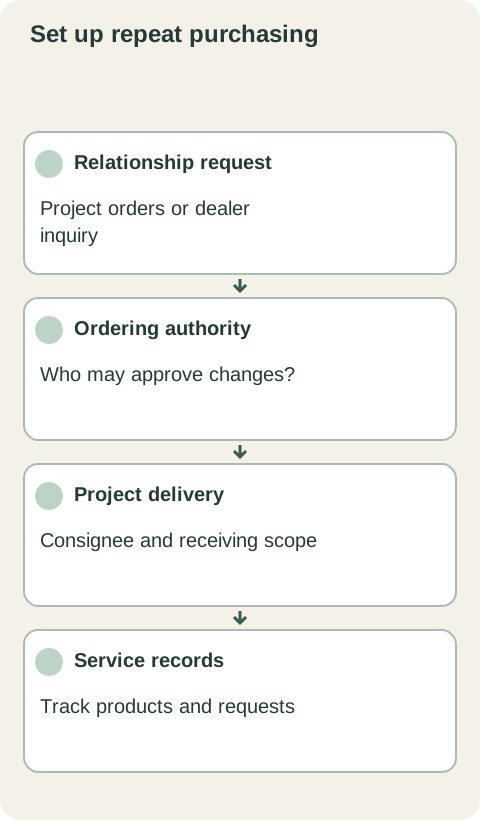
A contractor who buys cabinets for jobs and a business considering a dealer relationship may need different arrangements. Start by stating what you want to do: purchase for projects, receive repeat quotations, coordinate multiple jobs or discuss a formal sales relationship. A professional title does not establish an account, discount or credit line. When contacting usaKT.com, describe the arrangement you need and request confirmation of whether it is offered and on what terms.
State the purchasing relationship you need
Describe your business activity and how the cabinets will be used. Project purchasing, resale and representation are different conversations; keep the request specific. Cabinetworks Group publishes a partner inquiry for its own business, illustrating that a proposed relationship has a separate inquiry process. It does not establish another company’s eligibility or terms. Ask whether the requested arrangement is offered and what information is needed. Share business information through the agreed route and avoid treating an inquiry as approval.
Request the workflow for itemized quotes, drawing revisions and acceptance. Identify who on your team may select finishes, change quantities and authorize release. KraftMaid’s pricing FAQ explains that selections change the product package; a repeat purchaser still needs an order-specific specification. Ask how quote validity and substitutions are stated. Keep a customer’s approval linked to the items actually ordered. Do not use a reusable price sheet as proof that freight, stock or a future project’s terms are settled.
Diagram A title or inquiry does not replace an accepted arrangement.
Build receiving responsibility into each job
For every project, identify the consignee, delivery address, receiving contact and handling scope. A professional account should not become a substitute for a receiving plan. KraftMaid’s inspection guidance highlights checking the shipment; your team needs an assigned person who has the current item list. If cabinets go to a warehouse before the job, record the handoff and preserve labels. Distinguish the supplier’s delivery endpoint from transportation and carry-in your own business will arrange.
Ask whose name appears on orders and invoices, who receives notices and how payment records are matched to projects. If credit or billing terms are offered, request the applicable written agreement rather than assuming a trade account includes deferred payment. Keep your own customer billing separate from supplier terms. Establish how a staff change affects ordering authority so an old email chain does not remain the only evidence of approval. Record accepted amendments with the affected order.
Understand support before promising it onward
Ask how to identify products for shortages, damage, replacements or later service. Request the actual policy and route for each type of issue. Do not promise your customer a replacement date, reimbursement or coverage that has not been confirmed. Explain which work your business will perform and which requires a supplier decision. If you keep spares, identify them by project and finish. A clear after-order process matters for repeat purchasing even if no special account benefit is offered.
Judge fit using an actual project brief
Prepare a sample inquiry from a real planned scope without committing to unverified volume. Compare clarity of specification, completeness of quote, receiving arrangements and how revisions are recorded. Keep any proposed dealer terms in a separate relationship file and ask for the finalized agreement before relying on them. Routine purchasing can still be workable without a special program. The useful outcome is an agreed ordering process and responsibility map, with unresolved benefits left as questions rather than advertised promises.
Create a purchasing contact map
List the contact for quotations, the person who may approve product changes, the billing recipient and the job-site receiver. Give each role the information it needs while keeping the same order identifier throughout. When a customer requests a change, route it through the authorized approver instead of allowing a site conversation to modify the supplier order. If your business buys for several clients, retain separate acceptance records. This process remains valuable with ordinary purchasing terms and can later be carried into a formal account arrangement if one is agreed.
Before you release the order
Describe project purchasing and proposed dealer activity separately.
Confirm offered services and eligibility in writing.
Name staff authorized to approve each order.
Keep customer promises within confirmed supplier and installer scope.
Finish references
Pure White
Cream White
Light Warm Gray
Gray
Navy
Black
Oak Tone
Dark Walnut Tone
Design study These finish studies are design references, not a list of currently orderable colors. Screens and lighting change the appearance; compare a physical sample before choosing.See all finish options →
Compare appearance requirements and structural performance separately. A Premium aesthetic specification does not, by itself, purchase a higher structural duty level.
An unfinished cabinet purchase includes a separate finishing project. Compare the completed result, handling route and usable date before treating a lower cabinet invoice as savings.
An inspection report should state which pieces and which characteristics were examined. A passed sample does not certify every cabinet, and a full count is not a full performance test.
The sample shows the door frame, a separate center panel, the face frame and the cabinet box. Each component has its own place in this Shaker construction.
Shaker construction: door frame, center panel, face frame and cabinet box. The cutaway helps locate these parts; confirm each material in the specifications for the selected cabinet.
01 / Door frame
The Shaker door has rails and stiles around a separate center panel. The frame and center panel are different components; confirm their materials in the specifications for the selected cabinet.
02 / Face frame
The face frame surrounds the opening at the front of the cabinet box and sits behind the doors. The face frame, door frame and cabinet box are separate parts.
03 / Cabinet box
The sample exposes the cabinet sides, interior surfaces and layered edges. The image does not establish the wood species or material specification of a selected cabinet.