Commercial cabinet quotes: AWI aesthetic grade is separate from duty level
Compare appearance requirements and structural performance separately. A Premium aesthetic specification does not, by itself, purchase a higher structural duty level.
When a commercial cabinet proposal uses AWI grades, record the aesthetic grade and the required Performance Duty Level separately. Premium is not a substitute for a performance requirement. Conversely, meeting the specified duty does not settle the visible wood, surface treatment or workmanship expectations. A useful comparison keeps both requirements attached to the actual cabinets being quoted, then identifies any additional project-specific appearance details.
The classification has separate purposes
AWI identifies Economy, Custom and Premium as aesthetic grades controlling materials, workmanship and manufacture. It describes Performance Duty Levels separately as structural performance established through laboratory testing. These are different dimensions of a casework specification.
Read Custom as the named grade when it appears in this context. It is not simply a promise that the cabinet dimensions were customized. Likewise, a salesperson using premium as a general adjective has not necessarily offered the AWI Premium grade. The comparison needs the applicable standard, the intended classification and the offered product scope stated explicitly.
Translate appearance into visible surfaces
An AWI Architectural Wood Casework table for exposed interiors with transparent finishes illustrates a concrete distinction: Premium calls for the exterior species and cut; Custom calls for the exterior species. This example concerns the specified surface category, not every hidden part or door reverse.
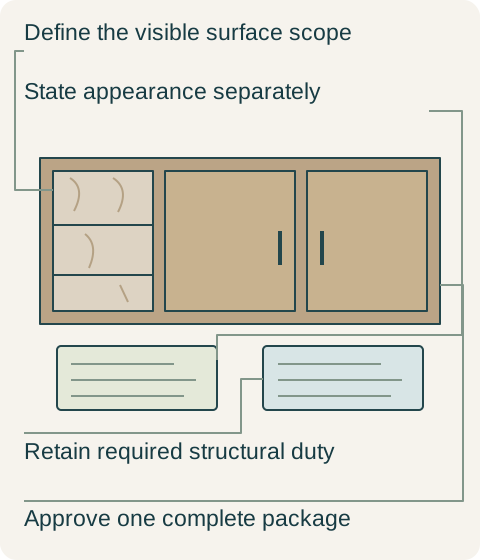
Teaching example Hypothetical commercial serving cabinet and separate appearance/performance review records. The drawing is an original purchasing diagram, not an AWI test specimen, compliance mark or construction detail.
That difference can matter in a glass-front display or an open serving cabinet. Naming oak alone may leave a buyer expecting a particular grain appearance that has not been stated. Mark the exposed interior faces on the elevation, then describe the appearance that matters there. Keep the selected wood cut and any separately required matching together. A grade label should help define the result rather than replace the drawing.
Do not reduce the entire aesthetic grade to this one table entry. Other applicable requirements still need review. Adding a particular interior appearance to a Custom-grade proposal does not turn the whole cabinet into Premium grade. It creates a specific project requirement alongside the named grade. Describe it that way so the supplier and reviewer understand exactly which additional work is included.
Keep use requirements out of the color column
Identify the actual use with the project designer: what the cabinets will hold, how they will be accessed and what installed assembly is proposed. Then retain the selected performance requirement while comparing appearance alternatives. Do not infer a suitable duty from a photograph of well-matched veneer, an expensive finish name or a heavy-feeling sample door. Those observations do not establish the structural classification.
The performance evidence also needs to correspond to the offered configuration. A relevant documented casework solution is more useful than a loose shelf or drawer demonstration attached to an unrelated cabinet drawing. Keep installation and support information with the package. Changing a drawer arrangement or the supplied construction should trigger review of what changed, rather than inheriting the earlier classification merely because the exterior still looks the same.
A breakroom order preserves performance and a specific display detail
Consider a hypothetical office breakroom with closed working cabinets and an open wood-lined serving niche. Its design team has already selected the structural duty requirement. The initial proposal specifies Premium aesthetics throughout. During a budget review, the team asks for a complete Custom-grade alternative at the same required duty, with a separately specified wood species and cut for the niche’s exposed interior faces.
The supplier returns a complete alternative that documents the same performance requirement and explicitly includes that niche detail. The team reviews the remaining aesthetic differences rather than assuming the niche clause makes everything equivalent. The alternative costs less in this hypothetical quote and its other visible treatments are acceptable to the project. The buyer selects it, retains the performance requirement and records the additional niche requirement in the final scope.
The decision saves on the accepted appearance package, not by quietly lowering structural expectations. It also avoids paying for a broader appearance grade merely because the team needed one particular visible detail. A different project may value the remaining Premium provisions and retain them. The example depends on an actual supported and priced alternative; it is not a general promise that a mixed specification is always cheaper.
Review both columns when a quote changes
Put the aesthetic grade, structural duty and specific appearance additions in separate fields of the comparison. Alongside them, keep the actual cabinet list, exposed-face drawing and evidence scope. This makes a supplier revision legible: a change to the grade, a changed performance claim and an omitted niche finish are different events. A single line reading equivalent quality can conceal all of them.
If an alternative changes several items, have the project designer evaluate the combined result before release. Do not add independent savings from incompatible proposals or preserve only the most favorable description from each. The selected package needs one coherent construction and appearance specification. A more detailed comparison is worthwhile when it prevents the approved drawing from describing one cabinet while the price covers another.
Approve the package without inventing a service-life guarantee
The final order should retain the selected classifications and the project-specific exceptions or additions that were accepted. At review and receipt, compare visible treatment against the appearance records and performance documentation against the offered construction. Neither column alone answers every question. This method applies when the project has chosen to use the relevant AWI framework; it does not establish that an unreviewed residential cabinet or a usaKT.com product meets those requirements.
Pure White
Cream White
Light Warm Gray
Gray
Navy
Black
Oak Tone
Dark Walnut Tone
Design study These finish studies are design references, not a list of currently orderable colors. Screens and lighting change the appearance; compare a physical sample before choosing.See all finish options →
A dramatic clip may show one surface or joint under one condition. Look for the tested assembly, method and result before applying it to a whole cabinet.
An unfinished cabinet purchase includes a separate finishing project. Compare the completed result, handling route and usable date before treating a lower cabinet invoice as savings.
The sample shows the door frame, a separate center panel, the face frame and the cabinet box. Each component has its own place in this Shaker construction.
Shaker construction: door frame, center panel, face frame and cabinet box. The cutaway helps locate these parts; confirm each material in the specifications for the selected cabinet.
01 / Door frame
The Shaker door has rails and stiles around a separate center panel. The frame and center panel are different components; confirm their materials in the specifications for the selected cabinet.
02 / Face frame
The face frame surrounds the opening at the front of the cabinet box and sits behind the doors. The face frame, door frame and cabinet box are separate parts.
03 / Cabinet box
The sample exposes the cabinet sides, interior surfaces and layered edges. The image does not establish the wood species or material specification of a selected cabinet.