Pre-shipment cabinet inspection: sampling or checking every unit?
An inspection report should state which pieces and which characteristics were examined. A passed sample does not certify every cabinet, and a full count is not a full performance test.
Buy pre-shipment inspection by its defined coverage, not by a single inspected stamp. Sampling can support a decision about a production lot; checking every unit can provide a record for each listed piece. Both still need clear requirements and a usable inspection method. For a cabinet order, the practical choice is often different coverage for identity, dimensions, appearance and operation rather than one percentage applied to everything.
Define what belongs to the lot
List the goods covered by the inspection before selecting any sample. Separate finished cabinet bodies, loose fronts, trim and hardware where their requirements differ. A door is not interchangeable with a carton as the inspection unit: a carton can contain several parts, and a correct carton label does not establish the condition of everything inside. Preserve that distinction in the report.
NIST describes acceptance sampling as selecting a random sample to decide the disposition of a lot. It emphasizes that the main purpose is deciding lot acceptability, not estimating the lot’s quality. A sample pass is therefore a bounded decision.
For a mixed kitchen order, identify the sizes, finishes and special components represented in the proposed coverage. A sample consisting only of convenient small doors will not tell you what was observed on the large exposed ends. This does not justify inventing a sampling plan at the packing bench; it means the supplier and inspector should settle the grouping and selection method before the visit.
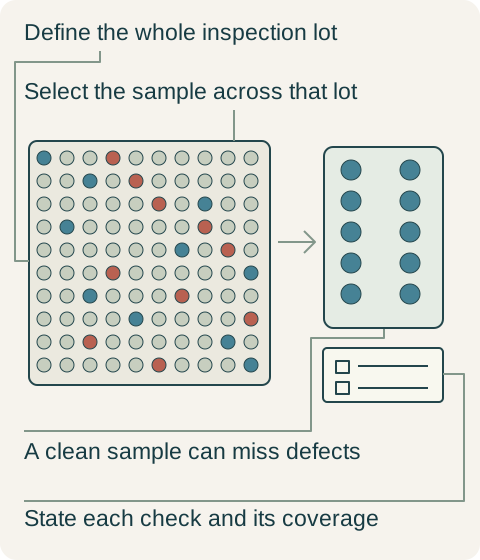
Teaching example Hypothetical model: the left grid has 100 units, including 10 red nonconforming units; the 10 blue selected units contain none of them. The right group shows that possible clean sample. Colors reveal the assumed model, not information an inspector would know without examining every unit.
Zero findings can occur in an imperfect lot
Consider a hypothetical lot of 100 doors, exactly 10 of which have a defined visible nonconformity. Select 10 doors uniformly at random without replacement, and assume the inspection detects that condition perfectly whenever it is present. The chance that every sampled door comes from the 90 conforming ones is C(90, 10) ÷ C(100, 10), about 33.05%. Here C means the number of unordered combinations. A clean sample is possible even in this deliberately imperfect lot.
NIST’s glossary identifies the hypergeometric distribution with counts from sampling without replacement. That is the mathematical model used here. The example does not select a suitable sample size, supply an industry defect rate or replace an agreed acceptance plan.
Do not read the hypothetical 33.05% as the probability that a real shipment is bad after a clean inspection. The calculation starts by assuming a particular number of nonconforming doors. In a real report that number is unknown. Nor does choosing the top pieces of a stack reproduce the random selection assumed in the calculation. The example explains a limitation of the evidence, not a verdict on any manufacturer.
Specify the characteristic as well as the piece count
ASQ explains that acceptance sampling plans specify sample sizes and acceptance or non-acceptance criteria. It distinguishes counts of nonconformities from measured variables such as length. Merely saying that some pieces were checked leaves both coverage and the decision rule unclear.
A cabinet inspector can identify every item against the order while measuring only a sample, or measure every front while examining only selected finish surfaces. These are different services. Write a separate line for each required characteristic and its coverage. For measurements, identify the drawing revision and limits used. For appearance, connect observations to the agreed finish reference and viewing conditions. A photograph of a ruler should show which part and which dimension it represents.
Choose the coverage that protects this order
In a hypothetical order of 100 replacement fronts made in several sizes, the buyer needs each part to arrive at the correct project position. The buyer selects an inspection scope that records identity and specified finished dimensions for every front. The supplier and inspector separately establish a documented acceptance-sampling plan for the repeated finish work, with the lot definition, selection method, appearance criteria and disposition rule stated before inspection.
This hypothetical buyer rejects an alternative report that offers a carton count plus photographs of selected attractive faces as if it covered every front’s dimensions. The chosen report contains individual measurement records and a separately identified finish-sampling result. If that finish lot is not accepted, its disposition follows the agreed plan; removing the photographed bad piece alone does not erase the failed lot decision. The buyer releases the order only when the required checks meet the agreed release criteria and any specified corrective review is complete.
More coverage still needs a meaningful method
Checking every piece for a stated dimension is broader unit coverage than checking a sample for that dimension, but it does not test concealed bond strength, coating chemistry or long-term hardware life. Even a complete list depends on the measurement and observation actually performed. Ask for the service you need rather than expanding a visual visit into a claim of comprehensive product certification.
Keep the report tied to the inspected lot and packing identity. Record repairs, substitutions or newly added pieces that occur afterward so they do not inherit results from goods the inspector never saw. Pre-shipment inspection also does not describe damage that may occur later in transport. At receiving, use the shipment’s own condition and contents record alongside the factory report. Each observation should retain its actual time, scope and purpose.
Pure White
Cream White
Light Warm Gray
Gray
Navy
Black
Oak Tone
Dark Walnut Tone
Design study These finish studies are design references, not a list of currently orderable colors. Screens and lighting change the appearance; compare a physical sample before choosing.See all finish options →
Compare appearance requirements and structural performance separately. A Premium aesthetic specification does not, by itself, purchase a higher structural duty level.
The sample shows the door frame, a separate center panel, the face frame and the cabinet box. Each component has its own place in this Shaker construction.
Shaker construction: door frame, center panel, face frame and cabinet box. The cutaway helps locate these parts; confirm each material in the specifications for the selected cabinet.
01 / Door frame
The Shaker door has rails and stiles around a separate center panel. The frame and center panel are different components; confirm their materials in the specifications for the selected cabinet.
02 / Face frame
The face frame surrounds the opening at the front of the cabinet box and sits behind the doors. The face frame, door frame and cabinet box are separate parts.
03 / Cabinet box
The sample exposes the cabinet sides, interior surfaces and layered edges. The image does not establish the wood species or material specification of a selected cabinet.