Laminate or quartz kitchen countertops: compare the completed top
A laminate top is a surfaced assembly; quartz is an engineered slab. Judge the finished edge, sink system, care and installed scope before treating a stone-like pattern or a material reputation as the answer.
Choose laminate when the offered finished assembly provides the appearance and sink arrangement you want within the accepted project scope. Choose quartz when you prefer the actual slab surface and its completed details enough to select that package. Neither decision should rest on a claim that every laminate top is flimsy or every quartz top can take unlimited heat. Compare the countertop you will use: its broad face, exposed edges, sink opening, joints and installation. A small decorative sample cannot represent all of those parts.
The supporting construction is different
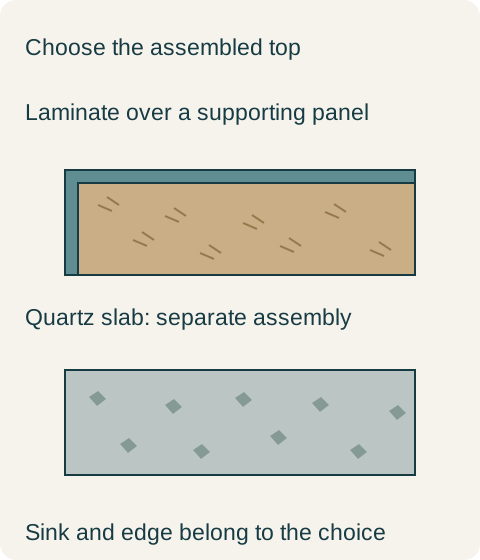
Formica describes HPL as resin-treated surface and kraft papers consolidated into a sheet, then applied to a substrate. The laminate supplies the decorative working face of an assembly. This is why an edge sample is more informative than a loose color chip: it shows how the selected face finishes over the supporting panel. The word laminate does not identify the whole countertop, and the same pattern could be offered with different finished details. Decide on the assembled top rather than pricing the decorative sheet as though it were ready to install.
Wilsonart describes its quartz as quartz crystals combined with resin, polymers and pigments. It is an engineered slab rather than a sheet of decorative paper on a separate wood-based top. That distinction identifies the material, but it does not establish that every offered quartz design has the same edge appearance or that it can span any cabinet opening unsupported. Review the proposed slab fabrication as its own complete assembly. A stone-pattern laminate and a quartz slab may fit the same color plan while remaining different purchases.
An undermount sink does not automatically exclude laminate
Formica identifies particular Karran undermount sinks for laminate and recommends professional installation to maintain the sealed junction. This is a system option, not permission to attach any sink beneath any laminate top. If undermounting matters, compare the offered compatible sink and top together. A general statement that laminate cannot have an undermount may wrongly eliminate a suitable proposal, while a general promise that all undermounts fit may create the opposite mistake. The actual joint and supplied basin settle this part of the selection.
Diagram Conceptual sections identify a laminate-faced panel and an engineered quartz slab. Thicknesses are exaggerated, the quartz drawing does not specify support, and neither section authorizes a sink installation.
A compatible sink keeps the laminate option in the comparison
In a hypothetical renovation, the owners initially rule out laminate because they want an undermount sink. The fabricator offers a compatible laminate-and-sink system with an edge sample they like, and the owners accept the bowl and complete installed scope. They choose that laminate package within their agreed budget instead of the quartz alternative. They retain the named sink system and finished edge in the order; a generic basin or a different edge is not an equivalent substitution. Their choice buys the assembled appearance and working sink they wanted without requiring a quartz slab.
Evaluate the edge from the places where it will actually be seen. A countertop viewed from a dining chair presents more edge than one seen only while standing. The exposed end of a peninsula also belongs in the sample discussion. Do not judge a whole laminate installation by an unfinished sample cut, or approve a quartz edge solely from the slab’s broad face. Compare finished examples with the intended edge shape. An accepted visible junction can be a legitimate design choice; it need not be defended as an invisible one.
The selected surface still needs heat and cutting protection
Formica’s installation-care article recommends cutting boards and heat pads and cautions against abrasive cleaning. Wilsonart’s quartz care likewise calls for cutting boards, trivets and nonabrasive cleaning. These instructions remove a misleading shortcut from the comparison: choosing quartz does not buy unrestricted hot-pan placement or direct chopping. For the hypothetical family, boards and heat protection already fit the cooking routine. The decision can therefore focus on the accepted surface and construction instead of assuming one name eliminates those habits.
Consider the sink perimeter as a finished detail that will remain visible and maintained. The proposed assembly should keep the substrate protected at its opening and provide the junction intended for the chosen sink. A spill-tolerant decorative face is not an instruction to leave water at an unresolved cut edge. In the example, the compatible installed system is part of what the owners accepted, so it cannot be replaced by merely cutting a hole into a different top and calling the appearance close enough.
Compare the work that arrives with the material
Keep fabrication, finished ends, openings, transport, installation and agreed supporting work in the price comparison. A decorative sheet, a countertop blank and a fitted kitchen top are different delivery stages. Likewise, a quartz slab price does not by itself include every finished edge and installation task. If the proposed change alters the backsplash or sink package, show that change separately. There is no useful universal price ranking when one number is for raw material and another includes the finished kitchen surface.
The accepted sample should show the finish the household will clean and touch. Look across a larger example when the pattern has strong movement, and review the planned joints rather than assuming the small swatch represents a continuous room-sized image. Keep the countertop and sink selections together through substitutions. In this project, the compatible undermount arrangement and preferred finished edge are essential to the laminate choice; losing either would reopen the decision rather than simply change a color code.
Pure White
Cream White
Light Warm Gray
Gray
Navy
Black
Oak Tone
Dark Walnut Tone
Design study These finish studies are design references, not a list of currently orderable colors. Screens and lighting change the appearance; compare a physical sample before choosing.See all finish options →
The exposed rim changes cleaning access, the visible opening and sometimes the operation of workstation accessories. Choose the edge relationship with the actual sink.
Compare the actual countertop products, heat-source routine and fabrication proposal. A fired porcelain slab and resin-bound quartz are different materials, but neither label replaces a complete kitchen specification.
The sample shows the door frame, a separate center panel, the face frame and the cabinet box. Each component has its own place in this Shaker construction.
Shaker construction: door frame, center panel, face frame and cabinet box. The cutaway helps locate these parts; confirm each material in the specifications for the selected cabinet.
01 / Door frame
The Shaker door has rails and stiles around a separate center panel. The frame and center panel are different components; confirm their materials in the specifications for the selected cabinet.
02 / Face frame
The face frame surrounds the opening at the front of the cabinet box and sits behind the doors. The face frame, door frame and cabinet box are separate parts.
03 / Cabinet box
The sample exposes the cabinet sides, interior surfaces and layered edges. The image does not establish the wood species or material specification of a selected cabinet.