Plywood shelf orientation: the grain you see is not the whole specification
Plywood has directional properties despite its cross-laminated construction. Identify the actual panel and its design direction before rotating a shelf cut to suit the visible grain.
Do not assume a plywood shelf performs identically after its cut orientation is rotated. Crossing the grain between layers makes plywood more balanced than solid lumber in its directional behavior, but it does not erase direction. Identify the panel construction and the direction used in its applicable performance information. Then coordinate the desired visible grain with the shelf's support arrangement before parts are cut.
Cross-lamination does not mean identical properties in every direction
Plywood places veneer layers in crossing grain directions. The contribution of those layers depends on their material, thickness and position through the panel. The USDA Wood Handbook states that plywood's differences in bending strength and stiffness along and across the panel are smaller than those of solid wood. Smaller differences are not the same as no difference.
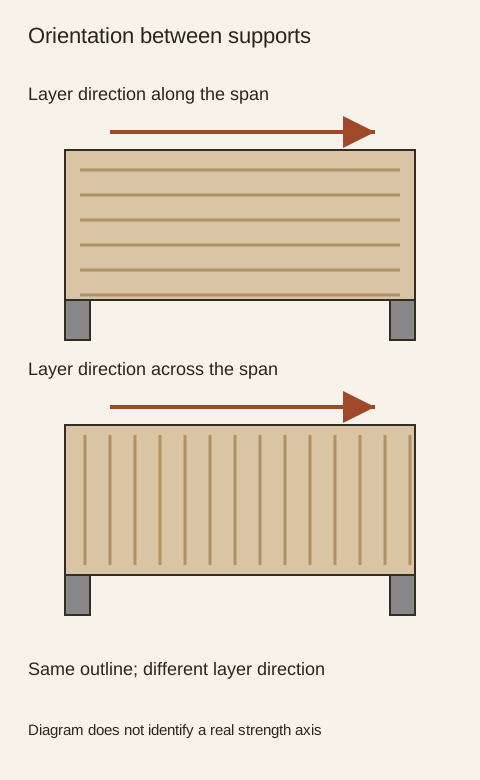
That distinction matters when a cut list turns a shelf to obtain a preferred grain appearance or fit more parts on a sheet. Keeping the outside shelf dimensions unchanged does not necessarily keep the same material direction between supports. A drawing that only labels width and depth can miss that change. Include a direction mark tied to the actual panel, rather than relying on how the finished surface happens to look.
Diagram The lines represent a conceptual layer direction, not a product's verified strength axis. The arrows show the span between the same supports. No relative capacity is assigned. Prepare and save project notes →
Mark the span before discussing along or across
Locate the supports that actually carry the shelf. For a simple shelf supported at its ends, the span runs from one supported end toward the other. Then show the identified panel direction relative to that line. Along the shelf, along the wall and along the original sheet are different references; any of them can cause confusion when an offcut is moved or rotated.
If a shelf has additional support at the back, a center divider or a designed front member, the behavior is not fully described by the simple end-supported sketch. Retain the actual support detail. Do not apply a generic orientation rule to a corner shelf, an unusually shaped panel or a component whose support conditions differ from those assumed in the documentation.
Decorative veneer can hide the information you need
The visible wood grain is an appearance layer. On an identified all-veneer panel, the face can provide useful orientation information when interpreted with the panel specification. On an unknown decorative panel, however, a thin face may cover a combination core, MDF or particleboard. A printed grain pattern may have no relationship to wood fibers in the core at all.
Columbia's core guide shows why the word hardwood plywood needs a core description. Different internal arrangements can sit beneath a similar decorative face. Ask whether the supplied structural or stiffness information describes the complete decorative panel, its underlying core or a different structural plywood. Do not turn an oak-looking surface into an engineering direction by eye.
Imagine a cabinetmaker has documented a shelf using an identified plywood panel with its specified direction running between the end supports. A revised nesting layout cuts the same shelf outline across the original sheet to reduce offcuts. The finished shelf still fits the cabinet and its surface may even look preferable. Yet the revision changes the panel direction relative to the span.
Before accepting the revision, ask whether the applicable shelf assessment covers that orientation. The maker may confirm it using appropriate data, restore the original cut direction or redesign the support arrangement. None of those answers can be obtained by measuring the outside outline alone. This hypothetical example assigns no strength ratio and does not claim the rotated shelf must fail; it identifies the assumption that changed.
Stiffness is not the same as breaking strength
A shelf may become inconvenient because it bends visibly long before a dramatic break occurs. Stiffness describes resistance to deformation; strength concerns failure under a specified test or design condition. The USDA treats elastic and strength properties separately. A claim that plywood is strong does not establish an acceptable shelf shape under the intended contents.
Also distinguish an initial load observation from long-term behavior. A brief demonstration with scattered objects does not reproduce years of storage, changes in moisture or concentrated loads. Request the maker's relevant shelf guidance instead of calculating a capacity from a generic material property found online. The actual panel, span, depth, thickness, support and loading arrangement still matter alongside direction.
Changing support can change the question
A properly designed intermediate support can shorten the span, but it must transfer load into a suitable part of the cabinet. A decorative divider that stops short of the shelf is not a support simply because it appears beneath it in a front view. Likewise, a strip touching the shelf without a specified connection should not be credited as structural reinforcement.
If a proposed material or cut direction changes, ask the maker to review the whole shelf detail. Do not add a center post, glue on an edge or move shelf pins solely to preserve an assumed capacity. Those changes can affect access and the cabinet around the shelf. A reviewed alternative can be useful; an undocumented alteration is a different assembly from the one described in the original guidance.
Keep direction identifiable through fabrication and delivery
The useful record includes the panel identification, component name, cut direction, support arrangement and applicable performance statement. When several shelf parts look alike, a labeled drawing or retained offcut can help the fabricator preserve the intended orientation. A finished decorative face by itself may be insufficient once the original sheet label has been removed.
Finish references
Pure White
Cream White
Light Warm Gray
Gray
Navy
Black
Oak Tone
Dark Walnut Tone
Design study These finish studies are design references, not a list of currently orderable colors. Screens and lighting change the appearance; compare a physical sample before choosing.See all finish options →
Hardwood plywood can have a veneer, fiberboard or particleboard core. Choose the core for the actual component, then verify the complete panel and connection details.
The sample shows the door frame, a separate center panel, the face frame and the cabinet box. Each component has its own place in this Shaker construction.
Shaker construction: door frame, center panel, face frame and cabinet box. The cutaway helps locate these parts; confirm each material in the specifications for the selected cabinet.
01 / Door frame
The Shaker door has rails and stiles around a separate center panel. The frame and center panel are different components; confirm their materials in the specifications for the selected cabinet.
02 / Face frame
The face frame surrounds the opening at the front of the cabinet box and sits behind the doors. The face frame, door frame and cabinet box are separate parts.
03 / Cabinet box
The sample exposes the cabinet sides, interior surfaces and layered edges. The image does not establish the wood species or material specification of a selected cabinet.