A long cabinet shelf should be selected from its complete support and loading conditions. Record the distance between the supports that actually carry it, the shelf construction and the intended contents. The cabinet’s outside width and a material label do not supply a usable load limit. If the shelf is already bowing, address that condition separately before adding more weight.
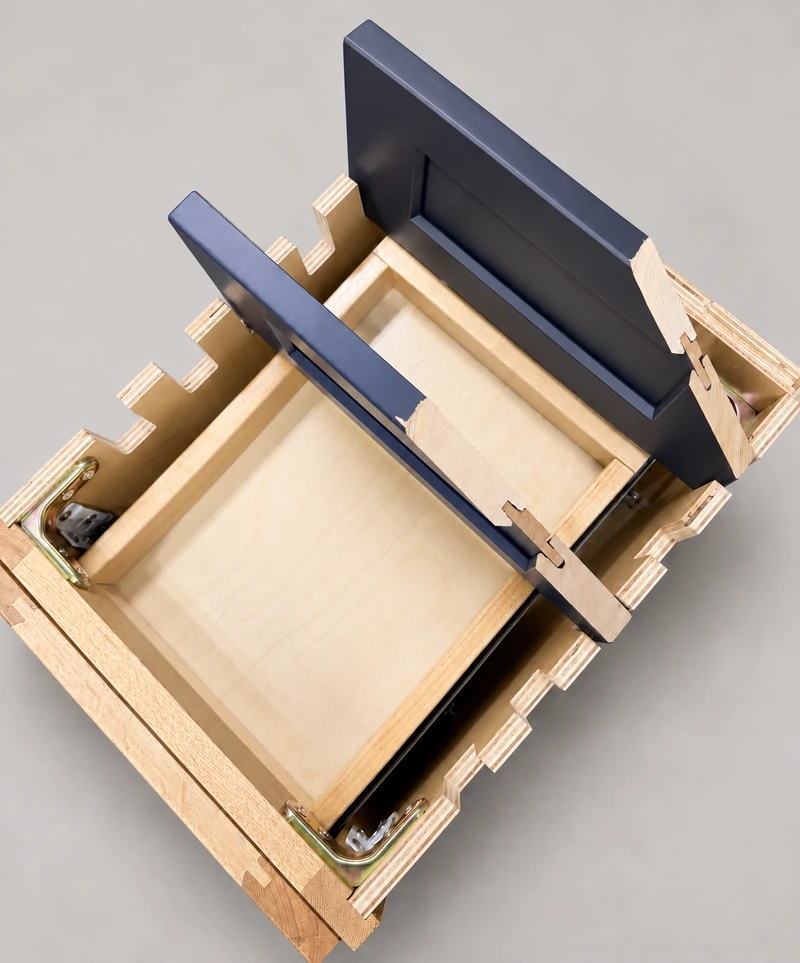
Physical sample Visible edges help distinguish panel thickness from an added facing. The sample is not a shelf-load test and does not show a rated unsupported span.
Measure the shelf and the supported opening separately
The shelf’s overall length includes the portions resting on supports; its unsupported span concerns the space between those supports. A cabinet face frame or decorative strip can obscure that distinction. Identify the actual shelf rests, sides, divider or other specified support instead of estimating the span from the door opening.
Record shelf depth and the specified thickness as well as length. Note whether it is adjustable or fixed and whether the visible front has a separate lip or reinforcement. A thicker-looking front edge may conceal a thinner panel behind it. Ask for the component section if the full construction cannot be seen, and keep your measurements distinct from dimensions supplied in the catalog.
Use material information as one part of the comparison
Columbia Forest Products’ core guide distinguishes spanning properties among veneer and composite cores. That is useful material context, but it does not provide a load rating for an assembled cabinet shelf with its particular supports and dimensions.
Ask for the exact shelf specification and any applicable load guidance for the quoted size. The answer should identify the support arrangement and loading conditions it assumes. A statement about the cabinet as a whole may not answer the shelf question. Likewise, a general capacity advertised for shelf-support hardware cannot automatically be treated as the capacity of the panel resting on it.
Describe where the contents will sit
Make a short list of the intended contents and how they contact the shelf. Several objects spread across the surface and a concentrated stack near the middle describe different uses. Include containers or inserts that remain on the shelf. If the future use is uncertain, state that uncertainty rather than requesting a rating for an undefined “normal household load.”
Do not test the shelf by leaning or standing on it, or by adding weight until it visibly bends. That does not reproduce a controlled product assessment. Nor should an improvised front strip or extra support be assumed to solve the issue without checking how the manufacturer permits the shelf and cabinet to be modified.
A worked choice when the preferred shelf lacks documentation
Imagine a wide shelf intended for a collection of heavy serving pieces. The first option has an appealing wood surface, but its quote says only “plywood shelf.” The second option provides shelf construction and load information for its stated support arrangement. Before choosing the first, send the intended contents and span to the supplier and request the missing product-specific answer.
If that answer remains unavailable, a documented alternative may be the more useful choice even if the first sample looks substantial. Another possible option is a manufacturer-approved arrangement with different support conditions; confirm that arrangement before ordering. The decision is about an actual shelf and load, not a universal ranking of plywood against every other panel.
Keep acceptance and maintenance observable
Save the shelf dimensions, construction, support type and applicable load statement with the order. Record any required support or restriction so it does not disappear during installation. At delivery, compare the shelf and supplied supports with the description. Report an unexpected thinner panel, absent support or damage before the shelf is put into service.
If an existing shelf develops a visible bow, reduce or remove its load as appropriate and document the condition while arranging an assessment. Photograph the whole opening and supports, not just the center curve. A deformed shelf may need more than rearranged contents. Avoid simply flipping it over and treating the symptom as resolved; first establish whether the panel, supports or cabinet connection needs attention.
Pure White
Cream White
Light Warm Gray
Gray
Navy
Black
Oak Tone
Dark Walnut Tone
Design study These finish studies are design references, not a list of currently orderable colors. Screens and lighting change the appearance; compare a physical sample before choosing.See all finish options →
A painted door, a wood-grain side and a plywood cabinet box can belong to the same cabinet. Here is how to read those parts, what the sample photos actually show, and which details to put on a quote.
Identify whether the visible cabinet end is an applied decorative panel, a finished structural side or a different construction option before approving the quote.
The sample shows the door frame, a separate center panel, the face frame and the cabinet box. Each component has its own place in this Shaker construction.
Shaker construction: door frame, center panel, face frame and cabinet box. The cutaway helps locate these parts; confirm each material in the specifications for the selected cabinet.
01 / Door frame
The Shaker door has rails and stiles around a separate center panel. The frame and center panel are different components; confirm their materials in the specifications for the selected cabinet.
02 / Face frame
The face frame surrounds the opening at the front of the cabinet box and sits behind the doors. The face frame, door frame and cabinet box are separate parts.
03 / Cabinet box
The sample exposes the cabinet sides, interior surfaces and layered edges. The image does not establish the wood species or material specification of a selected cabinet.