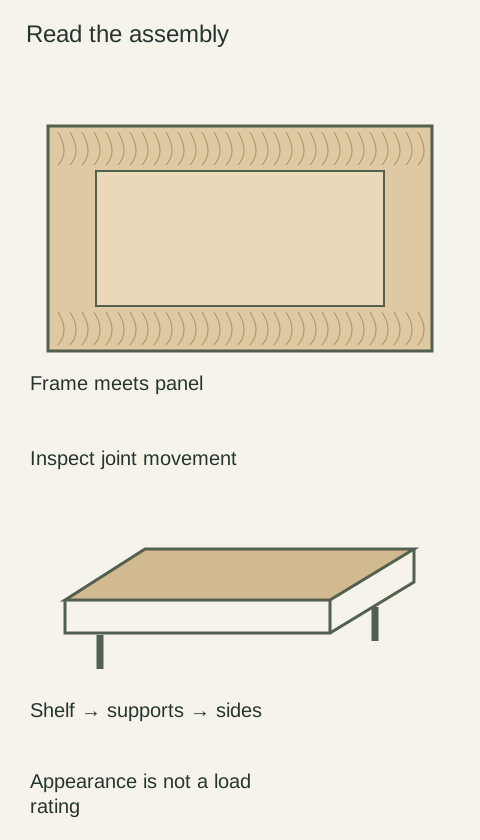
When an installed shelf appears to bow, rearranging its contents may reduce a concentration of weight, but it does not establish that the shelf and supports remain suitable. Remove accessible contents where this can be done safely, identify the shelf and document its condition. If the shelf or its supports appear unstable, seek assistance with unloading rather than continuing normal use. The next decision concerns the complete supported shelf, including its panel, bearing points and cabinet attachment.
Diagram Assess the actual panel and supports; the diagram supplies no load rating, safe span or repair design.
Record the shape and support relationship
Show the whole shelf and its location in the cabinet, then visible edges and supports. Describe whether the middle appears lower, an edge has lifted, a support seems displaced or there is a crack or other visible change. Do not treat every sloping shelf as a bowed panel; uneven support and panel shape are different questions that may need separate assessment.
Note when the change was noticed and whether contents or their arrangement changed beforehand. A photograph taken before unloading can preserve the original distribution if it can be obtained without delaying necessary action. Do not leave an unstable shelf loaded merely to produce better evidence. Describe the former contents afterward if that is the practical way to record them.
Unloading is not a capacity test
Where ordinary contents can be removed safely, keep them off the affected shelf while seeking guidance. Do not add a trial load, press down on the shelf or repeatedly shift heavy objects to test whether one location feels stronger. A temporary change in appearance after unloading does not establish a rated capacity or confirm the condition of its supports.
Avoid flipping the shelf and reloading it as an assumed correction. That may change what you see without addressing why it changed, whether the panel is suitable or whether the attachment is sound. If the manufacturer provides a specific response for that product, use it only after confirming that the actual shelf and condition fall within its scope.
Identify the panel and the whole support system
Find the cabinet model, shelf part information and published use guidance. Columbia Forest Products distinguishes spanning properties among panel core constructions in its material guide. This illustrates why a generic label such as wood shelf does not determine performance, but the guide does not rate your assembled cabinet shelf or its supports.
Provide visible support information and any earlier modifications. A replacement board of similar color is not automatically equivalent in material, thickness, fit or bearing arrangement. Ask the supplier to identify the appropriate shelf component and evaluate the supporting hardware and mounting locations together. Do not select a replacement solely by whether it fits through the door opening.
Separate redistribution from permission to reload
Imagine a group of heavy containers had been concentrated in the middle and the shelf now looks lower there. Moving them toward the sides may seem intuitive, but it is not proof that the changed shelf can continue carrying them. First establish the condition and the product's allowed use. Redistribution is relevant only within a suitable, intact system and its confirmed limits.
If another permitted location is available, check its own suitability before moving the whole load there. Transferring contents should not simply move the uncertainty to a neighboring shelf. Tell the supplier what the affected shelf carried and whether the proposed future use differs, so the response addresses both the observed change and the intended return to service.
Confirm what is being restored
A service proposal should distinguish replacement of the shelf panel from repair or replacement of supports or their mounting area. Ask which components were assessed and which remain unknown until access is obtained. A flat replacement panel is not a complete answer if a bearing point is still damaged or the intended loading remains incompatible with the actual product.
After the appropriate work, follow the confirmed loading and use instructions and retain the part record. Observe the shelf during ordinary use without creating a home proof test. If a visible change returns, report it with the earlier service history. The useful outcome is a suitable shelf and support assembly for the agreed use, not merely a temporarily straighter front edge.
Pure White
Cream White
Light Warm Gray
Gray
Navy
Black
Oak Tone
Dark Walnut Tone
Design study These finish studies are design references, not a list of currently orderable colors. Screens and lighting change the appearance; compare a physical sample before choosing.See all finish options →
Routine cleaning, a finish touch-up and a moving wood joint need different responses. Identify the surface and condition before applying a cleaner or repair product.
The sample shows the door frame, a separate center panel, the face frame and the cabinet box. Each component has its own place in this Shaker construction.
Shaker construction: door frame, center panel, face frame and cabinet box. The cutaway helps locate these parts; confirm each material in the specifications for the selected cabinet.
01 / Door frame
The Shaker door has rails and stiles around a separate center panel. The frame and center panel are different components; confirm their materials in the specifications for the selected cabinet.
02 / Face frame
The face frame surrounds the opening at the front of the cabinet box and sits behind the doors. The face frame, door frame and cabinet box are separate parts.
03 / Cabinet box
The sample exposes the cabinet sides, interior surfaces and layered edges. The image does not establish the wood species or material specification of a selected cabinet.