Veneer core, MDF core or combination core: compare hardwood plywood by its job
Hardwood plywood can have a veneer, fiberboard or particleboard core. Choose the core for the actual component, then verify the complete panel and connection details.
Yes, decorative hardwood plywood can contain MDF or particleboard beneath its wood face. The hardwood name may identify the visible veneer rather than every internal layer. Veneer core, composite core and combination core are different constructions within this product category. The useful choice depends on whether the part must span an opening, present a particularly even surface, receive hardware or do several of those jobs at once.
Read the core as a separate line in the specification
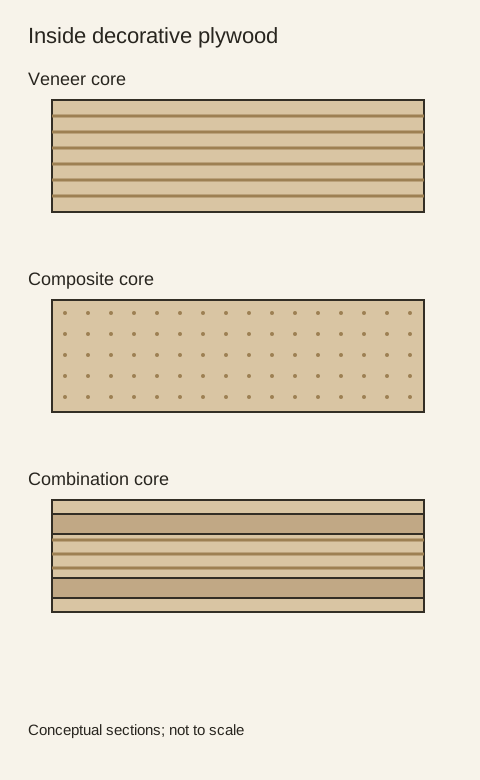
A veneer core consists primarily of bonded wood veneers with crossing grain directions. An MDF core uses a fiber-based panel; a particleboard core uses bonded particles. A combination core brings different materials together, often with veneer layers inside and smooth composite crossbands close to the decorative faces. The USDA Wood Handbook distinguishes decorative plywood from construction plywood and recognizes several possible center materials.
Do not collapse all of these into the word plywood, but do not dismiss a composite core as a mislabeled product either. Ask for the complete description: face species, core family, panel thickness, back construction and the cabinet component represented. A sample labeled oak plywood might provide only the face species. It says nothing by itself about the interior shelves, drawer bottoms or adjacent parts.
Diagram These sections distinguish core arrangements. They do not identify a usaKT.com panel, show actual layer thicknesses or rank finished cabinet strength. Prepare and save project notes →
Surface uniformity and spanning stiffness solve different problems
A broad, flat cabinet front draws attention to small surface irregularities. A shelf carrying dishes asks a different question: how much the panel bends between its supports. A smooth sample face cannot answer the shelf question, while a convincing shelf specification does not establish that the same panel will produce the desired painted or thin-veneered surface. Keep those performance questions separate while comparing cores.
Columbia's core guide describes smooth, uniform surfaces in its composite cores and compares their spanning behavior with veneer cores. Its Classic Core example places MDF crossbands near the faces over veneer inner layers to reduce the chance of underlying irregularities showing through. This demonstrates a reason to combine materials; it does not establish that every combination panel is superior or that usaKT.com uses that product.
A cabinet side may carry hinges, shelf supports and connections to the top and bottom. Ask which locations receive screws into the broad face and which receive connections into an edge. A published result for screw withdrawal from a face does not settle an edge connection with a different fastener. The panel around a hole, the fastener and its installation form a joint; the core name identifies only part of it.
For an unfamiliar construction, request a section or assembly detail rather than performing an improvised pull test on a display sample. Check whether the hardware instructions refer to the specified panel thickness and preparation. A different core substituted into the same-looking cabinet can require a different connection detail. The USDA separates bending properties from fastener-holding properties, which is why a single strength adjective is an incomplete comparison.
Imagine a kitchen with a broad decorative pantry side and an adjustable shelf for heavy serving dishes. Both are offered with the same wood veneer face. One proposal uses a combination core on the decorative side and gives a separate, documented shelf construction. Another uses a veneer core everywhere but supplies no shelf loading conditions. The second proposal is not automatically more suitable because its material description sounds more uniform.
For the pantry side, compare flatness, finished appearance, exposed-edge treatment and how the part is attached. For the shelf, compare its actual span, thickness, support arrangement and applicable load information. If the combination-core side provides the agreed appearance and the shelf has suitable documented support, the mixed construction can address the different jobs. If either proposal cannot answer the shelf question, leave that use unresolved. No capacity follows from this hypothetical example.
Weight matters where somebody or something carries it
Do not treat a heavier hand sample as proof of a stronger cabinet. It may indicate a denser core, a thicker panel, a larger sample or an added face layer. To compare handling weight, use equal-size specimens of known construction or request the component weight from its maker. Weight can matter for a large moving door and its hinges even when it is less important for a fixed panel that is properly supported.
Similarly, a lighter core does not authorize a larger unsupported shelf. The finish, joints and supports still need their own review. When a quoted door or side changes construction, ask whether the hardware selection and installed dimensions were reviewed along with it. A substitution that preserves the face color can still change the assembly behind that face.
Use the edge to confirm identity, not to invent a grade
A clean cutaway may reveal the arrangement of veneers and composite layers. Keep its label and the component description beside the photograph. A tiny dark line could be a glue line, shadow or local cavity; identifying the core family does not prove manufacturing consistency or bond quality. Do not peel the decorative veneer to find out how it was made. Ask for a supplied section sample if the construction is hidden.
Ask what an exposed edge will look like after fabrication. A layered appearance, a thin edge covering and a solid wood strip are different finish details. The diagram explains internal arrangements only; it does not specify an exposed plywood edge or a particular edging product. Avoid using a decorative edge photograph as evidence that every part of a cabinet shares its core.
Make a component decision you can check later
Write a short entry for the part: its job, named core, decorative face, back, specified thickness, exposed edges and the connection or support information that matters. State the unresolved question precisely, such as shelf load for the shown support arrangement or hinge preparation for the selected door. This makes the comparison more useful than a ranking of plywood, MDF and particleboard without a location or purpose.
Finish references
Pure White
Cream White
Light Warm Gray
Gray
Navy
Black
Oak Tone
Dark Walnut Tone
Design study These finish studies are design references, not a list of currently orderable colors. Screens and lighting change the appearance; compare a physical sample before choosing.See all finish options →
A painted door, a wood-grain side and a plywood cabinet box can belong to the same cabinet. Here is how to read those parts, what the sample photos actually show, and which details to put on a quote.
The sample shows the door frame, a separate center panel, the face frame and the cabinet box. Each component has its own place in this Shaker construction.
Shaker construction: door frame, center panel, face frame and cabinet box. The cutaway helps locate these parts; confirm each material in the specifications for the selected cabinet.
01 / Door frame
The Shaker door has rails and stiles around a separate center panel. The frame and center panel are different components; confirm their materials in the specifications for the selected cabinet.
02 / Face frame
The face frame surrounds the opening at the front of the cabinet box and sits behind the doors. The face frame, door frame and cabinet box are separate parts.
03 / Cabinet box
The sample exposes the cabinet sides, interior surfaces and layered edges. The image does not establish the wood species or material specification of a selected cabinet.