Exterior plywood is a bond classification, not a waterproof cabinet promise
A plywood bond label addresses a particular panel and exposure classification. It does not establish the moisture performance of the finish, joints, hardware or complete cabinet.
No plywood bond label, by itself, makes a finished cabinet waterproof. Exterior and Exposure 1 are classifications used for wood structural plywood, with different intended exposure conditions. They address the identified panel's adhesive bond and related construction requirements. The finish, wood condition, cut edges, joints, other cabinet components and installation still need evaluation for the actual environment.
Begin with the panel that actually carries the label
A cabinet description may say exterior glue, exterior plywood or water resistant without identifying a component. Ask which panel is being described and obtain its product information. A label on a cabinet side does not establish the shelf, back, door or drawer materials. Nor does a photograph of an unmarked layered edge demonstrate any bond class.
The USDA distinguishes construction and industrial plywood from hardwood and decorative plywood. These categories have different specification contexts. Do not take terminology from a structural sheathing guide and silently assign it to an unidentified decorative panel. Ask for the actual panel standard and manufacturer's description rather than assuming all plywood follows the same grading route.
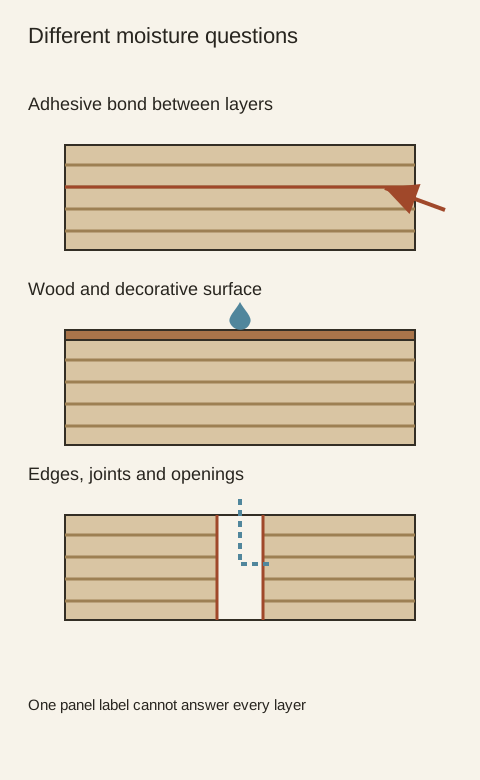
Diagram These are layers of review, not laboratory test results. The diagram does not identify a water-resistant usaKT.com product or a protective treatment. Prepare and save project notes →
Exposure classes are not a scale of cabinet quality
APA explains that Exterior panels are intended for repeated wetting and drying or longer weather exposure, while Exposure 1 addresses applications without long-term weather exposure, including limited construction moisture. These descriptions concern the class and intended use, not a household spill countdown. A panel's identification must match the claim before the distinction is useful.
Do not interpret the number in Exposure 1 as a number of hours, days or allowed leaks. Do not read Exterior as a strength grade or a statement that every surface will keep its appearance outside. The class answers an adhesive-exposure question. Thickness, grade, directional properties and the other requirements of the proposed use remain separate.
A durable glue line does not stop wood from interacting with moisture
The wood layers and the bond between them are related, but they are not the same thing. Wood can exchange moisture and change dimensions even when the adhesive remains effective. A decorative surface may show a change that is unacceptable to the owner without proving the bond has failed. Conversely, a good-looking face cannot verify the hidden condition of a wet edge.
APA explicitly separates bond classification from fungal-decay resistance. Its moisture guidance also considers in-service conditions and other design requirements. This is why a bond label should not be stretched into a claim of rot protection, flood survival or freedom from maintenance. The USDA's adhesive discussion likewise treats moisture-driven dimensional stresses as a distinct part of bonded wood behavior.
Follow the likely water route in the proposed cabinet: a pipe opening, a seam at the bottom, a fastener penetration or a junction with another material. Identify which components and treatments are actually specified at those locations. A neatly covered face does not establish how a cutout was finished. A tray can contain some spills under its stated conditions, but it does not change the underlying panel's identity.
Ask how the complete cabinet is intended to be used and maintained, including access to inspect plumbing and remove standing water. Do not substitute a homemade coating or sealant for an unverified cabinet specification. An added treatment can affect nearby finishes, hardware or service access. The responsible product and installation instructions need to address the actual proposal.
A hypothetical sink base and an outdoor kitchen
Imagine a sink-base proposal that names an Exterior-bonded plywood side, while the bottom, back and doors remain unspecified. That identified side is useful information. It does not establish that water collecting at a bottom seam will leave the entire cabinet unchanged. Ask for the missing component descriptions and the cabinet maker's intended-use statement before relying on the claim.
Now imagine using that same cabinet on a covered outdoor patio. A roof may reduce direct rain without reproducing the indoor conditions assumed for its finish, joints and hardware. The relevant question is whether the complete selected cabinet is approved for the proposed environment. An upgraded panel adhesive is not a substitute for that answer, and this hypothetical example does not recommend a particular outdoor construction.
Read a water demonstration for what was actually tested
A video of a loose panel in water may show a real observation, but identify the specimen, exposure, preparation and result. Was the panel edge sealed? Was it loaded? Was the claim about bond separation, thickness change or appearance? A short clip cannot silently become evidence about repeated service exposure or a cabinet assembled from other materials.
Ask for a test or technical statement that describes the actual product and relevant conditions. Do not conduct a destructive soak test on a cabinet sample and then extrapolate from an improvised result. If documentation is absent, record the moisture claim as unresolved and compare an alternative with a clearly stated intended use. Uncertainty is better preserved explicitly than hidden behind the word waterproof.
Keep the promise no broader than the evidence
Record the panel identity, claimed bond class, relevant source and the cabinet components to which it applies. Separately record the complete cabinet's permitted environment and care instructions. If the seller provides only a general material brochure, keep that distinction visible. A brochure can explain a material family without verifying the exact cabinet configuration in your drawing.
Finish references
Pure White
Cream White
Light Warm Gray
Gray
Navy
Black
Oak Tone
Dark Walnut Tone
Design study These finish studies are design references, not a list of currently orderable colors. Screens and lighting change the appearance; compare a physical sample before choosing.See all finish options →
The sample shows the door frame, a separate center panel, the face frame and the cabinet box. Each component has its own place in this Shaker construction.
Shaker construction: door frame, center panel, face frame and cabinet box. The cutaway helps locate these parts; confirm each material in the specifications for the selected cabinet.
01 / Door frame
The Shaker door has rails and stiles around a separate center panel. The frame and center panel are different components; confirm their materials in the specifications for the selected cabinet.
02 / Face frame
The face frame surrounds the opening at the front of the cabinet box and sits behind the doors. The face frame, door frame and cabinet box are separate parts.
03 / Cabinet box
The sample exposes the cabinet sides, interior surfaces and layered edges. The image does not establish the wood species or material specification of a selected cabinet.