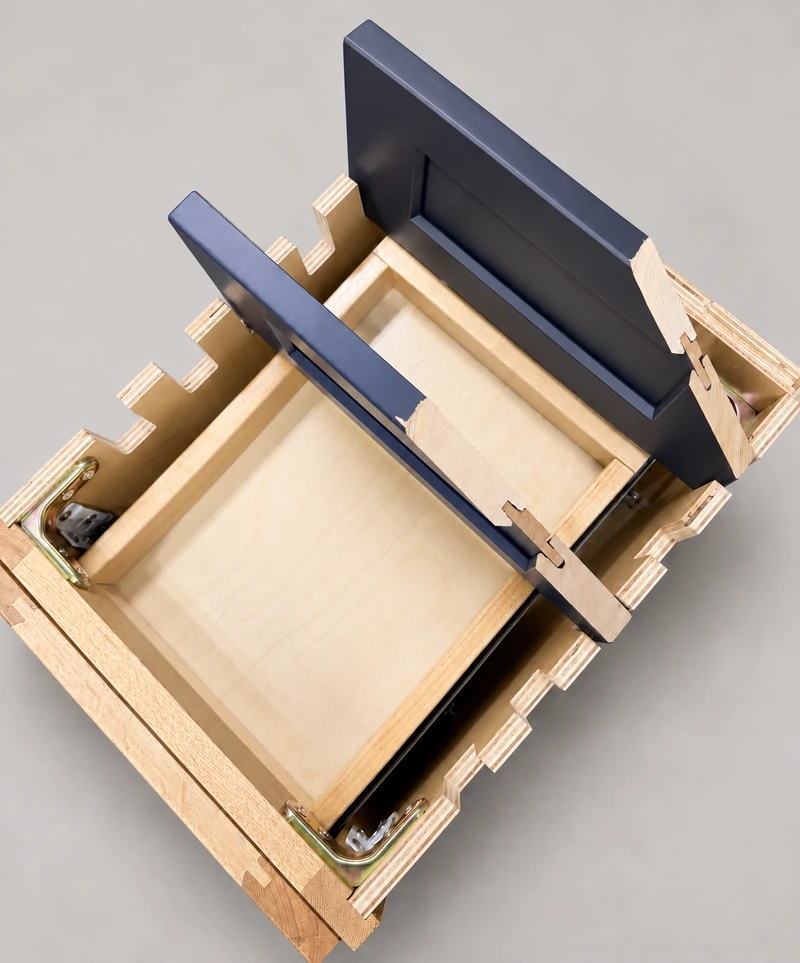
A visible plywood edge is useful evidence of how that particular piece is layered. It is a poor shortcut for ranking an entire cabinet. Examine the edge, identify the component it belongs to, and connect it with the supplier’s construction description. Counting dark and light lines alone cannot establish the panel grade, bond quality, shelf capacity or the materials used elsewhere in the cabinet.
Physical sample Follow the layered edge to its surrounding sample box. The adjacent painted component has a separate cut face; this image does not establish grades, void tolerances or thicknesses.
Start by identifying the piece
On a cutaway, follow the exposed edge back to the full part. Is it a cabinet side, a shelf, a drawer bottom or a decorative sample holder? A layered strip beside a painted door does not prove that the door has the same core. Photograph the part from far enough away to show its location before taking a close view of the edge. Keep the sample label in a separate picture so someone reviewing the images can connect them to the quoted series.
Look for a clean factory cut that represents the panel, rather than a crushed shipping corner or an area broken open for display. Damage from cutting or handling can make an edge look rough without explaining how the intact panel performs. Conversely, a carefully selected display piece cannot establish consistency across a shipment.
Read layers without inventing a grade
APA describes plywood as cross-laminated wood veneers bonded together. Its structural-panel guidance also distinguishes selection criteria such as grade, thickness and bond classification. Those criteria require identification; an unmarked cabinet sample does not acquire an APA rating because layers are visible.
Use the edge to form specific questions. Are the visible layers continuous along the accessible cut? Is there a dark line that could be a gap, or merely a glue line or shadow? Does the face veneer appear to stop cleanly at the edge? Record what you see without assigning a hidden cause. A photograph can document an opening, but it cannot test the bond inside a panel.
A gap needs a location and a purpose
A suspected void matters differently depending on where it occurs and how the part will be used. Mark its position relative to a corner, fastener or finished edge. If it is near a proposed hardware attachment, the supplier or fabricator needs that location to assess the actual assembly. Do not drill a new hole or fill the area merely to make the sample look acceptable.
Also distinguish a local cavity from separated layers extending along an edge. Describe each plainly and request an explanation tied to the exact panel. There is no universal visual rejection threshold in this guide. The agreed product specification and the manufacturer’s assessment must decide whether the observed condition is acceptable for that part.
Work through a comparison before choosing
Imagine comparing a shelf sample with clearly visible thin layers against another sample with fewer, thicker-looking layers. The first quote names only “plywood”; the second names the shelf construction and provides its intended support and load information. The layer count does not resolve the choice. First confirm that both samples represent shelves of the quoted thickness, then compare the complete shelf information and the finish at the exposed front edge.
If the first supplier cannot identify the sample, keep that uncertainty in the comparison. If either sample has a cavity, attach its photograph to the question about that exact part. This turns a general argument about “better plywood” into a purchase decision about the shelf you will receive.
Put the answer into the order record
Write the cabinet series, component name, specified thickness, core description and exposed-edge treatment beside the sample identification. Request a replacement sample or written clarification if the display and quotation disagree. Record whether an observed issue concerns the sample alone or has been assessed as representative of the ordered product.
Keep those photographs with the final order. At delivery, compare identifiable components and report discrepancies before altering them. The aim is a traceable match between sample, specification and delivered cabinet; a neat-looking stack of layers is only one observation in that chain.
Pure White
Cream White
Light Warm Gray
Gray
Navy
Black
Oak Tone
Dark Walnut Tone
Design study These finish studies are design references, not a list of currently orderable colors. Screens and lighting change the appearance; compare a physical sample before choosing.See all finish options →
A painted door, a wood-grain side and a plywood cabinet box can belong to the same cabinet. Here is how to read those parts, what the sample photos actually show, and which details to put on a quote.
Judge a painted MDF door by its actual profile, finished edges and construction, with a sample that represents the size and details you intend to order.
Check the edge-to-face transition, corners and visible match on a finished sample, and separate appearance questions from claims about hidden bonding quality.
The sample shows the door frame, a separate center panel, the face frame and the cabinet box. Each component has its own place in this Shaker construction.
Shaker construction: door frame, center panel, face frame and cabinet box. The cutaway helps locate these parts; confirm each material in the specifications for the selected cabinet.
01 / Door frame
The Shaker door has rails and stiles around a separate center panel. The frame and center panel are different components; confirm their materials in the specifications for the selected cabinet.
02 / Face frame
The face frame surrounds the opening at the front of the cabinet box and sits behind the doors. The face frame, door frame and cabinet box are separate parts.
03 / Cabinet box
The sample exposes the cabinet sides, interior surfaces and layered edges. The image does not establish the wood species or material specification of a selected cabinet.