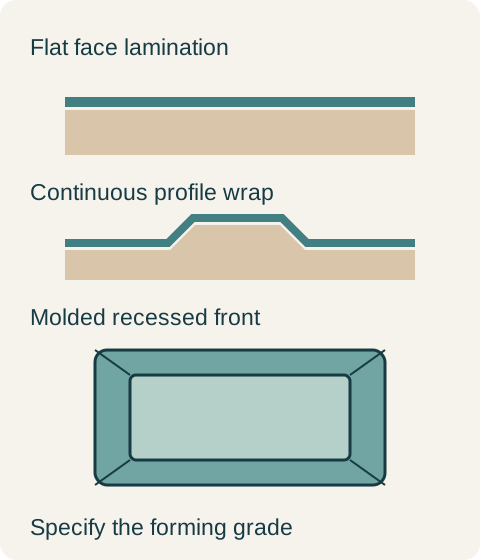
Do not approve a routed PET cabinet door simply by keeping the film name from a flat slab proposal. PET surfaces can be supplied for different manufacturing methods. The question is whether the particular film and process are suitable for the desired face, recesses and corners. A flat finished sample cannot answer that question on its own.
PET is not a synonym for flat-only construction
RENOLIT’s cited Premier Matt brochure distinguishes a variant for flat lamination and profile wrapping from a variant optimized for thermoforming. It describes the latter for molded furniture fronts made from MDF. This provides a specific counterexample to the claim that all PET finishes are limited to flat doors. It does not establish that every PET film can be formed into any profile.
Profile wrapping and forming a complete recessed door face are different manufacturing tasks. A film that follows a continuous profile is not automatically approved to cover the meeting slopes and corners of a routed front. The application named for the exact film matters more than the broad polymer label or a color that appears in both product families.
Changing the door geometry also changes what the sample must demonstrate. The visible result now includes the recessed field, transitions, corners and outer edge, not just a broad flat color. A full representative front shows whether the selected process delivers the intended appearance at those places. The film, routed substrate and manufacturing method form the package being approved.
Teaching example Conceptual flat, wrapped-profile and recessed-front geometries. Not a forming recipe, radius limit, heat rating or promise that all PET films fit all shapes.
Accept the formed-door package when the profile is essential
Suppose a hypothetical cabinet order begins with matte PET slab fronts. The buyer then chooses a recessed profile. The original flat-lamination offer is replaced with a documented thermoformable film variant, an appropriate routed substrate and professional forming scope. After approving the completed representative door, the buyer accepts that revised package. The original flat film is removed from the production specification rather than being carried forward because its color name matches.
In the hypothetical comparison, the alternate is evaluated at finished-door level, including forming and edge completion. A quote that changes only the MDF machining while leaving the film unspecified is incomplete. If the profile does not justify the new package, retaining the original slab design is the other clear choice; calling the change a minor routing update conceals the actual tradeoff.
A forming designation does not establish service heat resistance
The ability to shape a film during controlled manufacturing is different from the finished cabinet’s suitability near a heat source. The grade choice therefore does not remove the need for the completed door’s application and care information. Nor does it prove that PET is categorically better than another polymer in every kitchen use.
Retain the exact film variant, substrate profile, process scope and approved finished sample together. Compare later substitutions against that complete description. This lets a buyer choose the desired door shape without mistaking a polymer name for a manufacturing specification, while leaving temperatures, adhesives and equipment settings with the documented professional process.
Pure White
Cream White
Light Warm Gray
Gray
Navy
Black
Oak Tone
Dark Walnut Tone
Design study These finish studies are design references, not a list of currently orderable colors. Screens and lighting change the appearance; compare a physical sample before choosing.See all finish options →
Review the cabinet finish, appliance instructions and exposed edge locations together before choosing foil-covered doors near equipment that produces heat or steam.
Judge a painted MDF door by its actual profile, finished edges and construction, with a sample that represents the size and details you intend to order.
A color name does not identify a finish system. Compare the decorative surface, the core, the edge and the repair method before choosing a cabinet front.
The sample shows the door frame, a separate center panel, the face frame and the cabinet box. Each component has its own place in this Shaker construction.
Shaker construction: door frame, center panel, face frame and cabinet box. The cutaway helps locate these parts; confirm each material in the specifications for the selected cabinet.
01 / Door frame
The Shaker door has rails and stiles around a separate center panel. The frame and center panel are different components; confirm their materials in the specifications for the selected cabinet.
02 / Face frame
The face frame surrounds the opening at the front of the cabinet box and sits behind the doors. The face frame, door frame and cabinet box are separate parts.
03 / Cabinet box
The sample exposes the cabinet sides, interior surfaces and layered edges. The image does not establish the wood species or material specification of a selected cabinet.