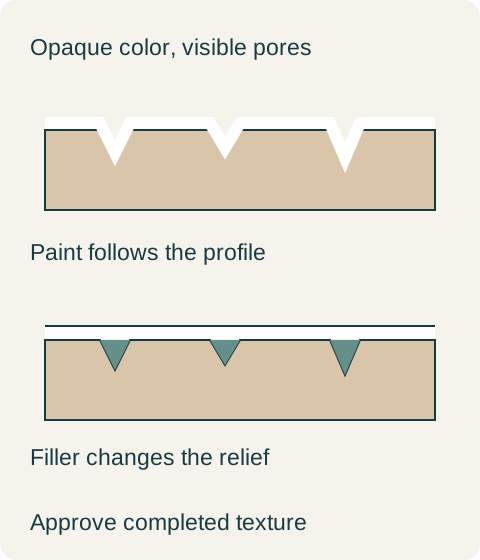
An opaque painted oak door can still show the wood’s pore pattern in side light. If the project requires a smooth filled appearance, put that texture requirement into the finishing scope before comparing quotes. A color name and a promise of full coverage describe color hiding; they do not necessarily describe the surface relief that remains beneath the paint.
Pore filling addresses the surface profile
Mohawk’s published Grain Filler data sheet describes filling the pores of open-grained woods such as oak. It separately states that this material is not intended to repair large holes, cracks or gouges. The distinction is between filling the natural pore structure and repairing a different kind of damage.
A coating can conceal color while following the existing contours. Light striking obliquely makes those contours easier to see because raised and recessed areas reflect differently. More opaque paint does not, by definition, make the underlying profile level. The intended result should therefore be judged in ordinary frontal light and in representative side light, rather than only by whether the original wood color has disappeared.
A pore-filling operation must belong to a compatible complete finishing system. The cited filler description explains its function; it does not approve that particular material under every cabinet paint. The finishing shop should select and demonstrate the actual preparation and coating combination. A buyer can specify the desired completed texture without prescribing an unverified recipe.
Teaching example Hypothetical enlarged sections. Pores and layers are exaggerated; the diagram shows color hiding versus filling, not coating thickness or a promised texture tolerance.
Doors and exposed frames need the selected texture scope
Suppose a hypothetical owner retains oak doors but wants the painted fronts to read as a comparatively smooth surface. The first completed sample has the right color and an intentionally visible pore pattern. A second completed sample includes a compatible pore-filling preparation and has the accepted texture under the project’s side lighting. The owner chooses the second scope, including that preparation on the retained doors and matching exposed frame surfaces, rather than buying the first and expecting another ordinary coat to erase the texture.
In the hypothetical comparison, the textured sample is not automatically defective. It demonstrates a different finish outcome that another buyer might prefer. The approved filled sample becomes the appearance reference for this job, with any remaining visible texture understood at approval. The purchase is not a promise of a perfectly featureless surface under every possible inspection light.
Separate pore texture, joints and physical damage
A joint line, a dent and an open pore are different features. Filling pores does not establish that a moving door joint will disappear, nor does it replace a repair plan for damaged wood. Keep those conditions visible in the initial assessment. Otherwise a quotation for grain filling can be mistaken for an unlimited guarantee to remove every mark on a retained door.
Compare like-for-like finished samples and include the same exposed components in each offer. If only the doors receive the selected texture treatment while the adjacent face frame retains a pronounced pore pattern, the completed cabinet may show a difference the color sample never revealed. State the treatment boundary and the accepted surface character together before the work starts.
Pure White
Cream White
Light Warm Gray
Gray
Navy
Black
Oak Tone
Dark Walnut Tone
Design study These finish studies are design references, not a list of currently orderable colors. Screens and lighting change the appearance; compare a physical sample before choosing.See all finish options →
A color name does not identify a finish system. Compare the decorative surface, the core, the edge and the repair method before choosing a cabinet front.
The sample shows the door frame, a separate center panel, the face frame and the cabinet box. Each component has its own place in this Shaker construction.
Shaker construction: door frame, center panel, face frame and cabinet box. The cutaway helps locate these parts; confirm each material in the specifications for the selected cabinet.
01 / Door frame
The Shaker door has rails and stiles around a separate center panel. The frame and center panel are different components; confirm their materials in the specifications for the selected cabinet.
02 / Face frame
The face frame surrounds the opening at the front of the cabinet box and sits behind the doors. The face frame, door frame and cabinet box are separate parts.
03 / Cabinet box
The sample exposes the cabinet sides, interior surfaces and layered edges. The image does not establish the wood species or material specification of a selected cabinet.