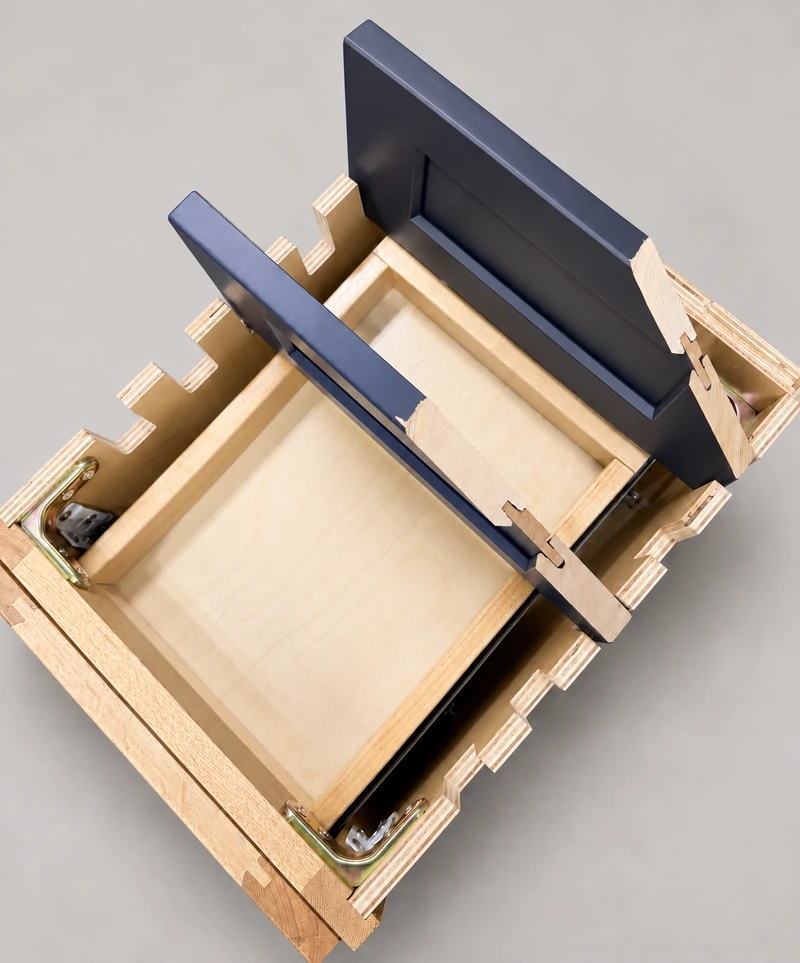
A replacement door needs to match the cabinet as it looks now, as well as fit correctly. Start with the original product identity and a representative physical reference, then compare the proposed replacement beside the fronts that will remain. An old finish name is a useful lead, but it is not a guarantee that a newly made door will be visually indistinguishable.
Physical sample A physical reference can reveal profile and surface details together. This sample is not an example of an older finish or a guaranteed replacement match.
Recover the product identity before shopping by color
Look for the original invoice, order record and accessible cabinet labels. Preserve photographs of labels before copying the information into your request. Include door style, wood or surface material, finish, decorative treatments and sheen when known. Mark missing details as unknown rather than selecting a likely color from a website and treating the guess as a confirmed identification.
KraftMaid’s identification guidance, for example, points owners to order information and photographs of the center panel and edge profile. This illustrates why a close color photograph alone is an incomplete identification record. It does not establish that another supplier can reproduce an older door.
The damaged door may not be the best color reference if its face is stained, faded unevenly or otherwise altered. Identify a representative neighboring front and explain where the replacement will sit. Also note whether the room contains visibly different groups of existing doors. Matching a protected interior face may not reproduce the exposed exterior you will actually see.
Before judging color, clean the reference only according to its known finish instructions. Do not sand, polish or apply a color-restoring product to create a target for the supplier. That changes the evidence. If the existing finish cannot be confidently identified or safely cleaned, discuss the condition as part of the assessment instead of presenting an altered sample as the original appearance.
Build a comparison package with useful views
Provide a whole-front photograph, a close view of the inner and outer profiles, the reverse and relevant labels. Include a photograph showing the replacement location with its neighbors. Images help identify shape and context, but screen color cannot be treated as the finished match standard. Ask whether a physical reference can be reviewed and how it will be protected and returned.
Keep fit information separate but connected: actual door dimensions, thickness, handing and hardware preparation still need confirmation. A visually close door that cannot use the intended hinges is not a successful replacement. Do not drill or modify the candidate simply to try it while the supplier is still assessing appearance or while its agreed return conditions remain relevant.
A worked decision when the old color name is available
Imagine finding the original finish name and receiving a current sample under that name. Its broad color is close, but it looks cooler and more reflective beside the neighboring installed doors. The name helped locate a candidate; the side-by-side check revealed that the result does not yet meet your expectation.
Ask what can actually be offered: another documented option, an assessed custom match if available, or a consciously different treatment for a coordinated group. Each alternative needs a sample and clear scope. Do not assume a new door will automatically become identical after time passes, or authorize a whole set based on the hope that the difference will disappear once installed.
Agree on the visual outcome before final release
State whether the aim is the closest available replacement, a reviewed custom match or a coordinated contrast. Keep the accepted physical reference, finish description and any acknowledged difference together. If only a photograph has been reviewed, record that limitation and agree when an actual sample or finished item will be evaluated before further irreversible work.
On receipt, compare the clean, dry replacement with the same neighboring surfaces under the lighting used for approval. Confirm fit and appearance before drilling, installing or discarding the old reference. Report a concern with the product labels and complete comparison view. The successful outcome is an agreed, usable replacement, not merely a new door carrying a familiar color name.
Pure White
Cream White
Light Warm Gray
Gray
Navy
Black
Oak Tone
Dark Walnut Tone
Design study These finish studies are design references, not a list of currently orderable colors. Screens and lighting change the appearance; compare a physical sample before choosing.See all finish options →
A color name does not identify a finish system. Compare the decorative surface, the core, the edge and the repair method before choosing a cabinet front.
The sample shows the door frame, a separate center panel, the face frame and the cabinet box. Each component has its own place in this Shaker construction.
Shaker construction: door frame, center panel, face frame and cabinet box. The cutaway helps locate these parts; confirm each material in the specifications for the selected cabinet.
01 / Door frame
The Shaker door has rails and stiles around a separate center panel. The frame and center panel are different components; confirm their materials in the specifications for the selected cabinet.
02 / Face frame
The face frame surrounds the opening at the front of the cabinet box and sits behind the doors. The face frame, door frame and cabinet box are separate parts.
03 / Cabinet box
The sample exposes the cabinet sides, interior surfaces and layered edges. The image does not establish the wood species or material specification of a selected cabinet.