Paint existing cabinets or reface them: decide what needs to change
Repainting retains the existing fronts; refacing can replace them and cover fixed exterior faces. Compare the desired door shape, retained interior and complete finished scope.
Repaint when you want to keep the existing cabinet fronts and change their finish. Reface when the cabinet structure still suits you but the fronts themselves need a different design, with a coordinated treatment for the fixed exterior surfaces. Both routes can retain the layout. The useful starting point is what you want to see, touch and use afterward, rather than which service is advertised as the quickest kitchen update.
Try the new color on the old door shape
Look at an existing door with its color mentally removed. Do you still want its arched panel, raised center, broad frame or decorative edge? A new opaque color can change the impression of that door, but it does not replace its shaped construction. Judge the profile in side light and from across the room. If the profile is the feature you dislike, a color rendering alone can make a repaint proposal look more complete than it is.
Next look at the drawer fronts, exposed cabinet ends and trim. A plain door beside a strongly molded drawer front may leave an unintended mixture. Changing doors alone also leaves the existing fixed surfaces to be resolved. The proposed result should explain how those parts meet visually, including the small exposed bands between fronts, rather than presenting an attractive replacement door in isolation.
What the two services actually retain
Benjamin Moore’s cabinet painting guidance includes removing hardware and doors, cleaning, surface preparation, priming and drying. Its sequence makes clear that a repaint project involves work on the existing surfaces, beyond choosing a paint color.
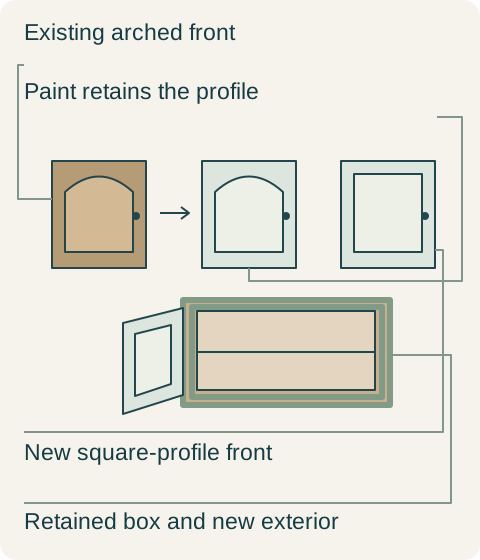
Teaching example Original hypothetical comparison. Repainting changes the illustrated front’s color while refacing uses a different front and covers agreed fixed exterior surfaces. The retained interior remains visible; this is not a product or installation specification.
WalzCraft describes refacing as replacing visible components such as doors and drawer fronts while retaining the cabinet structure. Its refacing materials include veneers and solid wood stock. This provides a different starting scope from coating the existing fronts; the actual proposal must identify the parts being replaced or covered.
Before choosing either route, decide whether the boxes and existing storage arrangement are worth retaining. Open every cabinet and use the drawers with their normal contents. Record a damaged interior, an inconvenient partition or a drawer that you want to replace as a separate issue. New color and new fronts are not evidence that those concerns have been resolved. If the retained structure fails the project’s needs, this comparison may lead outside both proposals.
Inspect a complete corner, not only a loose door
For repainting, the accepted sample should use a representative existing surface and the proposed preparation and coating system. It should show the texture you will retain as well as the color. Do not treat a smooth sample board as a promise that an old textured door will become equally smooth. This is a finish acceptance step; the contractor still needs to establish that the old surface is suitable for the work.
For refacing, review a small assembly that includes a new front, the adjacent fixed face and an exposed end. Look at the junction between materials and the visible edge when the door opens. The point is not to demand that every hidden surface be replaced. It is to know which surfaces will remain old, which will be new and whether that division is acceptable in everyday use.
Have the proposal identify hardware that is retained, replaced or adapted. Reusing a handle may leave its existing holes relevant to a repaint job; a new front permits a different hole layout only when that is actually specified. Replacement fronts also need a compatible attachment and opening arrangement. A photograph of the desired door style does not establish those details for the existing cabinet.
Square fronts solve a problem that paint cannot
In a hypothetical kitchen, the owners like the cabinet layout and the usable interior storage. The old fronts are intact, but they dislike their arched raised panels. A proposed painted sample looks attractive in the new color, yet the arch still dominates the wall. Their goal is a simpler square-front composition, not merely a lighter finish.
They compare a repaint of the existing doors with a refacing package that supplies new square-profile doors and coordinated drawer fronts, treats the fixed faces and exposed end, and includes the required hardware fitting. They accept the unchanged interior finish after reviewing an open-door sample. There is no promise that the interiors will look newly manufactured.
They select the refacing package within their stated project budget because it delivers the intended front design while retaining the storage they already like. They remove an optional interior recoloring item that would not improve the way they use the cabinets. The completed scope includes the visible end and trim, so the selected front is not left surrounded by an unresolved old finish.
Compare the finished jobs rather than a price per door
Put each proposal beside a cabinet elevation and mark its included surfaces. Include the door backs, drawer fronts, face frames or cabinet edges, exposed ends, toe area and any trim that participates in the design. Mark retained surfaces explicitly. The list may differ between the two routes; it should not differ accidentally because one contractor counted only the fronts.
Include removal, transport if needed, reinstallation, hardware work, protection of nearby surfaces and final adjustment in the same comparison. A repaint proposal with substantial preparation can legitimately contain different labor from a refacing proposal with new components. Compare actual totals for the agreed result. Neither the number of doors nor the words “paint” and “reface” establish a universal price order.
Discuss when the cabinets can be handled and returned to service under the selected finish system. A surface that looks dry is not automatically ready for every use, packaging method or cleaning product. Keep those release instructions with the final scope rather than relying on a generic promise that every cabinet makeover finishes on the same schedule.
When the existing door shape is already right, a qualified repaint can be the complete choice: the project changes its finish and deliberately retains its design. When the shape is wrong but the boxes remain suitable, replacing the fronts can address the actual objection. Purchase the change you need, with the retained parts visible in the decision.
Pure White
Cream White
Light Warm Gray
Gray
Navy
Black
Oak Tone
Dark Walnut Tone
Design study These finish studies are design references, not a list of currently orderable colors. Screens and lighting change the appearance; compare a physical sample before choosing.See all finish options →
Refacing can change the visible kitchen while retaining its cabinet structure. Decide whether that retained interior and layout still solve the household’s storage problem before buying the new appearance.
Compare the actual countertop products, heat-source routine and fabrication proposal. A fired porcelain slab and resin-bound quartz are different materials, but neither label replaces a complete kitchen specification.
The sample shows the door frame, a separate center panel, the face frame and the cabinet box. Each component has its own place in this Shaker construction.
Shaker construction: door frame, center panel, face frame and cabinet box. The cutaway helps locate these parts; confirm each material in the specifications for the selected cabinet.
01 / Door frame
The Shaker door has rails and stiles around a separate center panel. The frame and center panel are different components; confirm their materials in the specifications for the selected cabinet.
02 / Face frame
The face frame surrounds the opening at the front of the cabinet box and sits behind the doors. The face frame, door frame and cabinet box are separate parts.
03 / Cabinet box
The sample exposes the cabinet sides, interior surfaces and layered edges. The image does not establish the wood species or material specification of a selected cabinet.