Reface the existing cabinet boxes or replace the cabinets?
Refacing can change the visible kitchen while retaining its cabinet structure. Decide whether that retained interior and layout still solve the household’s storage problem before buying the new appearance.
Choose refacing when the existing cabinet boxes and their arrangement are worth keeping, and the proposed new surfaces and fronts deliver the change you actually want. Choose replacement when the retained structure prevents the required storage or when its condition does not justify building another finish package around it. Refacing is not automatically a lesser renovation, but a good-looking new door does not make the space behind it new. Start by deciding what must improve when the cabinet is open as well as when it is closed.
What remains after the visible kitchen changes
WalzCraft describes refacing as replacing visible doors, drawer fronts and hardware while retaining the existing cabinet structure. That is the central purchasing boundary. A new drawer front can cover the same old drawer box; a new door can still open onto the same shelf arrangement. Draw the retained case separately from the replacement fronts. This makes the offer understandable without assuming that every item shown in a finished-room rendering is newly supplied.
Open the existing cabinets before discussing colors. Put the items that cause trouble into their actual storage positions. If a large pan cannot pass through a fixed opening, covering the frame does not make that opening wider. If a drawer is awkward because its useful interior is too small, a more attractive face does not create the missing volume. Those observations tell you whether the desired change is mainly visual or whether the project needs different cabinet construction. Some internal improvements may be feasible, but they are additional designed work, not an automatic feature of refacing.
The surface package includes the stationary parts
WalzCraft’s refacing methods use different combinations of veneer, plywood and solid stock; existing surface condition, space and corner treatment help determine the method. A door-only price therefore should not be mistaken for a complete refacing price. The stationary frame and exposed cabinet ends remain part of what you see. Their junction with the new fronts needs an accepted treatment. A beautiful loose door sample cannot show whether the completed corner, end and frame will look like the kitchen you approved.
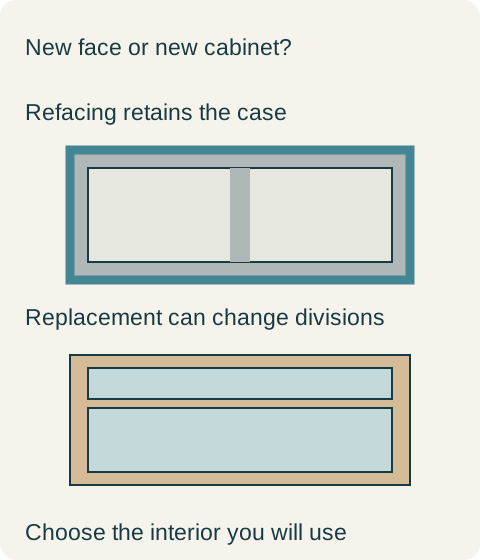
Diagram Conceptual comparison of a retained cabinet case with new facing and a replacement case with a different internal division. Colors identify scope; they do not show a particular finish or a structural repair.
A new front cannot fix the storage this family wants
In a hypothetical renovation, the room arrangement works and the old cabinets are serviceable, but the family wants wide drawers for cookware that the current narrow compartments cannot accommodate. They review a refacing proposal that retains those compartments and a replacement proposal that provides the accepted drawer interiors. They choose replacement, even though they like the refacing sample and could have kept the existing boxes. The reason is specific: preserving that structure would preserve the storage limitation they are paying to remove. The new cabinet package includes the agreed internal arrangement rather than merely a new exterior.
A different household could reach the opposite decision in the same room. If the existing compartments already hold everything comfortably and only the visible finish is unwanted, retaining them may be entirely sensible. Refacing should then be assessed on its complete appearance, fitting and retained condition. This is why a universal percentage saving is a poor substitute for a project comparison. Spending less on a change that leaves the main problem intact is not the same outcome as spending less while achieving the intended result.
Added material changes the finished outside
A refacing skin occupies space. Even without assigning a generic thickness, it is clear that covering an exposed end moves its finished face outward. Covering a frame changes the surface against which the new fronts and hardware are fitted. Review the finished arrangement where it meets an appliance, adjoining cabinet, wall return or trim. These are reasons to draw the new surface, not only trace the old one. The method should preserve the clearances required by the actual assembly rather than relying on the fact that the old kitchen operated before the work.
Keep repairs and cosmetic coverage separate. A decorative skin should not be treated as proof that a loose joint, deteriorated base or damaged attachment area has been restored. The proposed retention decision needs an assessment of the parts that will keep carrying the cabinet’s work. If a local repair is accepted, identify it as part of the scope and evaluate the resulting assembly. If the case cannot support the intended service, hiding its surface is not the same purchase as replacing it with a sound case.
A refreshed outside can coexist with an older inside
Decide whether the interiors are retained as they are, cleaned, refinished or replaced in selected places. Looking into an open cabinet is a normal part of ownership. A new outside with an old inside may be completely acceptable, but it should be an intentional result. The same applies to drawer boxes and moving hardware. Keep existing items clearly identified and judge them on how they work. Do not call the whole kitchen new hardware when the quoted change covers only hinges or pulls.
The countertop and surrounding finishes also belong in the scope comparison. Determine which proposal retains them and which requires removal, alteration or replacement. Reusing a top is a project-specific undertaking, not an entitlement created by the word refacing; replacing the cabinets is likewise not a price for all surrounding work unless that work is included. In the hypothetical family’s accepted replacement package, the consequences for the countertop and adjoining finishes are included in the decision, so the better drawer arrangement is not purchased against an artificially incomplete renovation figure.
Compare the offers by retained parts, new parts and necessary work, then decide whether each finished kitchen meets the same objective. For the family that needs different interiors, replacement solves a problem refacing would leave behind. For owners satisfied with their existing storage, a well-specified refacing package can deliver the desired visible change while keeping useful cabinets. The meaningful saving is useful construction retained in a kitchen that works, rather than the number of old parts that remain hidden behind new doors.
Pure White
Cream White
Light Warm Gray
Gray
Navy
Black
Oak Tone
Dark Walnut Tone
Design study These finish studies are design references, not a list of currently orderable colors. Screens and lighting change the appearance; compare a physical sample before choosing.See all finish options →
A painted door, a wood-grain side and a plywood cabinet box can belong to the same cabinet. Here is how to read those parts, what the sample photos actually show, and which details to put on a quote.
Compare the actual countertop products, heat-source routine and fabrication proposal. A fired porcelain slab and resin-bound quartz are different materials, but neither label replaces a complete kitchen specification.
The sample shows the door frame, a separate center panel, the face frame and the cabinet box. Each component has its own place in this Shaker construction.
Shaker construction: door frame, center panel, face frame and cabinet box. The cutaway helps locate these parts; confirm each material in the specifications for the selected cabinet.
01 / Door frame
The Shaker door has rails and stiles around a separate center panel. The frame and center panel are different components; confirm their materials in the specifications for the selected cabinet.
02 / Face frame
The face frame surrounds the opening at the front of the cabinet box and sits behind the doors. The face frame, door frame and cabinet box are separate parts.
03 / Cabinet box
The sample exposes the cabinet sides, interior surfaces and layered edges. The image does not establish the wood species or material specification of a selected cabinet.