Open or sealed gas burners: choose the whole rangetop and its cleanup routine
Compare the cooking arrangement, removable parts and surrounding kitchen before choosing an open-burner or sealed-burner appliance. The burner label does not rank the complete purchase.
Choose an open-burner gas appliance when the actual cooking arrangement suits your meals and you accept its documented routine for collecting spills and handling removable parts. Choose a sealed-burner candidate when its cooking layout and fixed surface suit you better. Neither label settles how easy the whole kitchen will be to maintain. The useful purchase comparison includes the grates, collecting surfaces, controls, surrounding counter and place where removed parts will be washed.
Start with the appliance format already intended for the kitchen. A rangetop above storage and a range containing an oven are different purchases, even if their burners look similar. Keep the oven location and storage brief visible while comparing the cooking surfaces. Otherwise an appealing burner demonstration can quietly change the furniture and equipment package being priced.
Look beneath the grate without inventing a disassembly
The cited BlueStar RNB rangetop lists open burners and removable stainless-steel drip trays. That identifies a particular collection-and-cleaning arrangement; it does not establish that every part, or every open-burner appliance, has the same care procedure.
Wolf states that the burner pans on its SRT sealed rangetops are not removable for owner cleaning; removal requires a service technician. A fixed pan and a removable collecting tray therefore involve different care locations.
Ask to see the owner-removable pieces of the exact candidate and its care instructions, with the appliance cool and out of use. Identify what remains in place and what is intended to leave the appliance. A seam around a component is not permission to lift it out, and a piece removed during servicing is not automatically an everyday cleaning part.
The term sealed also does not mean that the appliance needs no cleaning or that every joint is liquid-tight. Buy the construction shown for the selected product, not an imagined promise that any spill will stay where you want it. Conversely, a collecting tray that comes out has not made the collected material disappear; someone still needs to handle that tray.
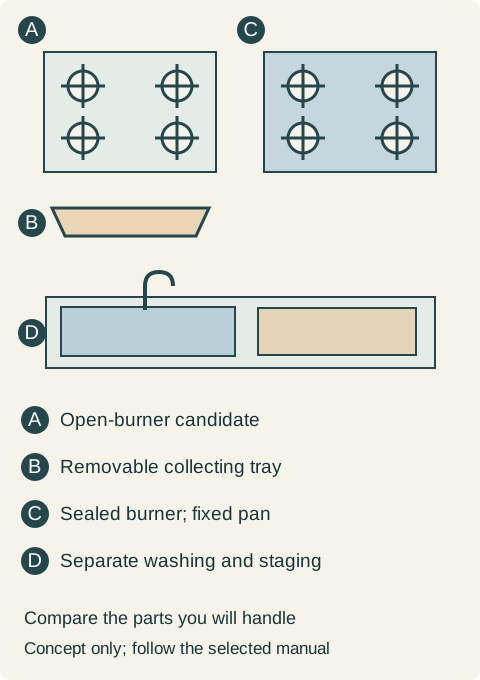
Teaching example Conceptual comparison of care locations, not a product cross-section: A identifies an open-burner candidate, with a removable collecting tray represented separately at B. C identifies a sealed-burner candidate with a fixed burner pan. D is the separate sink and staging area used when the selected instructions call for washing removable parts. No burner removal, spill path, clearance or cleaning procedure is illustrated.
Follow the removable part to a real destination
When comparing care routines, follow the actual piece from the appliance to its permitted washing place and back. Can the person responsible carry it comfortably? Where will it rest without using the only food-preparation surface? If the instructions call for hand washing, does the sink arrangement accommodate the piece and the owner's handling method? A large removable component can be easy to expose yet awkward to wash in a small sink.
Do not assume all grates, trays and burner components have the same permitted treatment. Even when a product page describes a tray as dishwasher-friendly, that does not approve every other part or establish that the owner's dishwasher can accommodate the tray alongside the daily load. Resolve the selected pieces and instructions individually before counting an appliance as effortless to clean.
A fixed burner pan leaves its cleaning work at the appliance. Consider access to the rear and corners with the prescribed owner-removable items taken into account. The adjacent counter can be useful for approved temporary staging, but it should not depend on moving dinner preparation into a walkway. These are practical use comparisons, not directions to dismantle a gas appliance.
Try the movements with clean display parts or an appropriate demonstration. A photograph of an empty surface will not tell the owner whether a grate is awkward to grasp or whether the part occupies the entire sink. The person doing routine care should take part in this assessment, even if another household member is most interested in cooking.
Bring the meal, not a burner-count contest
Arrange the important cold, empty pans on each candidate. Include the large skillet, small saucepan and covered pot used together, with their real handles. Check access to the controls and the ability to lift a pot without first moving another one. A surface can offer many burner positions while the household's actual vessels make some of them inconvenient to use together.
For cooking behavior, use a properly supervised demonstration under the product instructions. Identify the task you care about, such as controlling the familiar saucepan or using the preferred skillet. Do not infer that the words open or sealed alone predict a better simmer, faster meal or better result. Those conclusions require the actual equipment and task.
Optional griddles, charbroilers or other cooking areas should earn their space through real use. If the household regularly needs its ordinary pans at the same time, replacing their positions with a special surface may be the wrong exchange. If a dedicated surface is important, compare the whole selected configuration and its care, rather than attributing that benefit to the burner category.
A kitchen chooses the fixed-pan arrangement
In a hypothetical remodel, the owners already plan a rangetop with storage below and an oven elsewhere. They compare an open-burner candidate with a removable collecting tray and a sealed-burner candidate with a fixed pan. Both can accommodate their normal pan group, and supervised demonstrations leave them satisfied with the cooking tasks they actually perform.
The decision changes during the care trial. The owner responsible for cleaning can handle both sets of approved removable parts, but the open candidate's collecting tray would require the only large sink bay and the neighboring staging surface. Those places are occupied by the household's usual evening cleanup. The fixed-pan candidate keeps that part of the work at the appliance, which this owner prefers.
They choose the sealed-burner rangetop after confirming the full installation and cabinet package. The plan retains a suitable adjacent staging area for the parts that do come off under its instructions; it does not pretend the selected appliance has no removable grates or no care work. They accept cleaning the fixed surface in place instead of planning to remove it.
Another household with a suitable washing setup may prefer the removable-tray candidate after the same comparison. The result above does not make open burners intrinsically troublesome or sealed burners intrinsically cleaner. It records which routine this particular kitchen can support without competing for the evening's working space.
Finish the purchase beyond the cooking surface
Compare the exact appliance, selected cooking options, required installation work, ventilation coordination and affected cabinetry. A burner preference does not approve an existing gas provision, countertop opening or support. The responsible trades need the actual model information; this is a purchase scope, not a gas-connection instruction.
Keep meaningful differences visible in the quotations. If one proposal includes a different oven arrangement, special cooking surface or changed cabinet run, identify that difference instead of crediting the entire price change to open or sealed burners. A less expensive appliance can still require a larger kitchen alteration, and no universal price ranking follows from the burner label.
Finally, decide where the routine care items belong and which surfaces must stay available. A choice that cooks well but leaves its removable pieces without a practical washing and return route is unfinished. Buy the full cooking and cleanup arrangement the household accepts, including the parts that remain in place.
Pure White
Cream White
Light Warm Gray
Gray
Navy
Black
Oak Tone
Dark Walnut Tone
Design study These finish studies are design references, not a list of currently orderable colors. Screens and lighting change the appearance; compare a physical sample before choosing.See all finish options →
The appliance price is only part of a gas-to-induction change. Include compatible cookware, the cooking layout, electrical work, the retained countertop and the storage left below before deciding.
A rangetop is not simply a cooktop with different knobs. Its front opening and supporting cabinet can differ, while some cooktops also place controls through the cabinet face.
Choose the supported combination and its interface parts before defining the opening. Product width, finished assembly width and countertop cutout are different measurements.
The sample shows the door frame, a separate center panel, the face frame and the cabinet box. Each component has its own place in this Shaker construction.
Shaker construction: door frame, center panel, face frame and cabinet box. The cutaway helps locate these parts; confirm each material in the specifications for the selected cabinet.
01 / Door frame
The Shaker door has rails and stiles around a separate center panel. The frame and center panel are different components; confirm their materials in the specifications for the selected cabinet.
02 / Face frame
The face frame surrounds the opening at the front of the cabinet box and sits behind the doors. The face frame, door frame and cabinet box are separate parts.
03 / Cabinet box
The sample exposes the cabinet sides, interior surfaces and layered edges. The image does not establish the wood species or material specification of a selected cabinet.