Open or false louvered cabinet doors: the same look can hide a closed panel
Choose the construction behind the slats. Fixed open louvers provide passages, operable louvers change position, and false louvers can be decorative moldings on a solid panel.
A louvered appearance does not establish that air passes through a cabinet door. Buy an open construction when actual passages are part of the requirement; choose a closed decorative construction when the slatted appearance is the goal. A straight-on picture can make them look similar because overlapping shapes conceal what lies behind the face.
Fixed does not mean closed
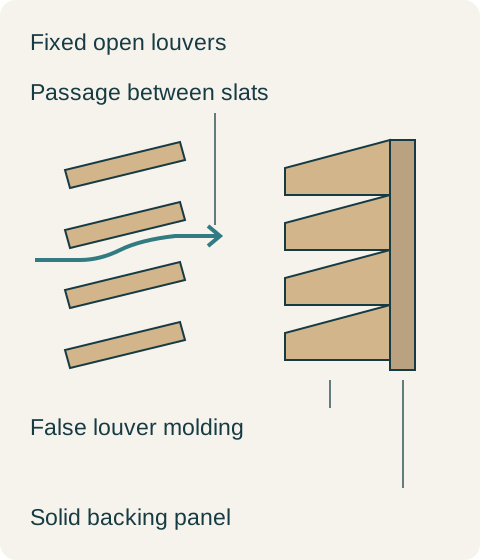
WalzCraft distinguishes fixed open louvers, adjustable operable louvers and closed false louvers. Its fixed open version leaves gaps between individual slats; those slats do not need to rotate for the door to have passages. The operable version adds movement to adjust airflow and light. “Non-operable” and “non-venting” therefore describe different things, and should not be used as interchangeable order terms.
The same manufacturer builds its closed version with interlocking louver moldings applied to a veneer panel. The face creates a louver-like pattern, while the backing closes the route through the door. A photograph of angled ridges cannot distinguish this assembly from a true opening reliably. A section or a view of the reverse reveals the material that a front elevation leaves hidden.
A slat gap is not an airflow rating
WalzCraft gives a 2.5 mm spacing for its fixed open louvers. That identifies a construction detail, not a universal ventilation capacity. Slat count, frame members and any solid center sections affect how much of the door is actually open. The quoted gap does not establish that a cabinet satisfies an appliance’s ventilation instructions, nor that a stored item will dry inside it.
Diagram Conceptual side sections: separated fixed slats at left, applied false-louver shapes on a closed backing at right. Diagram gaps are enlarged and are not a ventilation calculation.
Choose fixed openings for the stated storage brief
In a hypothetical dry-storage cabinet, the buyer wants the louvered appearance and permanent passages through the front, without a moving slat control. The shop presents fixed open and false-louver samples in the same finish. The buyer selects the fixed open construction and declines the false version because its backing contradicts the passage requirement. An operable alternative is also unnecessary for this brief; adjustable slats were never requested.
For a different cabinet whose brief is only decorative, the closed version may be the intended choice. Its backing is then part of the design, not a concealed defect. Compare like-sized finished doors and identify the reverse, center-panel treatment and hardware preparation in both offers. Do not convert a manufacturer’s lower-cost description into a universal price ranking across suppliers or finishes.
Check where the openings actually stop
WalzCraft permits configurations combining a louvered opening with a raised or flat panel. It also notes that rail dimensions may change to accommodate complete louvers. A sample showing slats across most of its face therefore does not define the construction of a differently divided door. Approve the actual division and the reverse-side condition, including any added cover that would close the intended passages.
Record “fixed open,” “operable” or “closed false” alongside the front design, instead of relying on “louvered” alone. Keep the section or reverse-view sample with the order. This makes the function visible in the purchase specification and prevents a decorative substitute from being accepted simply because its front looks close to the drawing.
Pure White
Cream White
Light Warm Gray
Gray
Navy
Black
Oak Tone
Dark Walnut Tone
Design study These finish studies are design references, not a list of currently orderable colors. Screens and lighting change the appearance; compare a physical sample before choosing.See all finish options →
Compare the actual countertop products, heat-source routine and fabrication proposal. A fired porcelain slab and resin-bound quartz are different materials, but neither label replaces a complete kitchen specification.
The sample shows the door frame, a separate center panel, the face frame and the cabinet box. Each component has its own place in this Shaker construction.
Shaker construction: door frame, center panel, face frame and cabinet box. The cutaway helps locate these parts; confirm each material in the specifications for the selected cabinet.
01 / Door frame
The Shaker door has rails and stiles around a separate center panel. The frame and center panel are different components; confirm their materials in the specifications for the selected cabinet.
02 / Face frame
The face frame surrounds the opening at the front of the cabinet box and sits behind the doors. The face frame, door frame and cabinet box are separate parts.
03 / Cabinet box
The sample exposes the cabinet sides, interior surfaces and layered edges. The image does not establish the wood species or material specification of a selected cabinet.