Choose an open end shelf only when its contents justify the exposed location
An open shelf removes a door but leaves the objects visible and within the end-of-run environment. Test the actual shelf shape, loaded outline and retrieval route before assigning it a job.
An open end shelf is useful when the assigned objects belong at that end and can be retrieved without creating another problem. The absence of a door removes a door-opening step, but it does not remove the space occupied by the contents or the person using them. Start with a real purpose for the exposed location rather than treating every cabinet end as an opportunity for another shelf.
Give the end a specific job
Choose a group that is selected from the end approach, such as table-setting accessories collected on the way to the dining area. Identify whether the user takes an individual item or lifts the whole group in a basket. Those tasks require different grips and movement. A shelf intended only to display a chosen piece is also a clear assignment, provided it is not counted again as general storage.
Consider how the end is seen from the room and how much of the ordinary collection should remain there. An open location makes the actual contents part of the view. A staged shelf holding a small selection does not demonstrate a workable home for the full group. Decide which objects stay and give the remainder another defined location.
Use the real shelf outline instead of its largest dimensions
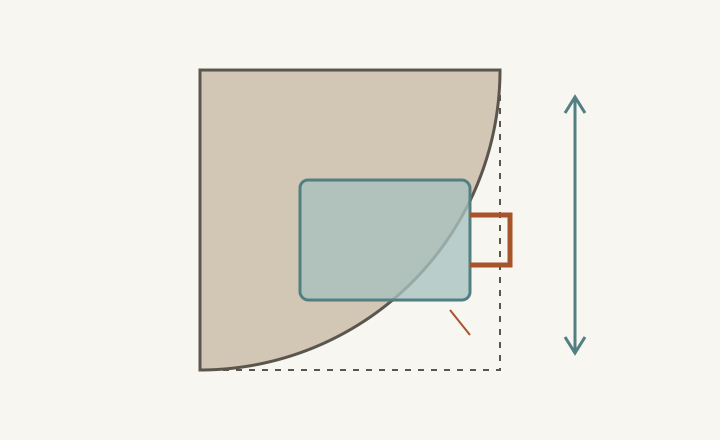
An end shelf may be rectangular, clipped or curved. Trace the actual usable platform and place the representative object’s footprint on it. The largest width and depth do not prove that a rectangular basket fits a shaped shelf. Check the selected product’s intended support and loading requirements; a conceptual footprint drawing is not a structural approval.
ABCD
Diagram The dashed rectangle shows the maximum outline, not a full shelf. The illustrated group does not fit within the curved platform. No shelf dimensions, load capacity or passage standard are specified.
A
The actual curved platform is the usable shape to inspect.
B
A rectangular group can exceed that shape.
C
The shelf ends before the maximum bounding rectangle does.
D
The adjacent route remains part of the decision.
Include handles, rolled textiles, utensils or other pieces extending above or beyond a container. The empty basket’s size does not describe the loaded outline. Also check the space to lift it past the shelf above. If the group can rest on the shelf but cannot be grasped and removed in its normal loaded state, the assignment remains incomplete.
Keep the end route present during retrieval
Show the person approaching, reaching and turning away with the item. Include the actual island or cabinet end, nearby furniture and the route used by others. The shelf may have no moving front while the user’s elbow or carried basket still needs space outside it. A convenient reach from an empty room does not establish access during the ordinary household task.
Check the contents at rest too. A handle or utensil projecting into the end route remains there after the user leaves. Do not count the shelf’s closed cabinet outline as the whole occupied area when the objects extend beyond it. Changing the direction of a handle may help, but that orientation must remain practical when the item is returned.
Test a loaded table-setting basket
In a hypothetical kitchen, a basket of table-setting accessories is proposed for an open island end. The empty basket looks suitable in the elevation. Once filled with rolled napkins and serving pieces, the group projects farther outward and requires a larger grip to lift. The person turning toward the table also carries it past the island corner. The original empty-basket view omitted both conditions.
Compare a smaller daily group with a defined reserve elsewhere, a verified different container or a closed storage location with its own tested door operation. Keep all retained accessories accounted for. If the open shelf needs to be kept almost empty to preserve the route and intended appearance, decide whether its actual job is display rather than everyday group storage.
Test the return that will preserve the arrangement
Put the group back after a representative meal or task. Check whether its handles and protruding contents return to the tested orientation without repeated rearrangement. Define what happens when extra pieces arrive and the home is full. Otherwise, a clearly planned shelf can gradually become an overflow point that no longer fits the route.
Save the assigned group, real shelf outline, loaded footprint and approach with the selected product details. Include the reserve location and any orientation that matters. Recheck if the basket, collection or nearby route changes. Choose the open end when the actual objects and retrieval support that exposed position, not simply because an unoccupied end looked unfinished.
Pure White
Cream White
Light Warm Gray
Gray
Navy
Black
Oak Tone
Dark Walnut Tone
Design study These finish studies are design references, not a list of currently orderable colors. Screens and lighting change the appearance; compare a physical sample before choosing.See all finish options →
Dual access can shorten serving and putting-away routes without creating another set of contents. Choose groups that remain understandable from both faces and define how they return.
A note saying left or right is incomplete without a viewpoint. Mark the hinges, handle and intended standing position on the same cabinet, then verify the selected opening arrangement.
The sample shows the door frame, a separate center panel, the face frame and the cabinet box. Each component has its own place in this Shaker construction.
Shaker construction: door frame, center panel, face frame and cabinet box. The cutaway helps locate these parts; confirm each material in the specifications for the selected cabinet.
01 / Door frame
The Shaker door has rails and stiles around a separate center panel. The frame and center panel are different components; confirm their materials in the specifications for the selected cabinet.
02 / Face frame
The face frame surrounds the opening at the front of the cabinet box and sits behind the doors. The face frame, door frame and cabinet box are separate parts.
03 / Cabinet box
The sample exposes the cabinet sides, interior surfaces and layered edges. The image does not establish the wood species or material specification of a selected cabinet.