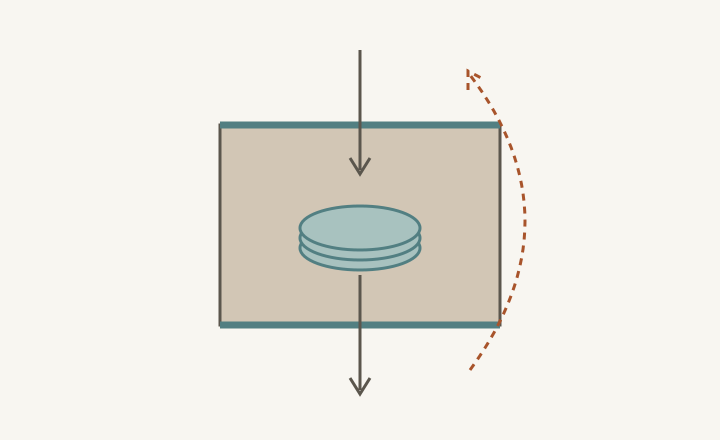
Give a cabinet opened from both sides a shared inventory and a clear return routine
Dual access can shorten serving and putting-away routes without creating another set of contents. Choose groups that remain understandable from both faces and define how they return.
Use access from both sides when it helps the same group of objects serve connected tasks. For example, dishes may be put away from the kitchen side and selected from the dining side. The benefit is an additional route to a shared collection, not extra inventory or automatically independent storage. Assign the contents and return routine as carefully as the access faces.
Confirm whether the contents really are shared
Distinguish a common compartment accessible from opposite faces from separate cabinets placed back to back. They support different storage habits. Confirm that the selected cabinet is intended for the proposed access and has the necessary construction, openings and fittings. Do not treat removing a cabinet back or adding a door as an established way to create a suitable shared compartment.
For a genuinely shared compartment, keep a single inventory. A stack visible from the kitchen and dining room is still the same stack. If the plan needs independent reserves on each side, assign separate groups and locations explicitly. Otherwise, someone may expect supplies on the dining side that were already taken from the kitchen side during another task.
ABCD
Diagram Arrows describe an example of putting away, selecting and returning shared dishes. This is an inventory and task map, not a cabinet construction or opening-clearance drawing.
A
Put cleaned dishes into their agreed home.
B
The same collection is available through either face.
C
Select dishes from the serving side.
D
Return preserves the same group and location.
Choose groups that remain understandable from either face
Test whether a user approaching from either side can identify and grasp the intended item without disturbing a different group. A simple plate stack may be easier to understand from opposite directions than a nested collection with labels and handles facing only one way. That is a household test, not a rule that every plate or container belongs in shared storage.
Arrange the group so its boundaries are clear from both approaches. Avoid silently making a front row for each face if those rows block access to each other. If containers and lids are separate, define where their matching parts live. A compartment can be physically open from both sides while still being difficult to search because each person sees the arrangement from a different direction.
Follow putting away and replenishment from the actual side
Identify which face is normally used after cleanup and which is normally used for serving. These can be preferences rather than exclusive permissions, but they give the arrangement a consistent home. Test putting items back without pushing neighboring contents out of position or crowding the opposite opening. Use the selected cabinet’s intended fittings and retention arrangements rather than improvising around missing construction.
Replenishment should restore the shared group, not gradually create separate territories that no longer work from the other side. Agree where extra quantities go when the normal home is full. If overflow begins blocking the serving entrance, a convenient put-away route has undermined the reason for having another access face. Record the reserve location and when it is used.
Test a clear group and a more complicated group
In a hypothetical island, clean plates are returned from the cooking side and taken from the dining side for meals. Both users understand the same stack and return it to the same location. This can shorten the serving route without requiring another plate collection. Test the actual fronts and approach, including the moment when someone is putting plates away while another needs them.
The household then proposes adding food containers with loose lids. If lids are returned from opposite sides into different spaces, the person selecting a container may need to search through the whole compartment. Compare a defined matching arrangement, a separate lid group accessible to both tasks or keeping that collection in a single-face cabinet. Preserve the retained containers; the extra door alone does not organize them.
Define what happens when people approach together
Check the selected fronts and the movement of the actual users. Opposite openings do not guarantee that people can safely handle the same stack simultaneously or move fronts without interference. Agree how users yield access to the shared group when necessary. A brief, understood sequence may be workable; frequent contention may indicate that the contents belong elsewhere.
Save the common inventory, group locations, normal loading and selection faces, overflow home and return routine. Review after changing the collection or household tasks. Choose double-sided access when it makes these routines clearer and shorter, while keeping the same objects easy to identify and restore from either approach.
Pure White
Cream White
Light Warm Gray
Gray
Navy
Black
Oak Tone
Dark Walnut Tone
Design study These finish studies are design references, not a list of currently orderable colors. Screens and lighting change the appearance; compare a physical sample before choosing.See all finish options →
On an island that also seats people, deeper rear storage uses space beneath the same top. Compare the actual stored group with the seated position and the complete depth arrangement.
An open shelf removes a door but leaves the objects visible and within the end-of-run environment. Test the actual shelf shape, loaded outline and retrieval route before assigning it a job.
The sample shows the door frame, a separate center panel, the face frame and the cabinet box. Each component has its own place in this Shaker construction.
Shaker construction: door frame, center panel, face frame and cabinet box. The cutaway helps locate these parts; confirm each material in the specifications for the selected cabinet.
01 / Door frame
The Shaker door has rails and stiles around a separate center panel. The frame and center panel are different components; confirm their materials in the specifications for the selected cabinet.
02 / Face frame
The face frame surrounds the opening at the front of the cabinet box and sits behind the doors. The face frame, door frame and cabinet box are separate parts.
03 / Cabinet box
The sample exposes the cabinet sides, interior surfaces and layered edges. The image does not establish the wood species or material specification of a selected cabinet.