Moving the basin toward one side can concentrate bowl and plumbing space in one part of a vanity, leaving another part available for drawers. That is a possible benefit, not an automatic storage gain. The selected cabinet may still contain partitions, short drawer boxes or other limits. Compare the actual usable drawer shape with a centered-basin arrangement, then test the consequences at the basin before choosing the offset version.
Start with the object that does not fit
Name the storage problem precisely. A long toiletry pouch, a grooming organizer or folded linens may need an uninterrupted rectangle. Small loose items may already work well in divided compartments around a basin. If the current difficulty is simply poor organization, shifting the basin and altering connections may be a disproportionate response. Identify the item and the retrieval action that a different drawer would improve.
Use the same inventory for both candidates. Check the drawer's interior width, depth and usable height, including any cutout and the opening through which objects must pass. A wide front does not prove that the box behind it is continuous. Ask for the actual interior configuration rather than relying on the front elevation's attractive balance of doors and drawers.
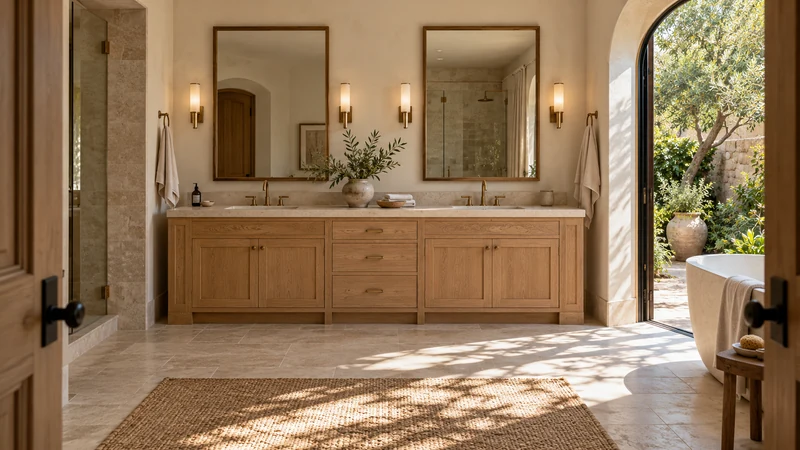
Design study The central drawer stack sits beside basin door bays in this design study. It illustrates separating drawer and bowl zones, not an offset-basin model or confirmed interior capacity.
Locate the whole basin assembly
On the plan and section, include the underside of the chosen basin, its drain and the connection space. The bowl's visible center does not describe every part below it. An offset rim or an off-center outlet may change where the plumbing occupies the cabinet. Keep the drawer's closed and moving envelope visible so the review covers the space it needs throughout use.
Select a cabinet-and-basin arrangement that the relevant suppliers support. Do not assume an existing top can be cut in a different place or that a drawer cabinet can become a sink bay by removing a partition. The offset should be part of the coordinated selection. Any proposed change to the top, support or interior must be resolved for the specific products before it becomes the basis of the layout.
Compare a useful storage gain
Consider a hypothetical homeowner whose daily grooming pouch does not fit the divided top drawer of a centered-basin candidate. An offset candidate provides an uninterrupted drawer at the other side, and the pouch fits with room to lift it out. That is a specific storage gain. It is stronger evidence than counting extra drawer fronts or describing the whole cabinet as more efficient.
Now test the corresponding washing position. If the offset moves the basin beside a projecting wall or into a busy approach, the drawer benefit may come at an unacceptable cost. Compare the same task at both candidates: wash, reach for the pouch and return it. The successful option makes that sequence easier overall, rather than improving storage while making the basin awkward.
Decide which side should carry the basin
Look at the approach route, adjacent fixtures, towel location and any dry preparation area. A left-hand and a right-hand version can behave differently even when their interior capacities match. The preferred drawer side should be reachable without forcing the user to walk around an open door or lean across the bowl. Include another person's retrieval if the room is shared.
Review mirror and faucet positions with the chosen orientation. An existing centered mirror or wall connection may not suit the new washing position. Record any work that the offset arrangement introduces. If preserving the current services is a firm requirement, compare the retained connections with the exact model; a promising drawer plan does not waive that constraint.
Order the orientation as part of the product
Keep the chosen basin side, drawer configuration, compatible top and basin identification together in the selection record. Confirm how the supplier defines left and right, using an elevation with the basin and drawers marked. A verbal description can be reversed when one person imagines facing the cabinet and another imagines standing behind it.
Recheck the complete drawing after any substitution. A different bowl or drawer box can erase the uninterrupted area that justified the offset. Choose this arrangement when the intended object fits, its retrieval improves and the washing position remains comfortable for the actual users. Otherwise, a centered arrangement with a different interior may answer the need with fewer changes.
Pure White
Cream White
Light Warm Gray
Gray
Navy
Black
Oak Tone
Dark Walnut Tone
Design study These finish studies are design references, not a list of currently orderable colors. Screens and lighting change the appearance; compare a physical sample before choosing.See all finish options →
Compare the basin's exterior underside, mounting arrangement and drain with the full drawer envelope before treating the visible bowl size as a fit check.
Match the fixed bowl position, underside shape and required support to the actual cabinet, rather than treating similar overall widths as compatibility.
The sample shows the door frame, a separate center panel, the face frame and the cabinet box. Each component has its own place in this Shaker construction.
Shaker construction: door frame, center panel, face frame and cabinet box. The cutaway helps locate these parts; confirm each material in the specifications for the selected cabinet.
01 / Door frame
The Shaker door has rails and stiles around a separate center panel. The frame and center panel are different components; confirm their materials in the specifications for the selected cabinet.
02 / Face frame
The face frame surrounds the opening at the front of the cabinet box and sits behind the doors. The face frame, door frame and cabinet box are separate parts.
03 / Cabinet box
The sample exposes the cabinet sides, interior surfaces and layered edges. The image does not establish the wood species or material specification of a selected cabinet.