KCMA’s August 2026 sales decline: what it can and cannot tell a cabinet buyer
The association’s monthly release reports lower sales than a year earlier. That result does not establish a matching discount on a particular cabinet order.
KCMA published its August 2026 Trend of Business update on October 9, 2026: reported overall cabinet sales were down 4.3% from August 2025. Public information reviewed October 23, 2026.
The release establishes a comparison between reported sales totals. It does not tell a homeowner what the same cabinet list cost in both periods. Revenue can change when the quantity sold changes, when the mix of products changes, when prices change, or when those factors combine. The short public release does not separate those possibilities. Treating its percentage as an available discount would require information it does not provide.
KCMA’s December 2024 program explanation describes monthly participating-company sales collected by a third party and reported in aggregate. That explains the program’s reporting structure; it does not identify the participant mix or coverage of the August release.
This matters when a seller uses broad market news to explain a particular offer. A manufacturer reporting less revenue may still have a full schedule for the line you want. A retailer may discount an item for reasons unrelated to the association’s monthly result. The headline alone cannot establish either situation, and it does not rank local suppliers by financial strength.
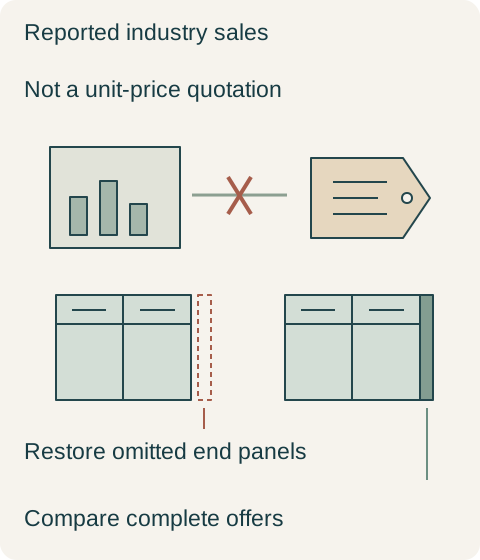
Teaching example Hypothetical purchase comparison. The diagram separates the public market measure from two offers for a complete cabinet order; it does not show market prices.
Test a revised offer with an unchanged order
If a supplier offers a better price after you mention the news, compare the same cabinet schedule before and after the revision. Keep the door construction, finish, exposed ends, drawers, accessories and delivery scope visible. Otherwise, a lower total may simply buy a different kitchen. Ask which specific terms changed, rather than requiring the supplier to reproduce the published market percentage.
A cabinet-only reduction and an installed-project reduction also have different boundaries. If installation remains separately quoted, compare it separately. Do the same for countertop work or preparation that is outside the cabinet contract. A monthly cabinet-sales statistic does not establish what those services should cost, so it cannot justify applying one reduction to every line of a renovation budget.
The lower cabinet subtotal can still lose
Consider a hypothetical buyer comparing a ready-to-approve order with a new promotional quotation. The promotion lowers the cabinet subtotal but removes finished end panels and treats delivery as an additional charge. The visible layout remains unchanged, so the buyer initially thinks the offers are equivalent.
The buyer restores the required end panels and delivery to the comparison. The revised promotion is no longer the lower complete offer. The buyer keeps the original order, which includes those items and has an acceptable agreed delivery arrangement. Nothing in the monthly sales release requires choosing the promotion. If the same complete scope had become cheaper on acceptable terms, the revised offer would have deserved a different decision.
Waiting needs a project reason
Delaying a purchase can be reasonable when the design is unfinished or the household is not ready for the work. Waiting solely because a sales decline supposedly guarantees a future price cut is a different proposition. This release contains no forecast of the price or availability of your selected product. It also cannot show that a quotation is about to expire or that you must buy immediately.
Use the news to reopen a concrete comparison if that is useful: the same order, the same inclusions and the current written terms. Retain the date of each offer so a later revision can be understood. The purchasing decision should be supported by the complete offer in front of you, with the monthly result kept as market context.
Pure White
Cream White
Light Warm Gray
Gray
Navy
Black
Oak Tone
Dark Walnut Tone
Design study These finish studies are design references, not a list of currently orderable colors. Screens and lighting change the appearance; compare a physical sample before choosing.See all finish options →
Approve a set of documents that agrees with itself. A drawing shows where parts go; the bill of materials identifies what will be ordered; the approval record says which version is authorized.
The quarter’s current-activity and near-term readings pointed in different directions. For cabinet businesses, that distinction matters when choosing between preparing for demand and committing to additional inventory.
The sample shows the door frame, a separate center panel, the face frame and the cabinet box. Each component has its own place in this Shaker construction.
Shaker construction: door frame, center panel, face frame and cabinet box. The cutaway helps locate these parts; confirm each material in the specifications for the selected cabinet.
01 / Door frame
The Shaker door has rails and stiles around a separate center panel. The frame and center panel are different components; confirm their materials in the specifications for the selected cabinet.
02 / Face frame
The face frame surrounds the opening at the front of the cabinet box and sits behind the doors. The face frame, door frame and cabinet box are separate parts.
03 / Cabinet box
The sample exposes the cabinet sides, interior surfaces and layered edges. The image does not establish the wood species or material specification of a selected cabinet.