A partial cabinet release is useful only when the released work can proceed without assuming the unresolved choice. Identify the open decision, trace the components and operations that depend on it, then ask the supplier to confirm a precise boundary. Do not define the release merely as “everything except the undecided item.” The undecided item may control other parts that look complete on the schedule.
Start with the decision that is still open
Describe the unanswered choice as a concrete input. “Hardware pending” is too broad. It might mean the decorative pull finish, its mounting pattern, the hinge system or an internal mechanism. Each can affect different work. Record what is fixed, what remains unknown and who must supply the answer. That gives the supplier enough information to assess the effect without guessing which interpretation the project intended.
Attach the current approved dimensions and product information. A release boundary cannot be evaluated from a future expected selection that has never been documented. If the project is still considering different cabinet constructions, door fits or appliance arrangements, those broader choices belong in the dependency map. Do not shrink the open issue to a color decision simply because color is what the owner mentioned most recently.
Follow the dependency into the parts
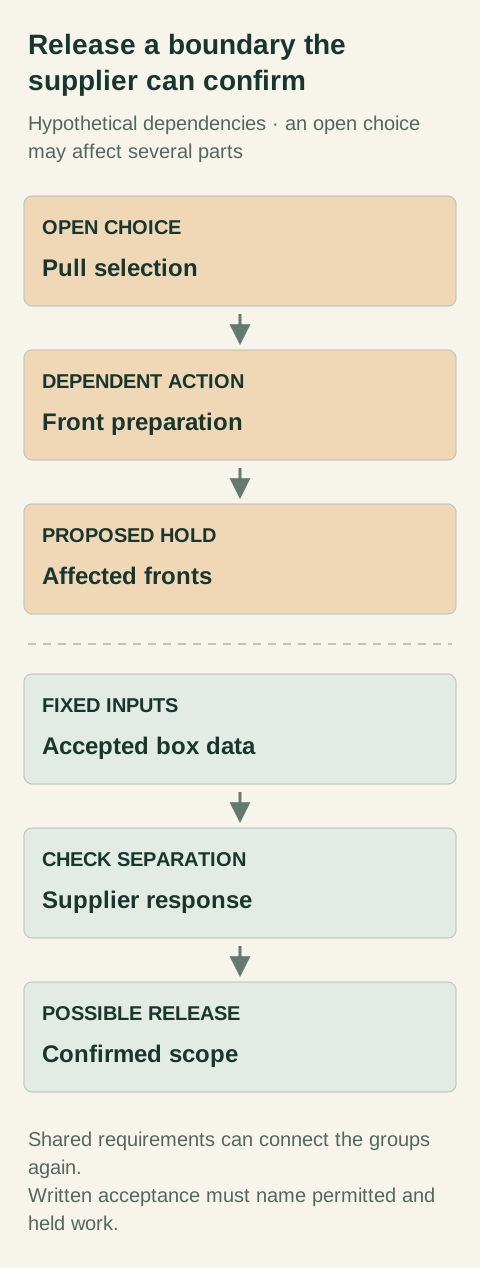
Diagram Hypothetical workflow. The supplier must confirm whether the proposed separation is available; the diagram is not a release instruction.
Draw an arrow whenever one decision is needed to define another item or operation. A chosen pull pattern may control front preparation. An accepted finish may connect doors, exposed panels and matching trim. A selected interior accessory may require a specific cabinet configuration. These are possibilities to verify for the actual product, not universal manufacturing rules. Ask the supplier which dependencies apply and which have already been resolved.
Separate a component from the operations performed on it. The supplier may be able to identify a blank panel while still needing a decision before finishing or machining it. Alternatively, its ordering system may treat the component as an inseparable finished product. A buyer's drawing can describe possible stages, but only the supplier can confirm which staged instruction it actually accepts and how it records the resulting responsibility.
Test a hypothetical release boundary
Imagine a project where cabinet dimensions, construction and door configuration are settled, but the owner has not chosen a decorative pull. The supplier confirms that the unresolved choice affects only a factory drilling operation on the fronts. The proposed release could identify the confirmed cabinet work separately while holding that specific preparation, if the supplier also confirms it can manage the separation. The example does not promise that any seller offers this process.
Now change the assumption: the unresolved selection is an internal pull-out whose required configuration has not been checked. The affected group may extend into the cabinet box and front arrangement. The earlier boundary no longer applies. Trace the new dependency and obtain a fresh response. A familiar phrase such as “hardware later” cannot carry the same release meaning across those different situations.
Check shared scope before declaring a group independent
Ask whether the apparently separate groups share dimensions, finish matching, paired components or other defined requirements. A front and an exposed panel may need a coordinated appearance decision even if their item codes are separate. An accepted partial release should preserve that requirement explicitly or identify the consequence of separating it. Do not assume splitting a purchase leaves every quality or commercial condition unchanged.
Also ask how the supplier's minimum order, pricing or processing arrangement would change, if applicable. Request actual terms rather than inserting a guessed fee or lead time into the decision. The project may decide that waiting is more practical than splitting, or that a narrowly confirmed group is worth releasing. Either decision should follow the real scope and response, not an invented benefit from starting sooner.
Define what the review status permits
AWI's submittal guidance distinguishes statuses permitting production from revise-and-resubmit. Use the actual project's agreed meanings and the scope of the response. A favorable status on a finish sample does not settle an unresolved machining detail elsewhere. Conversely, do not add an unnecessary approval cycle when the accepted status already permits a defined action with identified corrections.
For a proposed partial release, identify the drawing and product-list revisions, exact components, permitted operations and held dependencies. State the excluded work in plain language. Name the person issuing the instruction and the supplier contact who must confirm it. Keep this separate from an internal note that merely recommends proceeding. A recommendation, a transmitted request and an accepted instruction are different records.
Obtain a response to the boundary itself
Ask the supplier to acknowledge the specific permitted work and the held work, not just receipt of the attachment. If it cannot separate them, request an explanation of the connected requirement so the team can decide whether to resolve the input or defer the group. Do not interpret silence as agreement. Do not tell a downstream participant that production is held unless the relevant supplier has actually confirmed that state.
Keep the open decision visible after partial release. Assign its owner and the event that requires closure. Record the information the supplier needs to complete the held scope and how a later answer will be accepted. An internal date can guide coordination, but it does not establish a seller's cutoff or guarantee schedule recovery. Use the supplier's written process for those commitments.
Reconcile the remainder before the next release
When the missing choice is settled, compare it with the requirements preserved in the earlier release. Confirm it is compatible with what the supplier actually accepted and processed. If it changes a previously fixed input, treat that as a new change request. Do not quietly overwrite the old release record and assume the completed work now matches the new selection.
Issue the remaining scope against the same location identities, with an explicit record of what was already released. Check for duplicated components and required items that fell between the groups. The completed file should explain the full cabinet package through its successive instructions without forcing a reviewer to infer which partial email superseded which line.
Finish references
Pure White
Cream White
Light Warm Gray
Gray
Navy
Black
Oak Tone
Dark Walnut Tone
Design study These finish studies are design references, not a list of currently orderable colors. Screens and lighting change the appearance; compare a physical sample before choosing.See all finish options →
The sample shows the door frame, a separate center panel, the face frame and the cabinet box. Each component has its own place in this Shaker construction.
Shaker construction: door frame, center panel, face frame and cabinet box. The cutaway helps locate these parts; confirm each material in the specifications for the selected cabinet.
01 / Door frame
The Shaker door has rails and stiles around a separate center panel. The frame and center panel are different components; confirm their materials in the specifications for the selected cabinet.
02 / Face frame
The face frame surrounds the opening at the front of the cabinet box and sits behind the doors. The face frame, door frame and cabinet box are separate parts.
03 / Cabinet box
The sample exposes the cabinet sides, interior surfaces and layered edges. The image does not establish the wood species or material specification of a selected cabinet.