NKBA’s 2026 sustainability findings: who starts the cabinet-design conversation?
A public professional survey highlights who introduces sustainability. For a cabinet project, turn that opening conversation into a specific design priority and a visible tradeoff.
NKBA’s August 11, 2026 public sustainability summary reports that designers initiate the subject at 51%, compared with clients at 13%. The underlying online survey addressed kitchen-and-bath professionals, not a direct household purchasing panel.
Public information reviewed October 23, 2026. The useful question for a cabinet consultation is whether an important preference has been discussed before the design becomes difficult to change. Waiting for the homeowner to use the word sustainability can leave a relevant preference unstated. Introducing it does not mean assigning that homeowner a preference or a budget they have not chosen.
Starting a discussion is not buying a product
The public finding concerns who raises a topic. It cannot establish how many households purchased a particular material, accepted a price increase or achieved an environmental result. It also does not show that every household that stayed silent was uninterested. A client might ask to keep useful cabinets, avoid unnecessary replacement or obtain repairable components without using a broad sustainability label.
For a designer or dealer, the response is to offer a clear choice that the client can accept or reject. For a homeowner, it is to explain the desired outcome in ordinary project terms. A conversation about keeping an existing cabinet group is more actionable than adding an undefined green upgrade to the estimate. It creates a design question that can be drawn, priced and evaluated.
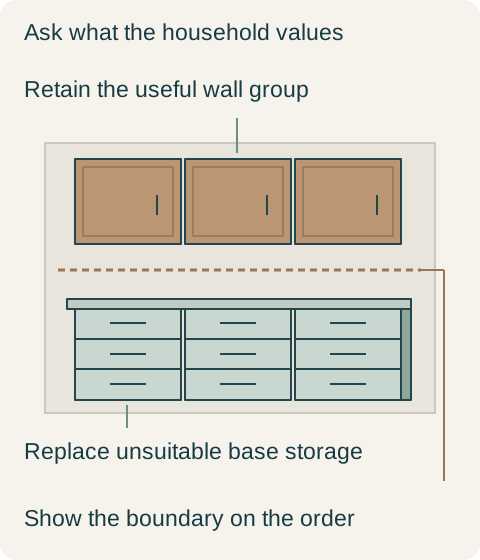
Teaching example Hypothetical design response to a stated retention priority. The diagram does not quantify environmental performance or depict a surveyed household.
Choose a priority before choosing a label
A household may care most about retaining sound existing parts. Another may prioritize being able to replace a damaged front later. Those priorities can lead to different cabinet decisions. Write the preferred outcome beside the component it affects, then identify the practical sacrifice: a retained box may preserve an unwanted storage arrangement, while a new assembly may provide a desired drawer layout but require more replacement.
Do not claim that either arrangement is environmentally superior just because it fits the stated priority. That would require evidence about the actual alternatives. The design conversation can still make progress without a numerical environmental ranking: it can show what stays, what changes, what the family gains and which further product information would be needed for a stronger claim.
Retain the useful wall, replace the unsuitable base storage
In a hypothetical consultation, the family initially describes sustainability as replacing as little cabinetry as practical. A review of the existing kitchen shows that the wall cabinets are useful and acceptable to retain, while the base storage does not meet the household’s access needs. A proposal that retains everything therefore misses the reason for remodeling.
The selected design retains the accepted wall-cabinet group and replaces the base group with the required drawer arrangement. The drawings identify the boundary, the new visible end treatment and how the finishes meet. The family accepts that the two groups will not pretend to be one identical new set. This resolves the stated priority while preserving the functional improvement that justified the project. No carbon saving or whole-project environmental score is assigned to the hypothetical choice.
Keep the preference visible when the order changes
A later revision can quietly undo the decision. A supplier might replace the entire wall group to simplify finish matching, even though retaining it was part of the approved design. Carry the retained-versus-new boundary onto the drawing and estimate so that any change returns to the household for a conscious decision. This is particularly useful when the designer, seller and installer are different parties.
The news supports opening the discussion early; the resulting design still needs the client’s own priorities. A useful meeting ends with a specific retained component, replacement choice or product-information request, rather than a broad statement that the kitchen will be sustainable. That makes the decision understandable even to a team member who was not present for the first conversation.
Pure White
Cream White
Light Warm Gray
Gray
Navy
Black
Oak Tone
Dark Walnut Tone
Design study These finish studies are design references, not a list of currently orderable colors. Screens and lighting change the appearance; compare a physical sample before choosing.See all finish options →
A statement about packaging, a panel or a factory may be useful without describing the whole cabinet. Connect each claim to the product and decision it covers.
Refacing can change the visible kitchen while retaining its cabinet structure. Decide whether that retained interior and layout still solve the household’s storage problem before buying the new appearance.
The quarter’s current-activity and near-term readings pointed in different directions. For cabinet businesses, that distinction matters when choosing between preparing for demand and committing to additional inventory.
The sample shows the door frame, a separate center panel, the face frame and the cabinet box. Each component has its own place in this Shaker construction.
Shaker construction: door frame, center panel, face frame and cabinet box. The cutaway helps locate these parts; confirm each material in the specifications for the selected cabinet.
01 / Door frame
The Shaker door has rails and stiles around a separate center panel. The frame and center panel are different components; confirm their materials in the specifications for the selected cabinet.
02 / Face frame
The face frame surrounds the opening at the front of the cabinet box and sits behind the doors. The face frame, door frame and cabinet box are separate parts.
03 / Cabinet box
The sample exposes the cabinet sides, interior surfaces and layered edges. The image does not establish the wood species or material specification of a selected cabinet.